In the mid-19th century, the British Empire was expanding rapidly into tropical regions, but it faced a microscopic, relentless enemy: malaria. The only known treatment was quinine, a natural substance painstakingly extracted from the bark of the cinchona tree in South America. It was incredibly expensive, labor-intensive to harvest, and in desperately short supply. The Empire was running out of time and medicine.
Enter August Wilhelm von Hofmann, an eminent German chemist at the Royal College of Chemistry in London. Hofmann had a wild, desperate hypothesis: what if quinine could be synthesized in a laboratory using coal tar, a plentiful, filthy waste product of the gas lighting industry? To solve this puzzle, Hofmann tasked his most promising assistant with the job. His name was William Henry Perkin, and he was just 18 years old.
A Spectacular, Foul-Smelling Failure
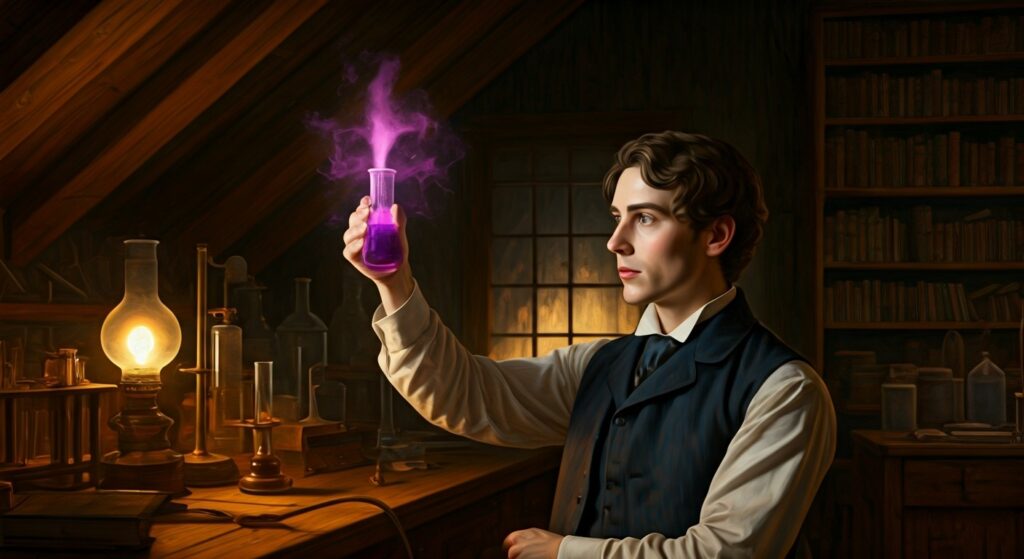
During the Easter holiday of 1856, while Hofmann was away, Perkin set up a makeshift laboratory in his family’s London apartment. He was determined to crack the quinine code. He attempted to synthesize the drug by oxidizing an aniline derivative, expecting the pristine white powder of life-saving medicine.
The experiment was an absolute disaster.
Instead of a medical miracle, Perkin was left staring at a dark, sticky, foul-smelling sludge at the bottom of his flask. Most chemists would have tossed the ruined glassware in the bin, writing it off as a fool’s errand. But as Perkin attempted to clean the flask with alcohol, he noticed something mesmerizing. The black sludge dissolved, producing a brilliant, intense purple solution.
Curious, Perkin dipped a piece of silk into the mixture. The fabric absorbed the color perfectly. Better yet, the dye didn’t wash out, nor did it fade in the sunlight. Perkin hadn’t cured malaria. He had accidentally bottled magic.
Democratizing the Color of Kings
To understand the magnitude of this accident, one must understand the history of purple. For centuries, achieving true purple dye was a logistical nightmare. It was extracted drop-by-drop from the glandular mucus of rotting, predatory sea snails to create Tyrian purple. It was so astronomically expensive that only royalty could afford to wear it.
Perkin realized he had just democratized the color of kings. Against his mentor’s furious advice, the teenager boldly dropped out of college. With financial backing from his father, he patented the dye, set up a factory, and renamed his creation “mauveine” after the French word for the purple mallow flower.
The timing was impeccable. The synthetic dye made purple accessible to the masses, and Victorian society absolutely lost its mind. The global fashion craze was dubbed the “Mauve Measles.” When Queen Victoria wore a mauve silk gown to the Royal Exhibition of 1862, and Empress Eugénie of France—the ultimate fashion influencer of the era—championed the color, it was game over. The trend was so inescapable that the 1890s were later dubbed the “Mauve Decade.”
The Beautiful Irony of the Magic Bullet
Perkin’s wild success proved that chemistry wasn’t just a stuffy academic pursuit; it could be incredibly lucrative. This realization sparked a global gold rush of chemical exploration. Soon, chemists were synthesizing a rainbow of colors from coal tar. Major conglomerates like BASF, Bayer, and Hoechst all originated in the late 19th century as synthetic dye manufacturers.
But here is where the story pivots from a fashion history dream into a medical miracle.
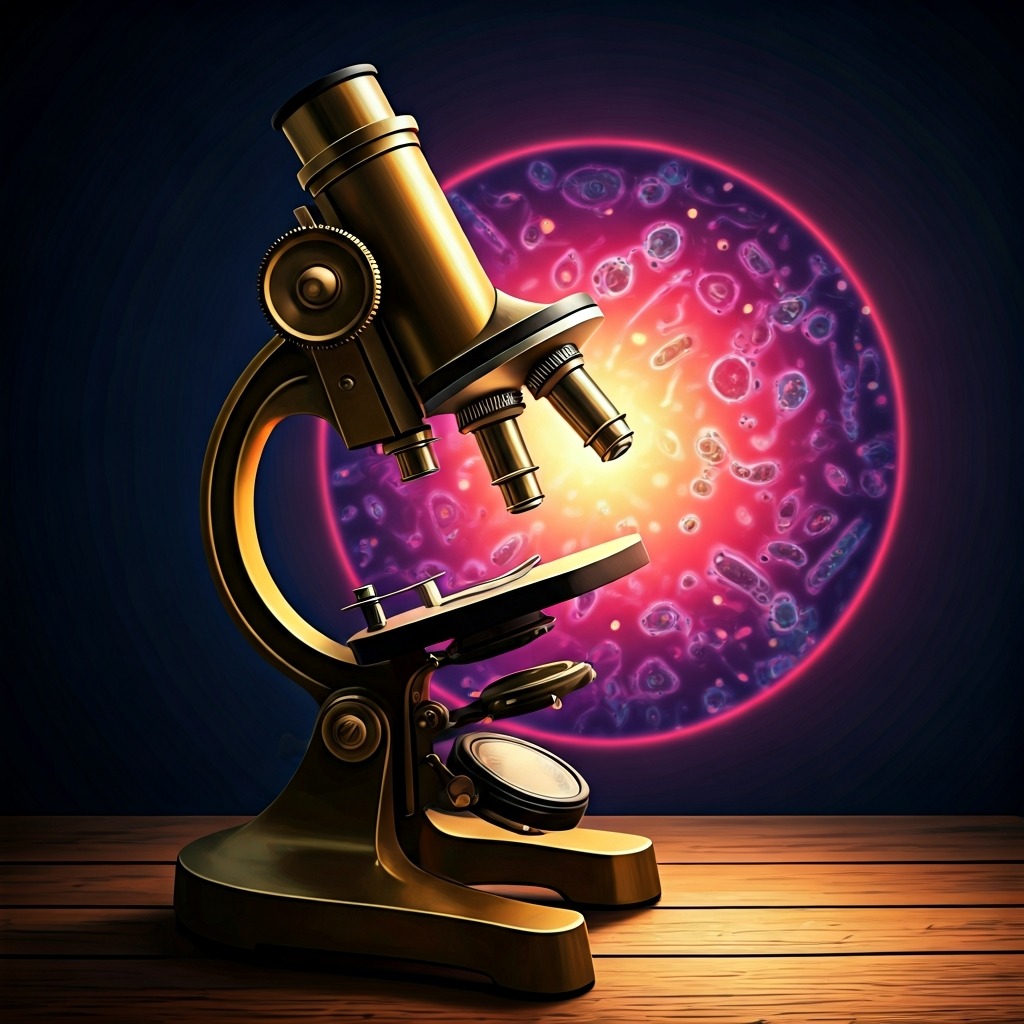
Before synthetic dyes, observing transparent cells under a microscope was nearly impossible. Scientists like Walther Flemming and Robert Koch began using these new synthetic coal-tar dyes to stain cells and bacteria. Suddenly, the invisible world was illuminated in vibrant pinks, blues, and purples. This directly led to the discovery of chromosomes, the tuberculosis bacillus, and the cholera bacterium.
Then came Paul Ehrlich, a pioneer in immunology. He noticed that certain dyes only stained specific tissues. He hypothesized that if a chemical could selectively target a pathogen, it could carry a toxin to kill it without harming the human host. He called these “magic bullets.” This concept birthed the field of chemotherapy and the modern pharmaceutical industry.
An 18-year-old boy failed to synthesize a malaria drug, and in doing so, accidentally created the high-fashion color of the century. In a twist of beautiful irony, that very failure provided the exact tools necessary to discover cures for countless other diseases.