Imagine trying to build a massive, thriving empire in a landscape that actively refuses to give you a single drop of surface water.
To the naked eye, the ancient Yucatán Peninsula was a vast, flat limestone shelf completely devoid of rivers or streams. Yet, it was here that the Maya built one of the most sophisticated and enduring civilizations in the Americas. How did millions of people survive in a harsh, unforgiving region prone to severe seasonal dry spells and prolonged, civilization-ending droughts?
They didn’t look to the horizon. They looked down.
Beneath their feet lay a hidden, mesmerizing, and terrifying world.
The Subterranean Abyss
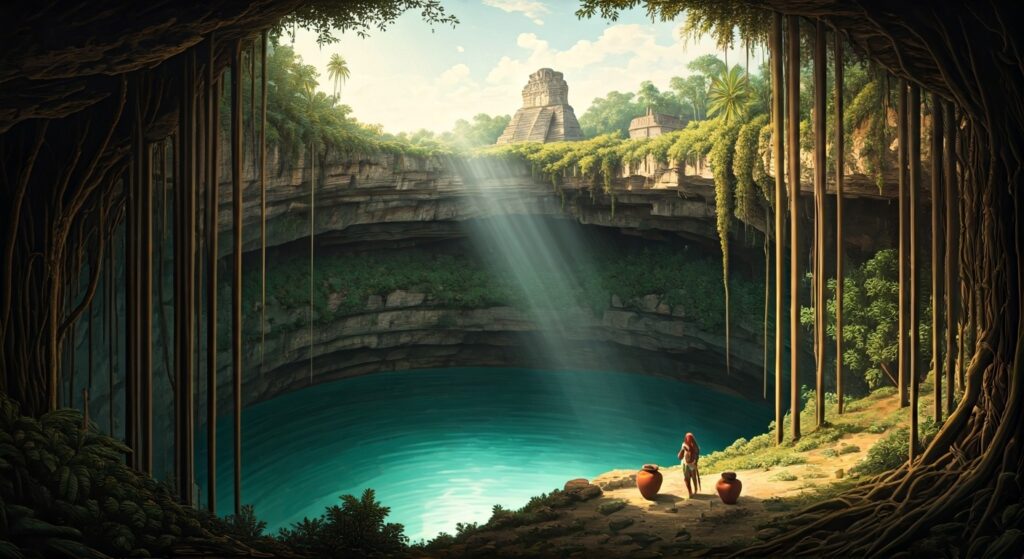
Over millions of years, the porous limestone bedrock of the Yucatán eroded and collapsed, exposing a massive, interconnected subterranean aquifer. These natural sinkholes became known as cenotes, derived from the Yucatec Maya word ts’onot, meaning “well” or “abyss.”
Cenotes are geological marvels. Some are cavernous underground pools with their limestone roofs still intact, dripping with ancient stalactites in the pitch black. Others are fully open cylindrical shafts, their sheer drop-offs exposed to the jungle sky. The water inside is famously crystal-clear, having been slowly filtered through the limestone. Dive deep enough into certain cenotes, and you’ll hit a “halocline”—a mesmerizing, eerie visual boundary where the fresh groundwater floats perfectly on top of denser, intruding saltwater from the ocean.
A Rigged Game of Survival
Building a civilization with no surface water is a logistical nightmare. But the Maya played the hand they were dealt with sheer brilliance.
Cenotes were their absolute lifeblood. Because surface water was practically nonexistent, major metropolises like Chichén Itzá, Mayapan, and Tulum were strategically built around these sinkholes. They provided a reliable, year-round supply of fresh water for drinking and agriculture. Without the cenotes, the Maya civilization in this region simply could not have existed.
But as with all things in the ancient world, survival wasn’t just a matter of engineering and logistics. It was a matter of divine appeasement.
The Watery Gates of Xibalba
To the Maya, a cenote wasn’t just a well; it was a sacred, highly volatile space.
In Maya cosmology, the universe was divided into the heavens, the earth, and the underworld, known as Xibalba. Staring down into the dark, jade-green waters of a cenote, the Maya didn’t just see drinking water—they saw a literal threshold to the realm of the dead. These were liminal spaces where the earthly plane intersected with the divine.
More importantly, these watery depths were the dwelling places of Chaac, the powerful and temperamental god of rain, lightning, and storms. Because Chaac controlled the rains that sustained their vital maize crops, keeping him happy wasn’t just a religious duty; it was a matter of civilizational survival.
And Chaac demanded a heavy price.
The Toll of the Rain God
The eerie duality of cenotes—as both givers of life and receivers of death—is most evident when you look at the archaeological record. During times of extreme environmental stress, like prolonged droughts or societal collapse, the Maya turned to their sacred portals in desperation.
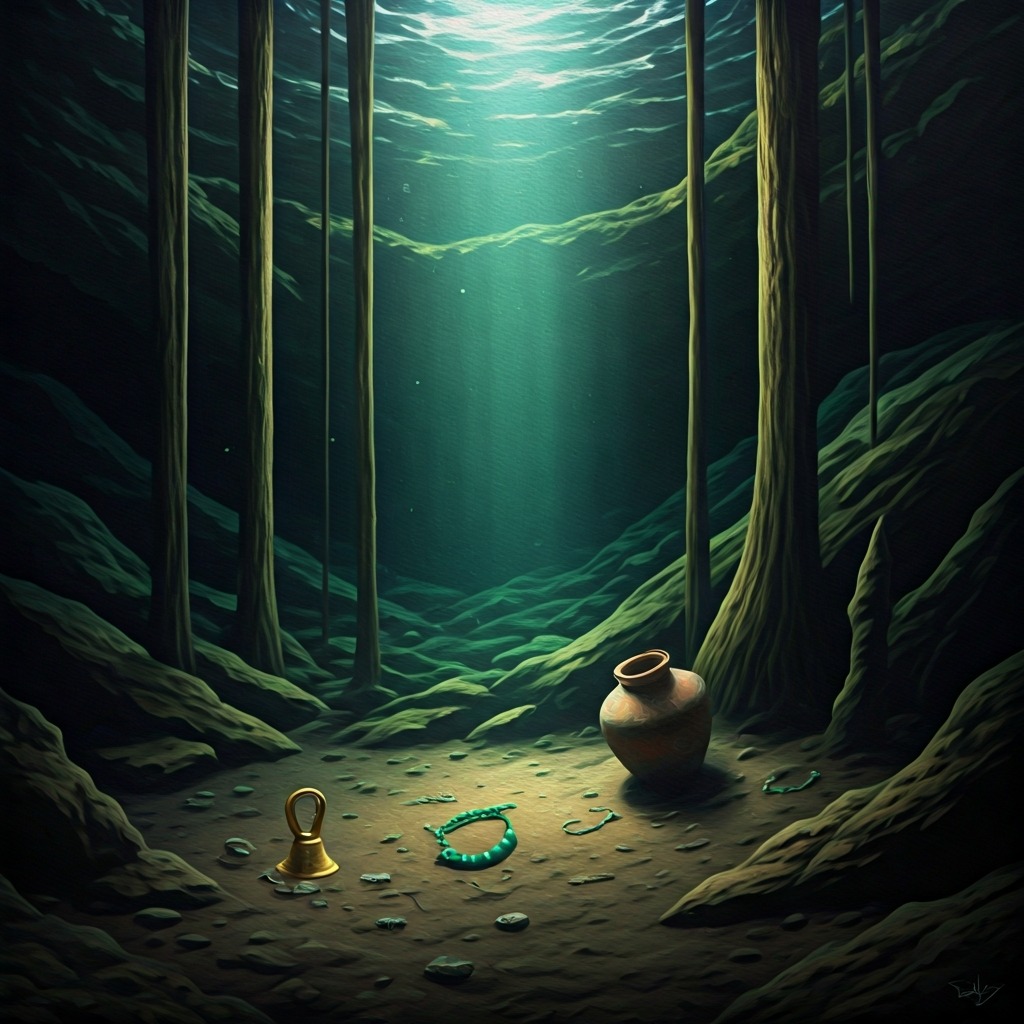
At the famous Cenote Sagrado (Sacred Cenote) at Chichén Itzá, priests conducted elaborate, terrifying ceremonies on the rim, casting their most precious items into the abyss. Modern underwater explorations have recovered thousands of artifacts: jade jewelry, gold and copper bells, obsidian blades, copal incense, and intricate pottery.
But the offerings didn’t stop at gold and jade.
Early romanticized myths claim that only beautiful virgin maidens were sacrificed to the cenotes. The truth is far darker. Bioarchaeological analysis of the skeletal remains recovered from the Cenote Sagrado reveals that the victims included men, women, and a staggering number of young children and infants. In the eyes of the Maya, children were considered the ultimate offering to Chaac, as their tears were symbolically linked to rainfall.
Many of the remains show signs of perimortem trauma, meaning they were killed or mortally wounded before being thrown into the water. Others were cast into the dark abyss alive, left to drown in the home of the rain god. Because the bottom of some cenotes features anaerobic (low oxygen) conditions, organic materials—including human bones, textiles, and wooden weapons—have been remarkably preserved, turning these sinkholes into eerie, submerged time capsules.
Echoes in the Abyss
Today, cenotes are celebrated as breathtaking natural wonders, crawling with eco-tourists and cave divers. But they are also vital to our understanding of history. Paleoclimatologists now extract sediment cores from the bottom of these pools to track ancient drought patterns—patterns that perfectly coincide with the violent collapse of major Maya cities.
Yet, the magic of the cenotes hasn’t entirely faded into the past. For the contemporary Maya people, many of these sinkholes retain their sacred status. Traditional agricultural ceremonies, such as the Cha-chaac—a ritual pleading for rain—are still performed near these ancient portals today.
It’s a haunting reminder that while empires rise and fall, the deep, crystal-clear abysses of the Yucatán are still watching, still waiting, and still connecting the world of the living to the mysteries of the deep.