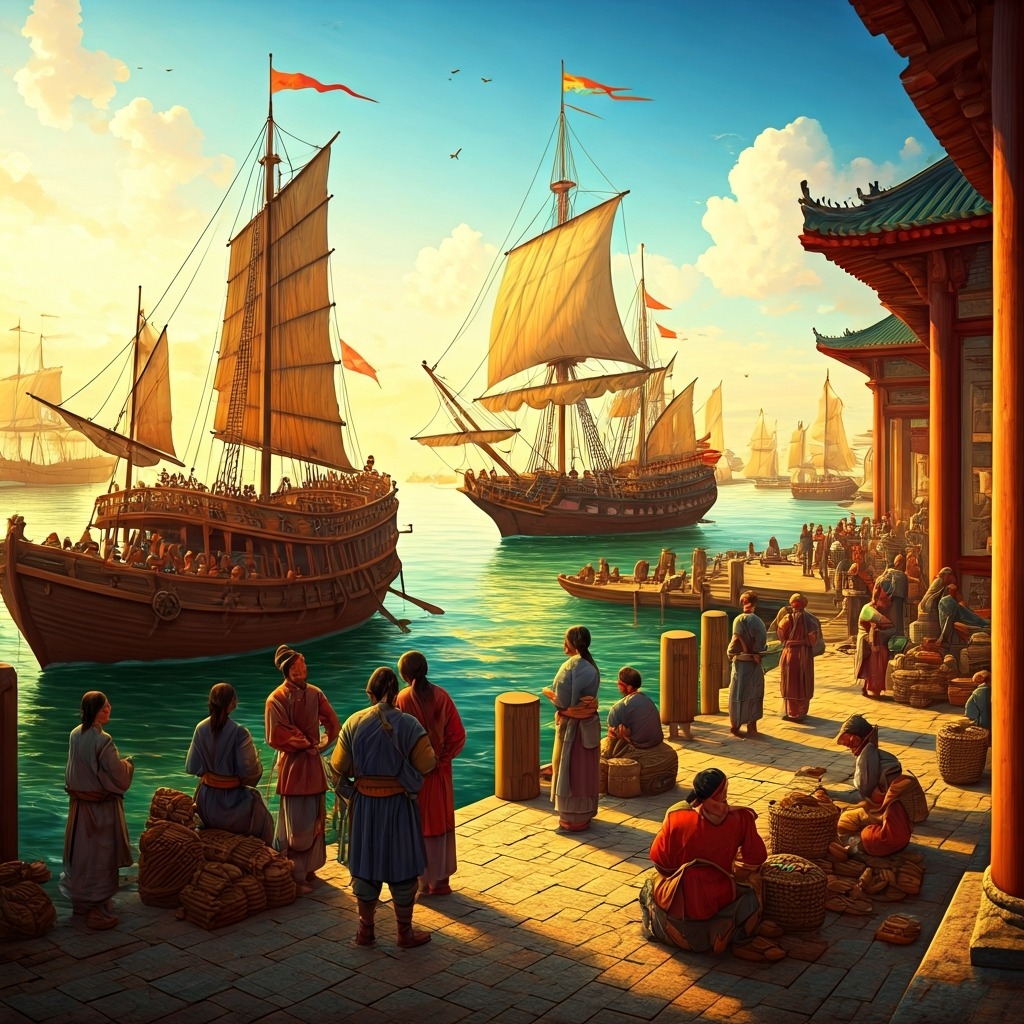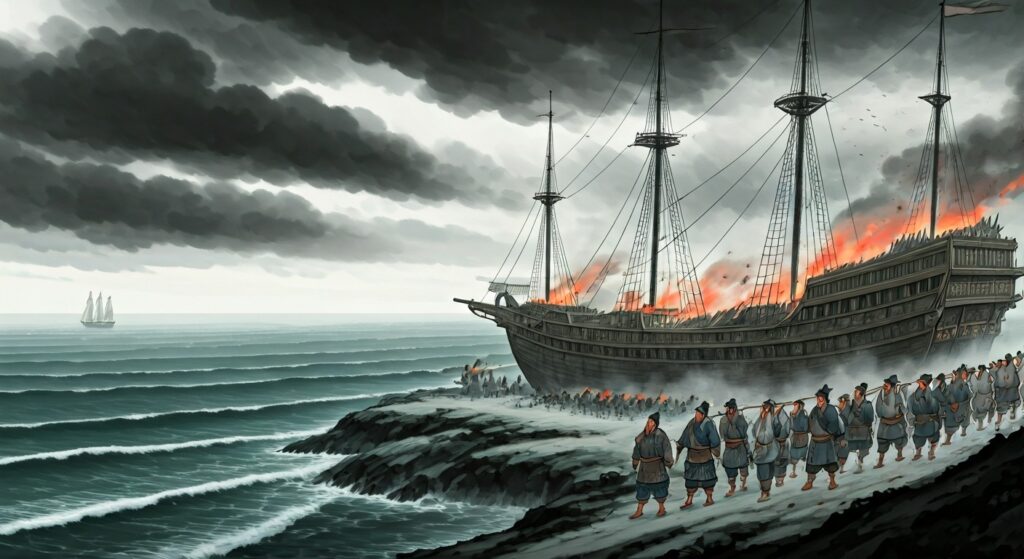
In 1371, the founder of the Ming Dynasty made a decision that would haunt his empire for two centuries. Driven by paranoia and a deep-seated Confucian disdain for commerce, the Hongwu Emperor sought to protect his fledgling nation from coastal rebels and early wokou—Japanese pirates raiding the shores. His solution was as absolute as it was devastating: he declared war on the ocean itself.
The Emperor’s Iron Edict
The policy was known as the Haijin, or the Sea Ban. The emperor didn’t just regulate maritime trade; he annihilated it. He ordered the destruction of all ocean-going, multi-masted ships and forced thriving coastal populations to pack up and relocate inland. His imperial edict was chillingly clear: “not a single plank is allowed out to sea.”
On paper, it appeared to be a ruthless but effective defensive strategy. In reality, it was a logistical nightmare that would soon birth the exact monster it was designed to destroy.
Criminalizing Survival
You cannot mandate a massive economic shift without consulting the map, and the Ming government completely ignored the geographical reality of southeastern coastal provinces like Fujian and Zhejiang. These regions were defined by rugged, mountainous terrain and notoriously poor arable land. You couldn’t simply hand a fisherman a plow and order him to grow rice; the rocky soil wouldn’t allow it. For generations, these people had depended entirely on the sea for their survival.
By criminalizing their only livelihood, the Ming government inadvertently plunged millions of its own citizens into extreme poverty. The state had made the very act of acquiring food and surviving an illegal enterprise. Desperate, starving, and with their backs against the mountains, these impoverished fishermen and merchants did what anyone pushed to the brink would do: they turned to the shadows.
The Birth of a Shadow Empire
When a government outlaws a vital supply chain, it doesn’t eliminate the demand—it simply hands the monopoly over to outlaws. Rampant smuggling networks quickly sprouted along the jagged Chinese coastline.
When Ming authorities caught wind of this illicit trade, they didn’t offer economic relief; they cracked down with brutal violence. To protect their cargo and their lives, the smugglers had no choice but to arm themselves. Slowly but surely, ordinary citizens trying to feed their families transformed into hardened, heavily armed syndicates. They became the very pirates the state had sought to eliminate.
This tension boiled over into the massive Wokou Crisis of the 16th century. The coastlines burned. The raids were devastating. The government blamed the terrifying “Japanese pirates.” But hidden within the Ming Dynasty’s own historical records lay a massive, embarrassing twist.
The Greatest Identity Theft in Pirate History
The word wokou literally translates to “Japanese pirates.” Yet, the truth was far more humiliating for the Ming court. Records reveal that up to 90 percent of these marauders were actually ethnically Chinese. This wasn’t a foreign invasion; it was a massive armed rebellion by a disenfranchised coastal populace.
Enter Wang Zhi, a legitimate merchant who was forced into the black market by the oppressive Sea Ban. Wang didn’t just survive in the underworld; he conquered it. He built a colossal, heavily armed syndicate that essentially controlled the East Asian seas. In a twist of profound irony, this pirate lord ended up providing the maritime order, stability, and trade that the Ming government had completely abandoned. He was running a more efficient and lucrative maritime empire as a fugitive than the emperor was as a sovereign.
The Silver Tide
The tragic, bloody irony of the Haijin lasted for nearly two centuries. The madness only stopped in 1567, when the Longqing Emperor ascended the throne and finally lifted the ban on private maritime trade.
The results were instantaneous. The terrifying wokou crisis evaporated almost overnight. Legitimate trade resumed, and the fearsome pirates peacefully returned to their lives as ordinary merchants and sailors—proving that people rarely choose to dodge imperial cannon fire for a living if they have a legal alternative.
The timing was immaculate. Just as the ban was lifted, the Spanish arrived in the Philippines, allowing Ming China to tap into a massive, global flow of New World silver. This sparked an unprecedented economic boom that would define the late Ming era and reshape the global economy.
The Sea Ban remains one of history’s most glaring lessons in human nature: an empire can write all the draconian laws it wants, but it can never legislate away the will to survive.