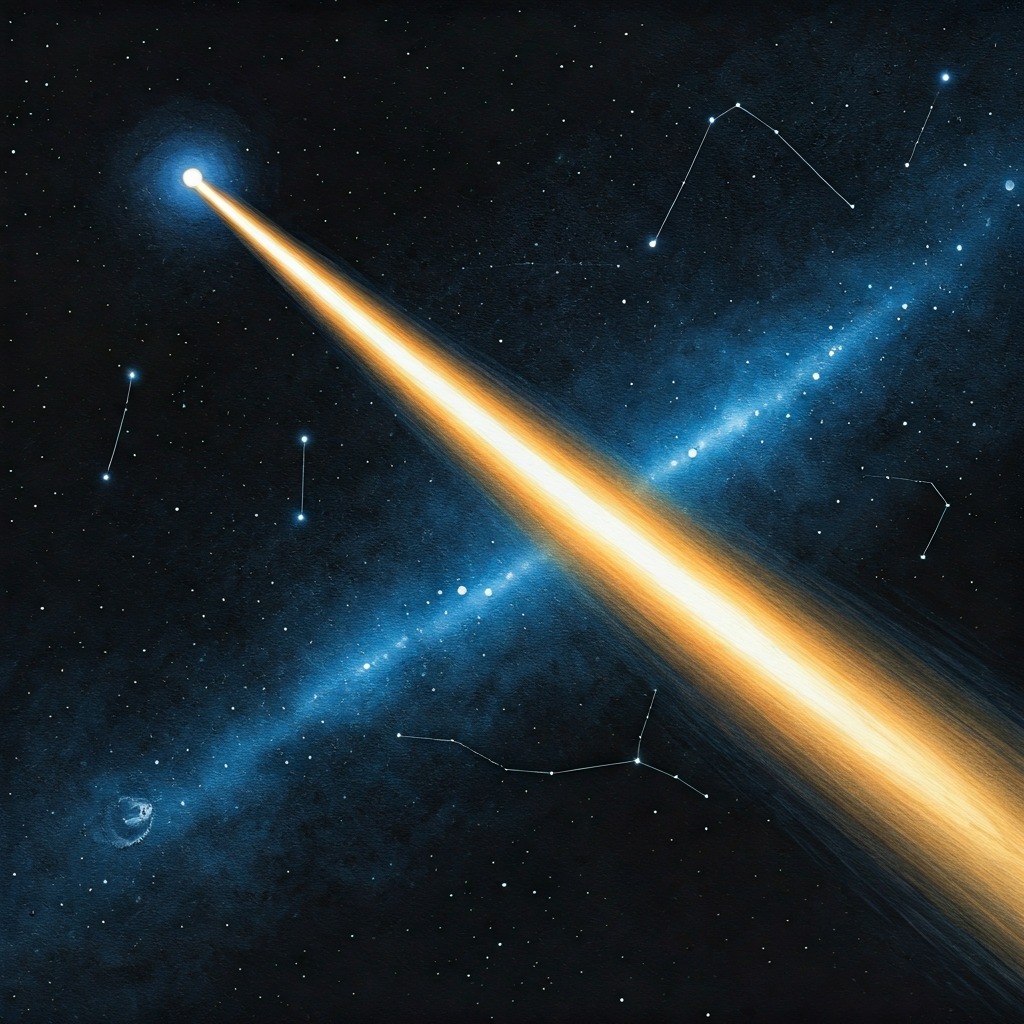
In the dead of night on August 15, 1977, the universe broke its silence. For decades, humanity had been pointing massive antennas at the stars, desperate for a whisper in the cosmic dark. What we got instead was a roar—a signal so powerful, so mathematically perfect, that it still keeps astronomers awake at night.
The Ghost in the Machine
The Big Ear radio telescope at Ohio State University wasn’t a telescope you looked through. It was a colossal, flat field of wire mesh and reflectors the size of three football fields. As the Earth rotated, the Big Ear swept the sky, blindly hunting for faint radio whispers from the void.
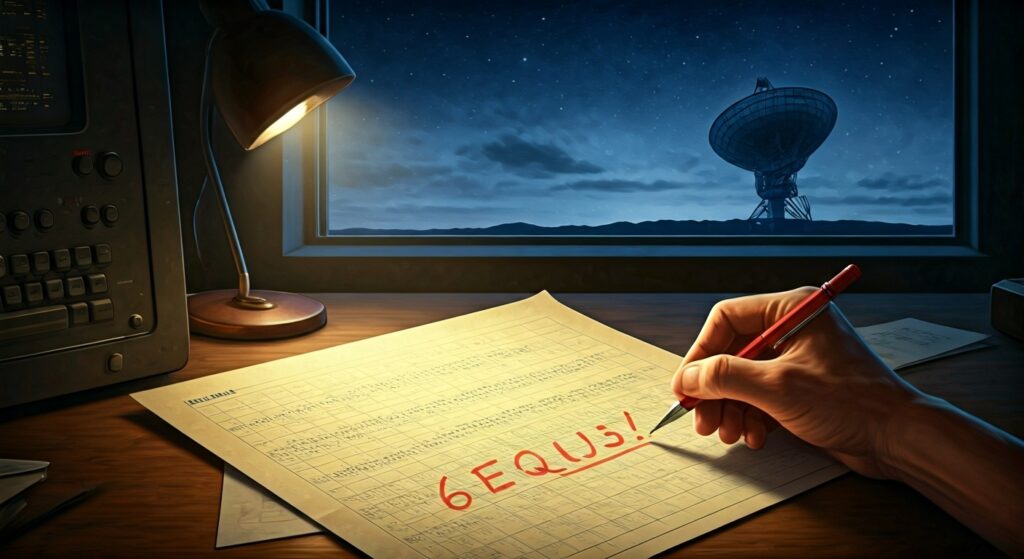
Days after a routine scan, astronomer Jerry R. Ehman sat down to the decidedly unglamorous task of reviewing towering stacks of computer printouts. The telescope’s data was represented by alphanumeric characters: numbers 1 through 9 for low-intensity background noise, and letters A through Z as the signal grew louder. Most of the time, the printouts were a monotonous sea of 1s and 2s.
But as Ehman scanned a page from the August 15 data, his eyes stopped dead.
Buried in the mundane static was an anomaly so powerful and perfectly shaped that it defied all natural logic. Astounded, Ehman grabbed a red pen, circled the sequence, and scrawled a single word in the margin: Wow!
6EQUJ5: The Anatomy of an Anomaly
The red-circled sequence read ‘6EQUJ5’. To the untrained eye, it looks like a terrible Wi-Fi password. To an astronomer, it was the holy grail.
The Big Ear telescope was fixed in place. As the Earth turned, a deep-space point source would naturally drift across the telescope’s listening window. It would start faintly, build to a peak intensity over 36 seconds, and then fade away over the next 36 seconds.
The ‘6EQUJ5’ sequence lasted for exactly 72 seconds.
This was the flawless, mathematical signature of an interstellar origin. It wasn’t a computer glitch. It wasn’t random static. It was a localized, incredibly strong beam of energy originating from the cosmos—specifically from the direction of the constellation Sagittarius.
The Cosmic Water Hole
If you’re going to call across the galaxy, you need to pick the right frequency. The Wow! Signal was detected at a frequency right near 1420.4056 MHz.
This detail is terrifyingly brilliant. That specific frequency is known as the hydrogen line. Hydrogen is the most abundant element in the universe. For decades, SETI (Search for Extraterrestrial Intelligence) researchers theorized that if an advanced alien civilization wanted to say hello, they would broadcast on this exact frequency. They call it the “water hole”—a quiet spot on the cosmic radio dial where interstellar dust doesn’t absorb the signal, allowing it to travel across thousands of light-years unimpeded.
It was the exact frequency we were looking for, behaving exactly the way an alien beacon should behave.
Comets, Satellites, and Dead Ends
Science demands skepticism, and for decades, researchers have desperately tried to cram this perfectly shaped puzzle piece into a box of known natural phenomena.
Was it a secret military satellite? Space debris reflecting a terrestrial signal back at Earth? The problem with the terrestrial interference theory is that the 1420 MHz band is internationally protected. Broadcasting on that frequency is strictly banned on Earth to keep it clear for astronomical research.
In 2017, it seemed the mystery was finally solved. An astronomer published a paper suggesting that hydrogen clouds surrounding two comets could have caused the signal as they passed through the telescope’s field of view. The media went wild, but the broader astronomical community quickly tore the theory apart. Comets simply do not emit narrowband signals at that frequency. Furthermore, orbital mechanics proved those specific comets weren’t even in the exact position of the Big Ear’s beam at the time of the detection. The comet theory fizzled out faster than a cheap sparkler.
The Silence That Followed
Despite exhaustive, highly funded follow-up searches pointing our most advanced equipment at that exact patch of Sagittarius, the Wow! Signal has never been detected again. It was a transient, roaring shout in the dark that vanished as quickly as it arrived.
Was it a passing transmission from a starship? A lighthouse beam sweeping across our solar system for just a minute before turning away? Or is it a bizarre, undocumented astrophysical phenomenon we just don’t understand yet?
Nearly half a century later, the Wow! Signal remains an isolated anomaly. It is a ghost in the machine that refuses to be explained away, keeping the ultimate dream of extraterrestrial contact brilliantly, stubbornly alive.