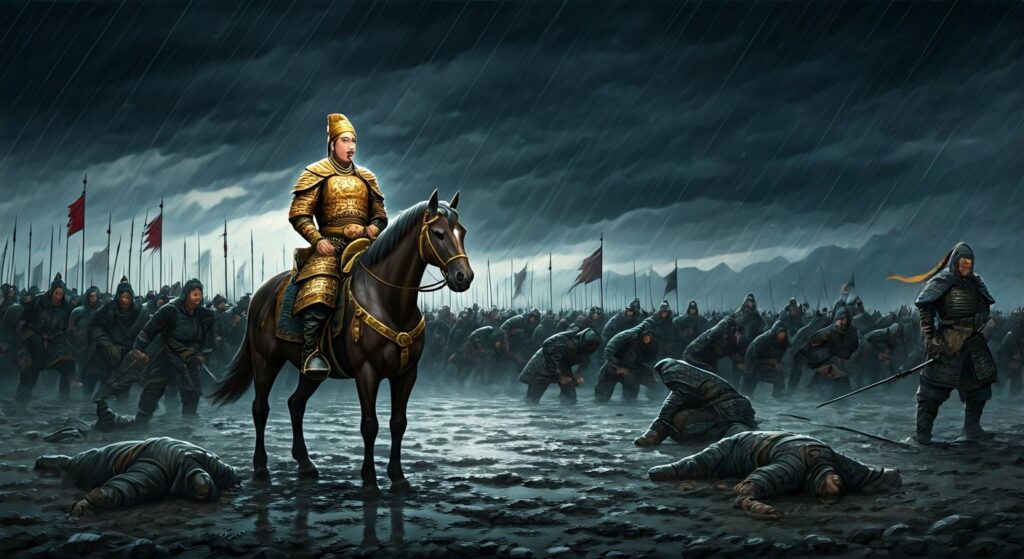
In the mid-15th century, the Ming Dynasty was the undisputed superpower of the world. Their armies were vast, their wealth immeasurable, and their borders seemingly impenetrable. Yet, in a matter of days, this invincible empire was brought to its knees by a massively outnumbered underdog—all because one corrupt official refused to let an army walk across his lawn.
This is the story of the Tumu Crisis of 1449, a chain of events so catastrophic and bizarre that it permanently altered the landscape of the globe.
The Billion-Dollar Grift
To the north of the Ming Empire, the Oirat Mongols had been unified under a brilliant and ruthless leader named Esen Taishi. The Ming managed their volatile relationship with the Oirats through a tribute system, but Esen was a master manipulator who quickly figured out how to game it. He began sending massive “tribute missions”—sometimes numbering over 2,000 men—knowing the Ming court was culturally obligated to shower them with lavish reciprocal gifts and lucrative trade privileges. It was an absolute scam, and Esen was bleeding the Ming treasury dry.
Enter Wang Zhen, the chief eunuch of the Ming court. Wang wielded a toxic, unprecedented influence over the 21-year-old Zhengtong Emperor. Tired of Esen’s grift, Wang decided to play hardball. In 1449, he drastically slashed the payment for the Oirat horses and openly insulted their ambassadors.
Esen Taishi didn’t just take the insult. He answered it with a multi-pronged invasion of Ming territory.
A Death March in the Mud
Against the desperate, screaming advice of every seasoned military commander and civil minister in the room, Wang Zhen persuaded the young emperor to personally lead a punitive expedition against the Oirats.
The Ming hastily mobilized a colossal force. While traditional records boast a mythical 500,000 men, modern historians estimate the actual combat-ready figure was between 200,000 and 250,000. Even at the lower end, mobilizing a quarter-million men in just a few days is a logistical death sentence. An army of that size requires grain, wagons, clean water, and flawless organization. The Ming army had none of it.
As they marched toward the frontier city of Datong in August 1449, the heavens opened up. Battered by torrential rains, starvation set in almost immediately. Morale plummeted into the mud. The imperial army was transforming into a lumbering, exhausted mob.
The Deadliest Detour in History
When the Ming forces finally reached Datong, they walked into a horror show. The Oirats had already massacred the local defenders. Seeing the carnage firsthand, Wang Zhen’s bravado evaporated. Panic set in, and he ordered an immediate retreat.
But Wang’s vanity would doom them all.
Initially, the chief eunuch wanted to parade the Emperor through his hometown of Yu province to show off his immense power. But halfway there, Wang had a horrifying realization: a starving, desperate army of 250,000 men would completely trample his sprawling personal estates. To save his lawn, he abruptly changed the army’s route.
This erratic, selfish maneuvering severely delayed the retreat. It was exactly the opening Esen Taishi was waiting for. Esen’s highly mobile cavalry of about 20,000 men easily caught up to the exhausted Ming forces.
The Thirst Trap at Tumu Fortress
On August 31, the Ming army made camp at Tumu Fortress. In what remains one of the worst tactical decisions in military history, Wang Zhen ordered the camp set up on a high, exposed plateau—completely cut off from local water sources.
Esen’s cavalry swiftly surrounded the plateau, blocking the Ming army’s access to the nearby river. For days, the Ming soldiers baked in the late-summer sun, driven mad by extreme thirst.
Sensing their absolute desperation, Esen sent a fake peace offer. The moment the Ming forces believed they were safe, all remaining discipline evaporated. The thirsty soldiers broke formation and stampeded toward the river.
The Oirats sprang the trap.
It wasn’t a battle; it was a slaughter. Hundreds of thousands of Ming soldiers and top government officials were cut down in the chaos. In the midst of the bloodbath, Wang Zhen’s own mutinous officers finally had enough. The architect of the disaster was reportedly bludgeoned to death by his own general.
When the dust settled, the unimaginable had happened: the 21-year-old Zhengtong Emperor was captured alive. The “Son of Heaven” was a prisoner of war.
The Coldest Calculation
Esen Taishi thought he had just won the geopolitical lottery. With the Emperor in chains, he planned to extort massive ransoms and territorial concessions from the Ming.
He didn’t account for Yu Qian, the Ming Minister of War back in Beijing.
With the capital in a state of sheer panic, Yu Qian took control and delivered one of the coldest, most pragmatic lines in history: “The empire is heavy, the emperor is light.”
Yu Qian completely neutralized Esen’s leverage. The Ming court flat-out refused to negotiate. Instead, they elevated the Zhengtong Emperor’s younger brother to the throne, officially stripping the captured emperor of his supreme status. Yu Qian then organized an iron-clad defense of Beijing, successfully repelling Esen’s siege.
The Tragic Postscript That Built a Wonder
Realizing his royal hostage was now completely useless and incredibly expensive to feed, Esen unconditionally released the former emperor in 1450.
But historical reality is rarely a fairy tale. Upon returning to Beijing, the former emperor was placed under strict house arrest by his own brother for seven long years. In 1457, while the new emperor lay on his deathbed, the former emperor launched a violent palace coup and reclaimed the throne. His very first order of business? He executed Yu Qian, the brilliant strategist who had saved the dynasty from complete annihilation.
The Tumu Crisis sent shockwaves through China that lasted for centuries. The trauma of the slaughter shattered the aggressive, offensive military posture of the early Ming Dynasty. They adopted a strictly defensive, isolationist policy, pouring their vast resources into an architectural marvel to ensure the Mongols could never threaten Beijing again.
We know that defensive project today as the massive expansion of the Great Wall of China. And it exists, in large part, because one corrupt bureaucrat didn’t want his lawn stepped on.