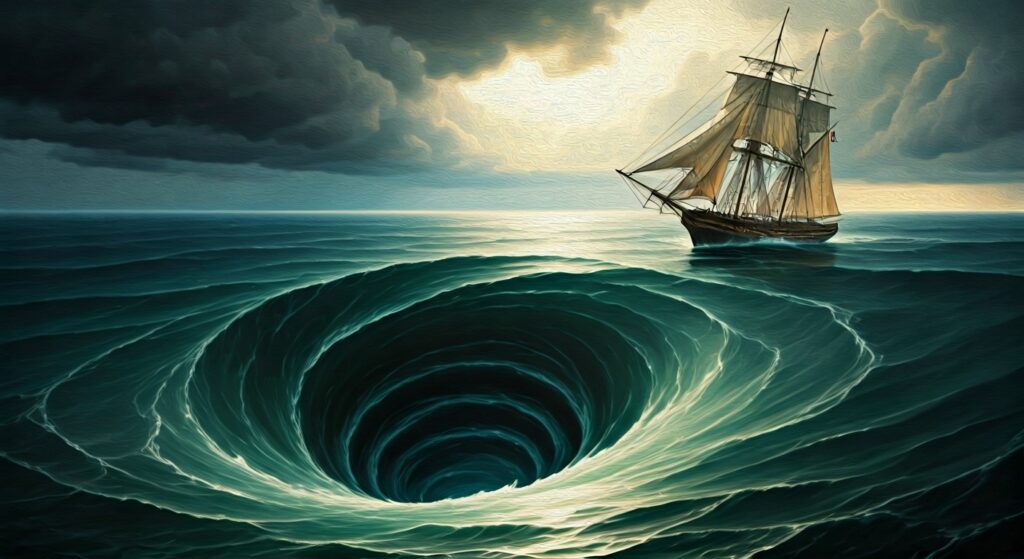
Imagine standing on the deck of a fragile wooden ship in the freezing, unforgiving waters of the North Atlantic. Without warning, the sea doesn’t just swell—it begins to rotate. A deafening, grinding roar echoes from the deep as the ocean surface drops, forming a massive, churning vortex that threatens to drag you into the black abyss.
Welcome to the Moskenstraumen.
The Ocean’s Jaws
Most whirlpools form in confined spaces—narrow straits, rushing rivers, or restricted bays. But the Moskenstraumen is a different beast entirely. It is a monster born in the open sea, lurking in the Lofoten archipelago off the coast of Norway, perfectly positioned between the islands of Moskenesøya and Mosken.
For centuries, sailors whispered terrified rumors of this aquatic leviathan. The reality of its immense power is generated by a deadly convergence of natural elements. Strong semi-diurnal tides clash violently with the warm North Atlantic Current. But the real trap lies hidden beneath the surface: a shallow underwater ridge, plunging 40 to 60 meters deep, connects the islands. This hidden wall forces a massive volume of water through a narrow passage, accelerating the current to terrifying speeds of up to 20 kilometers per hour.
The result is a series of chaotic, grinding vortices that can measure up to 50 meters across. If a ship were unlucky enough to be caught at the edge, the crew would watch in horror as the center of the ocean literally dropped by a full meter, forming a watery black hole.
The Grinding Stones of the Deep
Before modern science could map bathymetry and calculate tidal shifts, humans had to make sense of this terrifying anomaly through myth. In fact, the very word “maelstrom” was born here. Derived from the Dutch words malen (to grind) and stroom (stream), it was originally coined to describe this exact Norwegian phenomenon.
To the ancient Norse, these churning waters weren’t just a trick of the tides. They were the result of the Grottasöngr, a mythological tale of two giantesses condemned to endlessly grind a magical millstone at the bottom of the sea. According to legend, this eternal grinding not only created the violent vortex but also explained why the ocean itself was salty.
During the Age of Sail, the Moskenstraumen posed a lethal, unpredictable threat. Ships that miscalculated the tides were caught in the spin, their wooden hulls groaning and snapping under the immense pressure. Soon, exaggerated accounts spread across Europe, detailing galleons and even giant whales being sucked screaming into bottomless abysses.
A Descent into Madness
These maritime legends were simply too good for 19th-century writers to ignore. The Moskenstraumen quickly became the ultimate symbol of nature’s wrath, cementing its place in literary history.
Edgar Allan Poe popularized the phenomenon in his 1841 short story A Descent into the Maelström, depicting a terrifying, exaggerated vortex that swallowed ships whole and drove men mad. Jules Verne utilized the whirlpool as the ultimate, inescapable trap in his 1870 masterpiece Twenty Thousand Leagues Under the Sea, where Captain Nemo’s brilliant submarine, the Nautilus, is seemingly dragged to its doom in the Norwegian depths. Even Herman Melville couldn’t resist referencing the legendary vortex in Moby-Dick.
The Moskenstraumen had become a global icon of terror. Which makes what happened next all the more insane.
The Madmen Who Sailed Right Into It
You would think that a vortex famous for eating ships and inspiring terrifying myths would be a place humans actively avoided. But that underestimates the sheer, stubborn bravery of Norwegian fishermen.
Despite its inherent dangers, the Moskenstraumen has been a crucial economic resource for centuries. The intense churning of the water acts as a giant blender, bringing vital nutrients from the ocean floor to the surface. This upwelling creates a highly productive marine ecosystem, attracting vast schools of small fish. And where the small fish go, the monsters follow. The vortex draws massive predators: Atlantic cod, giant halibut, seabirds, and marine mammals.
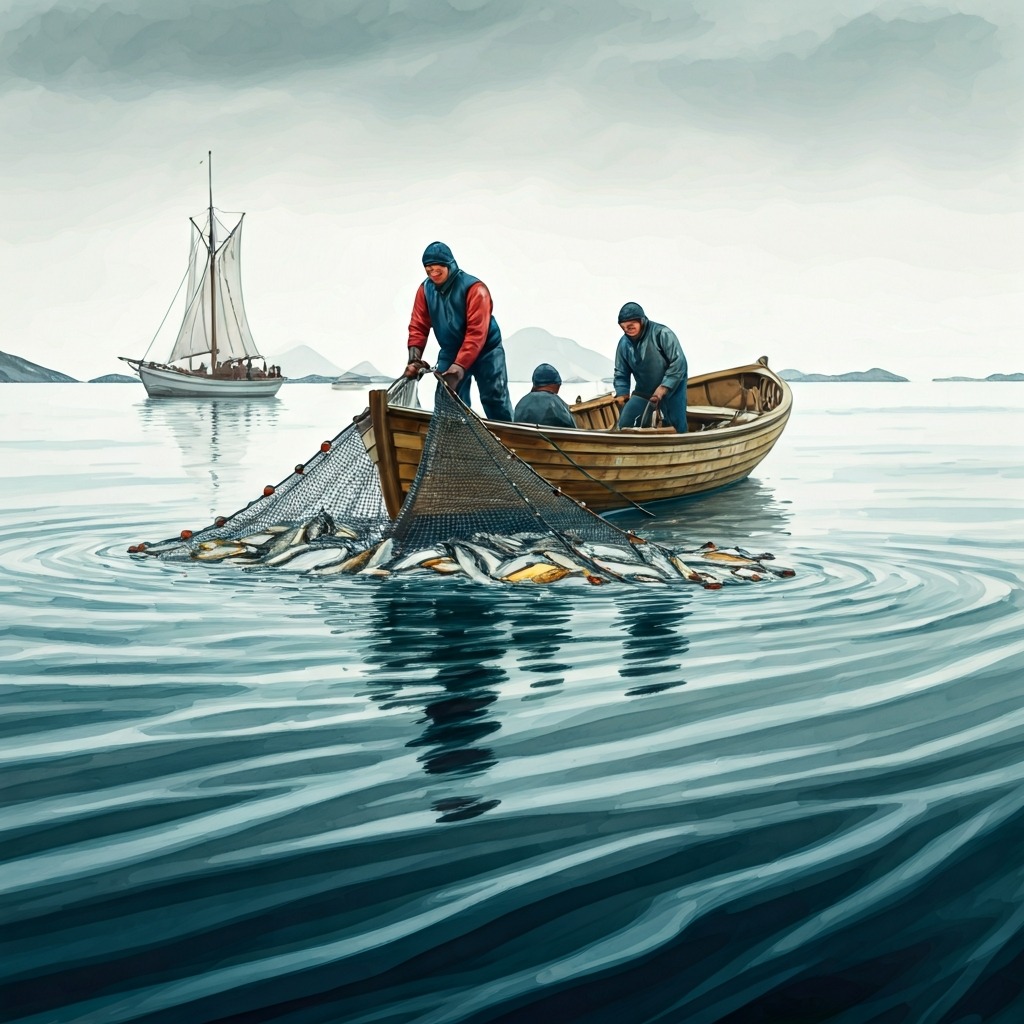
Risking a watery grave in a mythic whirlpool just to catch some cod requires a level of dedication that borders on madness. Yet, local fishermen have braved these treacherous currents for generations. They didn’t just sail in blindly; they learned to read the monster’s breathing. They timed their expeditions perfectly, waiting for the brief window of the “slack tide” when the waters temporarily calmed. In that fleeting moment of peace, they hauled in their massive catches before the ocean inevitably began to spin again.
Today, the Moskenstraumen remains a captivating natural wonder. It stands as a chilling reminder of a time when the edges of the map were filled with monsters—and of the absolute madmen who decided to sail out and meet them anyway.