The legend of the HMS Bounty has been sanitized by centuries of pop culture. You likely picture Captain William Bligh as a flog-happy, sadistic tyrant, and Fletcher Christian as the dashing, righteous hero who stood up to him. But peel back the myth, and the truth is far darker, far bloodier, and infinitely more fascinating. It is a story of men who looked out at the terrifying, endless expanse of the Pacific Ocean and decided to test their luck—only to find that the paradise they sought was actually a sun-baked hell of their own making.
The Paradise Trap
In 1787, the HMS Bounty set sail from England on a decidedly unglamorous mission: travel to Tahiti, collect breadfruit plants, and transport them to the West Indies to serve as a cheap food source for enslaved populations.
Under the command of Lieutenant William Bligh, the voyage out was brutal. History has painted Bligh as a monster, but modern historians have largely debunked this caricature. While he possessed a vicious temper and hurled harsh verbal abuse at his men, his actual record of physical punishment was lower than the Royal Navy average for the era.
The real catalyst for the mutiny wasn’t the lash. It was paradise.
To allow the breadfruit plants to mature, the Bounty was forced into a five-month layover in Tahiti. For five months, the sailors lived an idyllic, sexually liberated lifestyle alongside the native Tahitians. The rigid, bone-crushing discipline of 18th-century naval life evaporated. But when the time finally came to pack up the plants and return to the cramped, brutal reality of the wooden ship, morale completely shattered. The men had tasted heaven, and Bligh was dragging them back to hell.
The Breaking Point
Tension simmered in the claustrophobic hull until it finally boiled over on April 28, 1789. Fletcher Christian, the master’s mate and Bligh’s former protégé, orchestrated a bloodless, dawn takeover.
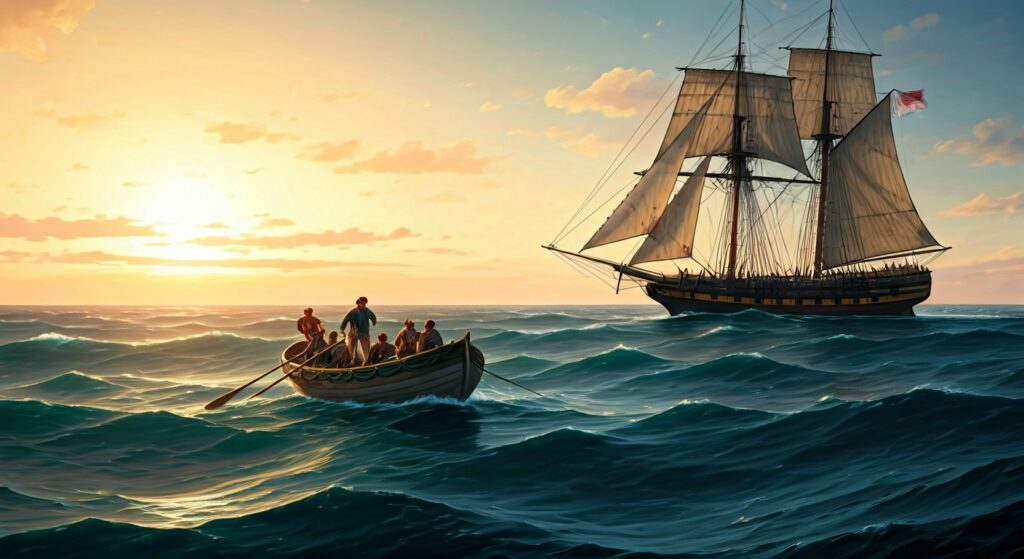
Bligh and 18 loyalists were hauled out of bed and forced into a 23-foot open boat. Armed with nothing but a few meager rations, a compass, and a pocket watch, they were cast adrift in the vast, unforgiving Pacific. The mutineers fully expected the ocean to swallow them whole.
To be stuck in an overcrowded, open wooden boat in the middle of the ocean amidst torrential storms and blistering heat is a death sentence. Yet, in what is widely considered one of the greatest feats of seamanship in human history, Bligh navigated that tiny vessel across 3,600 nautical miles of open water. He guided his starving, sun-baked crew all the way to safety in Timor, losing only a single man to a native attack along the way.
Bligh had survived. And that meant the hangman’s noose of the Royal Navy was coming for Fletcher Christian.
Erasing the Map
Knowing they were dead men walking, Christian and his faction needed to disappear completely.
They first attempted to settle on the island of Tubuai, but a violent clash with the indigenous population forced them to flee back to Tahiti. Sixteen men decided to roll the dice and stay there—a fatal bet, as they were later hunted down and captured by the HMS Pandora.
Fletcher Christian, along with eight other British mutineers, six Tahitian men, and eleven Tahitian women (some of whom were reportedly kidnapped), set sail into the unknown. They needed a ghost island.
In January 1790, they found it: Pitcairn Island. It was the perfect hideout for one simple, incredible reason—it had been misplaced on Royal Navy charts by over 200 miles.
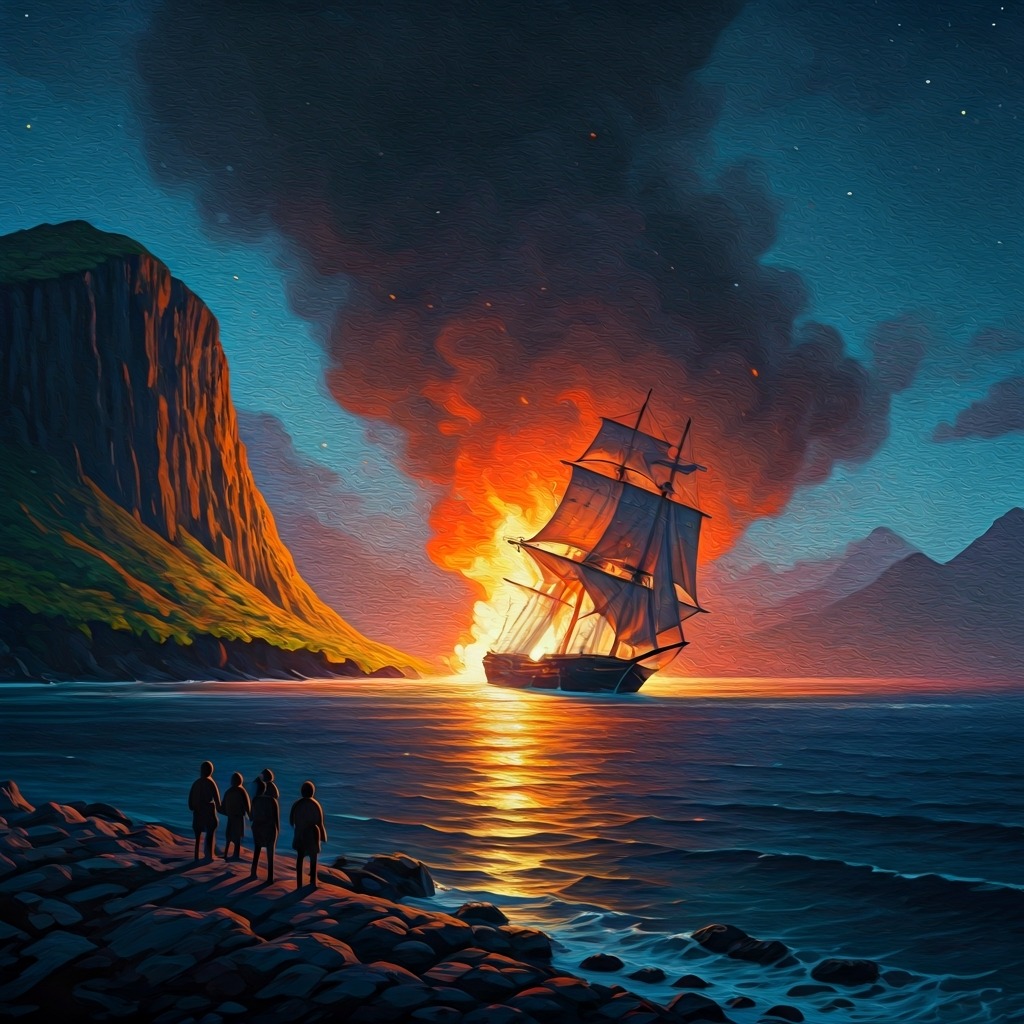
But Christian understood human nature. As long as the Bounty was anchored in the bay, passing ships might spot her masts. Worse, the temptation to flee the isolated rock would eventually fracture the group. So, on January 23, 1790, the mutineers stripped the ship of all useful materials and set it ablaze.
Watching their only means of escape burn and sink into what is now known as Bounty Bay, they sealed their fate. They were marooned by choice.
Descent into Hell
If you think this is where they built a tropical utopia, think again. The drama on that island makes the initial mutiny look like a minor disagreement.
The British sailors immediately treated the Tahitian men as slaves. They divided the island’s land entirely among themselves and began passing the Tahitian women around as property. Resentment festered, and soon, the island descended into a brutal racial and sexual war.
In 1793, the oppressed Tahitian men rebelled. They murdered Fletcher Christian and four other mutineers in a coordinated, gruesome bloodbath. But the violence didn’t stop there. The surviving British sailors, aided by the mutineers’ widows, retaliated and slaughtered every single Tahitian man on the island.
The nightmare only deepened. One of the surviving mutineers figured out how to distill a highly potent, crude spirit from a local root. Alcoholism swept through the survivors, leading to more violence, disease, and suicide. The population was rapidly decimating itself on a speck of rock nobody knew existed.
The Lone Survivor’s Redemption
Eighteen years later, in 1808, an American sealing ship named the Topaz was sailing through the South Pacific when it stumbled upon Pitcairn Island.
When the crew rowed ashore, they braced themselves for the unknown. Instead, they were astounded to find a thriving, peaceful community of Polynesian-speaking women and children.
Leading them was a single surviving man: John Adams (formerly Alexander Smith), the last of the Bounty mutineers.
Following the years of horrific bloodshed, Adams had experienced a profound religious awakening. Using a salvaged Bible from the burned Bounty, he had educated the children and established a pious, strictly moral society out of the ashes of a murder-soaked hellscape.
Today, Pitcairn Island remains a British Overseas Territory. Look closely at its roughly 50 inhabitants, and you will find the direct descendants of the Bounty mutineers and their Tahitian companions. It is a chilling, awe-inspiring testament to the extremes of the human condition—capable of the most brilliant survival, the darkest betrayals, and the strangest redemptions, all while trapped together on the unforgiving sea.