The late summer sun beat down on the fields of Woolpit, a rural village in 12th-century Suffolk, England. Reapers swung their scythes through the tall crops, the rhythmic slicing the only sound in the stifling heat—until a strange, frantic whimpering echoed from the edge of the field.
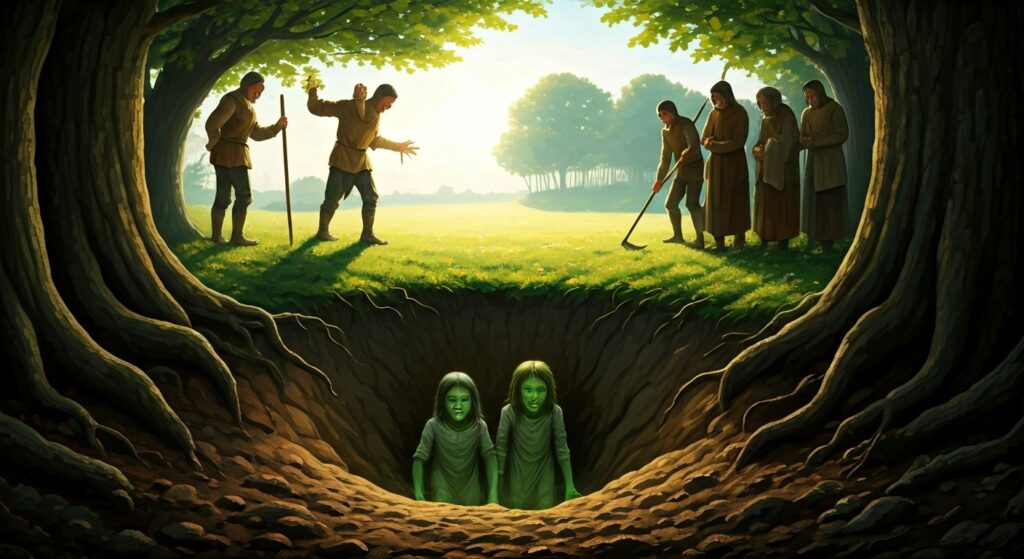
It emanated from a deep, ancient trench designed to trap wolves. But when the villagers cautiously peered over the edge, they didn’t find a snarling beast. They found two terrified children huddled in the dirt.
And they were entirely, vividly green.
The Discovery in the Wolf Pit
According to 12th-century chroniclers William of Newburgh and Ralph of Coggeshall, the discovery of the two siblings—a young boy and his older sister—sent shockwaves through the village. Their skin was the color of fresh leaves. They were draped in garments made of a bizarre, unrecognizable fabric. When the villagers attempted to speak to them, the children recoiled, responding in a frantic, melodic language that bore no resemblance to English, French, or Latin.
Bewildered, the villagers pulled the weeping children from the pit and delivered them to the estate of a wealthy local landowner, Sir Richard de Calne. The mystery, however, was only just beginning.
The Broad Bean Diet
For days, the children refused to eat. Sir Richard offered them bread, roasted meats, and the finest medieval delicacies available, but the siblings turned away in tears. They were clearly starving, yet entirely repulsed by human food.
Their fast was broken only when servants brought in a harvest of raw broad beans. The children tore into the stalks voraciously, ignoring the beans themselves until they were shown how to open the pods. For months, it was the only sustenance they would accept.
Slowly, Sir Richard’s household coaxed them into a standard English diet. As their eating habits normalized, a startling transformation occurred: the verdant hue began to fade from their skin.
Tragically, the younger brother, who had always been sickly and lethargic, did not survive long in this strange new world. He died shortly after the children were baptized. But the sister thrived. She lost her green coloration entirely, grew into a healthy young woman, and eventually learned to speak English.
Once she could finally communicate, she revealed a backstory that defied all logic.
A Tale from the Twilight Zone
When asked where she and her brother had come from, the girl didn’t name a neighboring village or a foreign kingdom. She claimed they hailed from “St. Martin’s Land.”
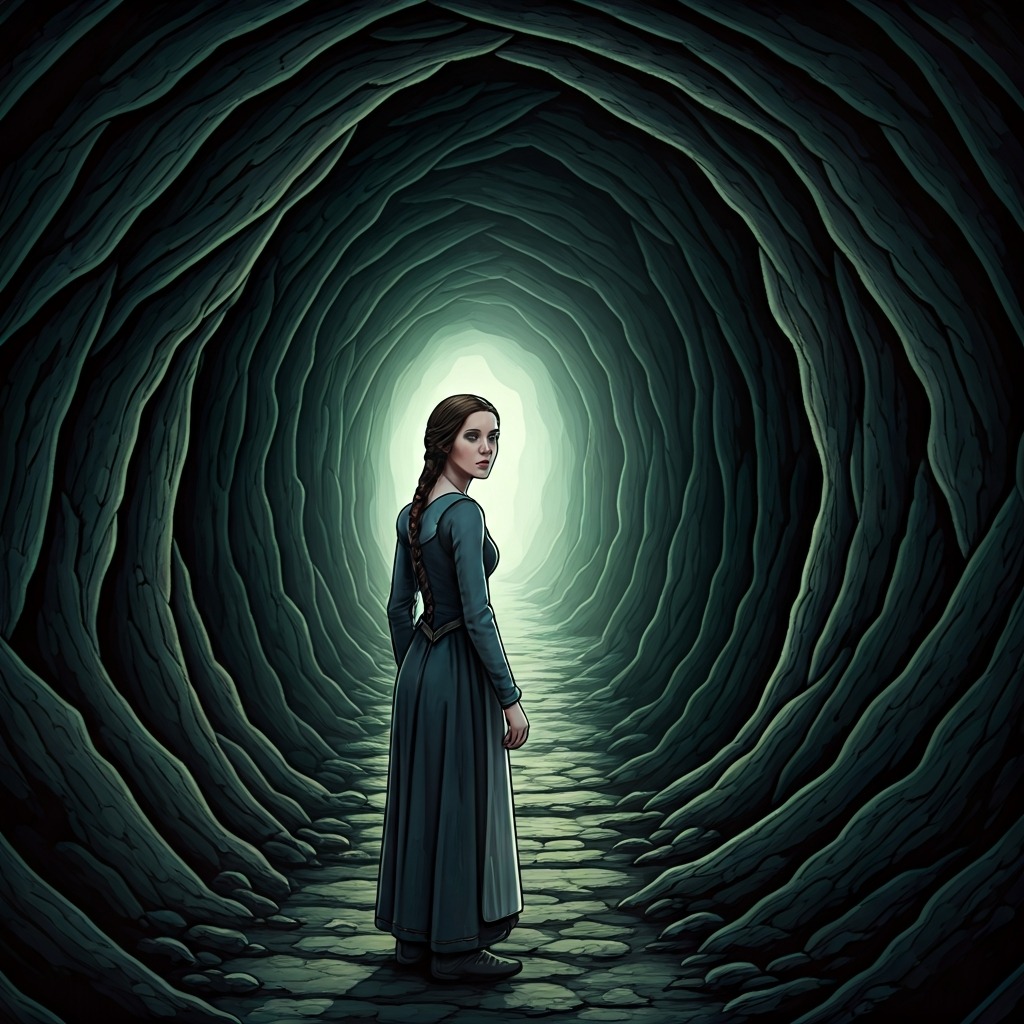
According to her chilling account, St. Martin’s Land was a subterranean world devoid of a sun. Its inhabitants lived in a perpetual, hazy twilight. And the most startling detail of all? Every single person in St. Martin’s Land had green skin.
She explained that she and her brother had been herding their father’s cattle when they heard a loud, echoing noise—a sound she later identified as the ringing of church bells. Disoriented by the chiming, they wandered into a cavern. When they emerged, they were instantly blinded by the agonizing sunlight of our world, trapped in the wolf pit of Woolpit.
True Crime in the Middle Ages
For centuries, historians, scientists, and folklorists have attempted to crack the case of the Green Children, proposing theories that turn this supernatural legend into a gritty medieval true-crime story.
The Flemish Orphans The most widely accepted historical theory suggests the children were Flemish immigrants. In 1173, thousands of Flemish mercenaries were slaughtered at the nearby Battle of Fornham. It is highly probable that these two children were orphaned during the chaos and fled into the dense, dark canopy of nearby Thetford Forest.
But why were they green? Medical historians point to chlorosis—a severe form of anemia caused by extreme malnutrition. Historically known as “the green sickness,” it can impart a distinct greenish tint to the skin. Once the girl began eating a balanced diet at Sir Richard’s estate, her anemia was cured, and her natural skin color returned. As for their “alien” language? It was likely a dialect of Flemish, which the insular Suffolk peasants simply didn’t recognize.
The Greedy Guardian Another, more sinister theory reads like a medieval murder plot. Some researchers suggest the children were heirs to a local fortune, and a greedy guardian wanted them out of the picture. Instead of killing them outright, he subjected them to arsenic poisoning—which can cause severe skin discoloration—and abandoned them in the woods to die.
The Babes in the Wood Folklorists argue that the story isn’t literal at all. Instead, it may be an early adaptation of the classic “Babes in the Wood” legend, heavily intertwined with traditional British fairy folklore, where green is universally recognized as the color of the supernatural.
An Enduring Enigma
The girl from the wolf pit eventually integrated fully into English society. Records suggest she took the name Agnes, lived out her days as a normal woman, and reportedly married a royal official from King’s Lynn.
We will likely never know the absolute truth. Was she a traumatized war orphan suffering from severe anemia? The victim of an attempted poisoning? Or a wanderer from a twilight dimension who stumbled into the wrong reality?
Whatever the answer, the Green Children of Woolpit remains one of history’s most captivating mysteries—a reminder that sometimes, the most inexplicable stories are the ones buried right in our own backyards.