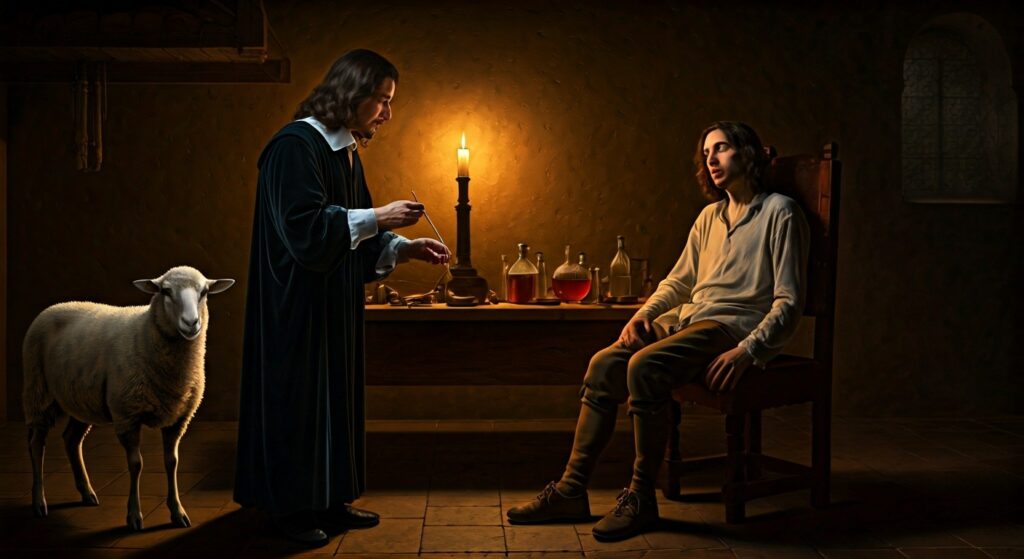
Forget the dry political treatises of the 1600s. The era’s real drama unfolded in candlelit laboratories, where rogue physicians decided to play God with human blood. When 17th-century doctors first began tinkering with the circulatory system, the results were far messier—and more macabre—than anyone could have imagined.
The Highway of Humors
In 1628, William Harvey shattered the medical paradigm by proving that blood circulates. For the first time, scientists realized the bloodstream wasn’t just a static puddle inside the body; it was a biological highway. It was the ultimate intravenous delivery system.
But medicine was still shackled to “humorism”—the ancient, slightly terrifying belief that physical and mental ailments stemmed from imbalanced bodily fluids. Physicians hypothesized that blood carried the literal personality traits of its host. Their logic? If a patient suffered from fiery madness, severe agitation, or a burning fever, you just needed to cool them down. And what could possibly be cooler and calmer than a farm animal? Doctors reasoned that introducing the blood of a gentle, docile creature like a sheep or a calf could literally wash away a patient’s insanity.
The Macabre Space Race
What followed was a high-stakes, fiercely contested race between the English Royal Society and French physicians to perform the first successful transfusion. It was essentially the Space Race of the 1600s, fueled by ego and livestock.
The English drew first blood in 1665 when physician Richard Lower successfully performed the first animal-to-animal transfusion, bleeding a dog almost to the point of death before miraculously reviving it with the blood of another hound.
But Jean-Baptiste Denis—the personal physician to King Louis XIV—refused to let England claim the glory. In June 1667, Denis crossed a terrifying threshold. He took a 15-year-old boy who was feverish and dangerously weakened by excessive leeching, and transfused a small amount of sheep’s blood directly into his veins.
Against all odds, the boy survived. Modern immunologists now know the kid was incredibly lucky; he only lived because the volume of sheep blood was too small to trigger a fatal systemic immune response.
The “Sheepish” Scholar
Not to be outdone, the English quickly retaliated. In November 1667, Richard Lower and Edmund King found Arthur Coga, an eccentric clergyman and scholar suffering from what they deemed a “harmless form of insanity.” They pumped sheep’s blood into Coga, hoping to cure his erratic mind.
Coga survived the procedure. While his mental state remained completely unchanged, he reportedly used his newfound fame to joke about his new “sheepish” nature.
It seemed like a medical miracle. The scientific community was thrilled. But they were walking blindly into a biological trap. The human immune system was waiting in the dark, and the bill for this reckless tinkering was about to come due.
Black Urine and a Lethal Twist
The experiments reached a chaotic, tragic climax in the winter of 1667. Jean-Baptiste Denis took on a new patient: Antoine Mauroy, a former valet suffering from violent, severe bouts of madness (historians today suspect he was actually suffering from late-stage syphilis).
Denis decided to transfuse calf’s blood into Mauroy. The first transfusion yielded a mild reaction. But during the second attempt, Mauroy’s immune system woke up and realized it was under attack. Mauroy experienced intense pain, profuse sweating, and violent vomiting. Most terrifyingly, his urine turned as black as soot.
Today, any first-year medical student would recognize this as a classic, severe hemolytic transfusion reaction. The human immune system was violently attacking and destroying the foreign animal red blood cells, completely overloading the kidneys. Following a third attempted transfusion, Mauroy died.
The Trial That Froze Science
The aftermath was an absolute spectacle. Mauroy’s widow immediately sued Denis for murder, dragging the grisly details of the experiment into the public eye.
But during the highly publicized trial, a shocking twist emerged that no one saw coming: evidence suggested that the widow had actually poisoned her husband with arsenic. She had used the experimental transfusions as a smokescreen to end her own suffering from his violent, unpredictable outbursts.
Although Denis was ultimately exonerated of murder, the PR damage was irreversible. The gruesome reality of the side effects, combined with the deep theological and ethical discomfort of mixing human and animal blood, caused a massive panic. By 1670, the French Parliament, the English Royal Society, and the Pope had all banned blood transfusions.
Just like that, the practice was plunged into absolute obscurity. The science of blood transfusion sat untouched in the dark for 150 years, waiting until 1818, when British obstetrician James Blundell finally pioneered successful human-to-human transfusions to save women suffering from postpartum hemorrhage.
It is a stark reminder that the history of science isn’t a straight line of clean, sterile progress. Sometimes, it is a chaotic series of wild guesses, catastrophic failures, and accidental discoveries that somehow, eventually, push humanity forward.