The modern world runs on a dark, bitter elixir. Every morning, billions of us partake in a global ritual, relying on a magical brew to lift the fog of sleep and jolt our minds into action. But how did humanity discover this potent liquid? The true story of coffee is not a tale of careful agricultural planning. It is a centuries-old epic of dancing animals, terrified monks, ancient survival hacks, and a cultural revolution that literally fueled the Age of Enlightenment.
The Midnight Dancers of the Ethiopian Highlands
The legend begins on the misty, ancient plateau of 9th-century Ethiopia. A young goatherd named Kaldi was wandering the dense, quiet forests with his flock when he noticed something terrifying. His goats were acting possessed. They were hyperactive, bounding erratically through the underbrush, and practically dancing on their hind legs.
Tracing the source of this chaotic goat-rave, Kaldi found a nondescript shrub covered in bright red berries. Intrigued—and exhausted from wrangling his frenzied flock—he popped a few of the mysterious fruits into his mouth. Within minutes, his heart raced. The heavy fatigue of the day vanished, replaced by an electrifying rush of energy. Kaldi had just experienced the world’s very first caffeine buzz.
Trial by Fire
Kaldi knew he had stumbled upon something miraculous. He gathered the berries and presented them to a local Islamic monk, hoping to share his divine discovery. The monk, however, was horrified. Fearing this intense stimulant was a demonic temptation designed to distract the faithful, he hurled the berries into a roaring hearth to destroy them.
But the fire did not destroy the magic; it unlocked it. As the berries blistered in the flames, the seeds inside began to roast. A rich, intoxicating aroma filled the stone monastery. The scent was so mesmerizing that the terrified monks scrambled to rake the glowing beans from the embers. Desperate to preserve this heavenly discovery, they ground the roasted beans and dissolved them in hot water. In doing so, they inadvertently brewed the very first cup of coffee. They quickly realized this dark water was a gift, keeping them wide awake during grueling hours of evening prayer.
The Original Energy Bar
It is a flawless origin story—perhaps too flawless. Historians largely view Kaldi and his dancing goats as an apocryphal myth, a brilliant piece of folklore penned in 1671 by a Lebanese professor in Rome. But the geographical roots of the legend are dead-on, and the true history is even more fascinating.
Long before anyone was sipping hot lattes, the indigenous populations of Ethiopia were harnessing the Coffea arabica plant for survival. Anthropological evidence reveals that the nomadic Oromo people would harvest the berries and crush them, seeds and all. They mixed this raw caffeine-bomb with animal fat, rolling the concoction into bite-sized spheres. These savory, centuries-old fat-bombs served as high-energy survival rations for warriors and travelers embarking on grueling journeys. It was the ultimate ancient energy bar.
The Mystics’ Secret Elixir
The transformation from chewed-up fat-balls to the hot liquid we crave today happened across the Red Sea in Yemen. By the 15th century, coffee had infiltrated the secretive Sufi monasteries of the Yemeni highlands.
It was here, shrouded in the shadows of the cloisters, that the beans were first roasted and brewed in a recognizable form. The Sufi mystics used the potent beverage to maintain wakefulness and intense spiritual concentration during dhikr, their late-night devotional chanting rituals. They called this dark brew qahwa—an Arabic term originally reserved for wine.
Fueling the Age of Enlightenment
From the Yemeni port of Mocha, the secret of qahwa could not be contained. By the 16th century, coffee cultivation exploded across the Middle East, Persia, Turkey, and North Africa. This birthed a revolutionary cultural phenomenon: the qahveh khaneh, or coffeehouse. Springing up in bustling cities like Mecca and Istanbul, these were not merely places to grab a drink. They became loud, vibrant hubs of intellectual exchange, music, and fierce political debate, earning the moniker “Schools of the Wise.”
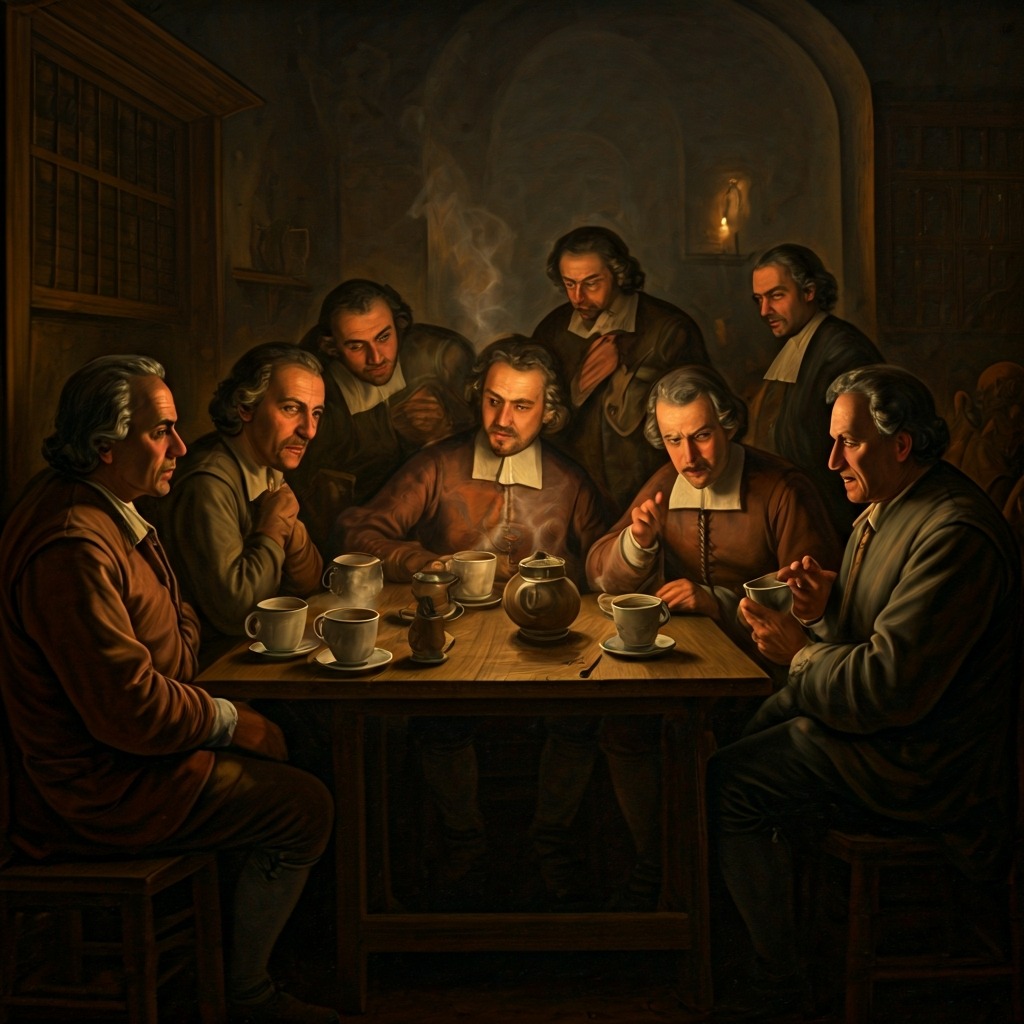
When coffee finally crashed onto the shores of Europe in the 17th century, it sparked a massive paradigm shift. Before coffee, the standard European morning drink was weak beer or wine, as the water was often unsafe to drink. Imagine trying to invent modern physics or democratic theory while nursing a low-key buzz on warm ale. Coffee replaced the alcohol with a sobering, hyper-stimulating brew that sharpened minds and accelerated the Age of Enlightenment.
From an Ethiopian survival ration to a Sufi mystical aid, to the very engine of modern civilization, the dark elixir in your mug holds a history as rich and complex as its flavor.