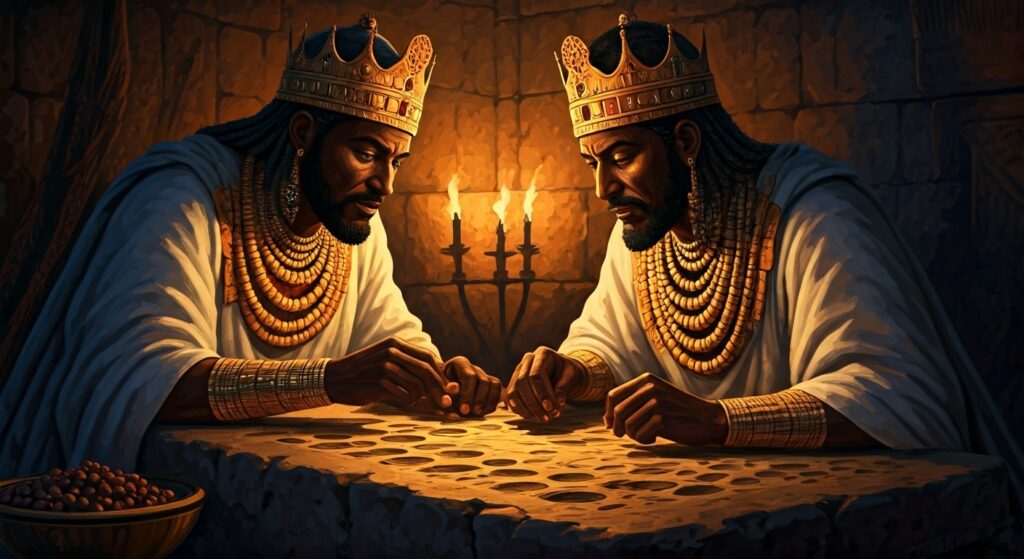
Thousands of years ago, long before the royal scandals of European courts or the invention of modern chess, ancient minds were executing mathematical strategies so complex they would make a grandmaster sweat. They didn’t use carved marble or digital screens. They used a patch of dirt and a handful of seeds.
This is the story of a game of pure, ruthless strategy—a battle of wits that conquered the globe without shedding a single drop of blood.
The 8,000-Year-Old Crime Scene
To understand this story, we must unearth the oldest unsolved mystery in the gaming world. We aren’t talking about a single game, but a vast family of “count-and-capture” board games known collectively as Mancala. The name itself is a massive clue, deriving from the Arabic word naqala, which translates simply to “to move.”
But who moved first?
Archaeologists point to a dusty Neolithic settlement in Jordan called Ain Ghazal. Beneath the earth, dating back to 6000 BCE, researchers discovered limestone slabs dotted with precise rows of depressions. Were these the world’s first gaming consoles? The historical community is fiercely divided. Some scholars look at these slabs and see ancient accounting ledgers. Others believe they were mystical tools used for divination, a way to read the will of the gods. But a rebellious faction of historians looks at those pits and sees a game—the genesis of a strategic obsession.
The Kings Who Played for Keeps
While the limestone slabs of Jordan remain shrouded in debate, the first undeniable proof of Mancala as a high-stakes battle of wits comes from the Horn of Africa.
Between 500 and 700 CE, the Aksumite Empire—a powerhouse of trade and military might in present-day Eritrea and Ethiopia—was thriving. In the ancient archaeological sites of Matara and Yeha, researchers finally found definitive, undeniable Mancala boards.
This wasn’t a casual pastime to kill a Tuesday afternoon. In many African cultures, Mancala was a game of absolute prestige, reserved for chiefs and kings. Imagine the ultimate historical power move: instead of sending thousands of warriors to die over a land dispute, two rival kings would sit across from each other, a wooden board between them, and battle it out using pure intellect. No dice. No luck. Just ruthless mathematical reasoning. Beyond royal disputes, the game was the ultimate educational tool, used to teach children arithmetic, memory skills, and strategic foresight. You didn’t just play Mancala; you survived it.
Surviving the Crossing
Because the game required nothing more than a few seeds and a patch of dirt to carve pits into, it became the ultimate viral sensation of the ancient world. Arab traders carried the game along the treacherous Silk Road and Indian Ocean trade routes, introducing it to India, China, and Southeast Asia, where it evolved into beautiful, localized variations.
But the most profound chapter of Mancala’s history is also its darkest.
During the horrors of the transatlantic slave trade, millions of West Africans were violently ripped from their homes and forced into the Americas and the Caribbean. They were stripped of their belongings, their freedom, and their names. But they could not be stripped of their minds.
Enslaved people brought West African variations of the game, such as Oware and Wari, across the ocean. In the dirt of plantations, they carved out the familiar rows of pits. With whatever beans or stones they could find, they played. In a world designed to break them, playing Mancala was a quiet, brilliant act of rebellion. It was a way to preserve their cultural heritage, their community, and their humanity, ensuring the game survived across oceans and generations.
The Illusion of Invention
Today, there are hundreds of variations of this ancient tradition played worldwide, from Bao in East Africa to Omweso in Uganda.
Yet, if you grew up in the West, the version you likely know is called Kalah. You might even assume it was a modern invention. In the 1940s, an American named William Julius Champion patented Kalah, commercializing the ancient African strategy for a new audience.
Champion may have secured the patent, but no one can truly own Mancala. It is a game that belongs to the ancient kings of Aksum, the traders of the Silk Road, and the resilient souls who carved it into the earth when everything else was taken from them. It remains a profound testament to human ingenuity—a reminder that sometimes, the greatest empires aren’t built with swords, but with a handful of seeds and the patience to wait for the perfect move.