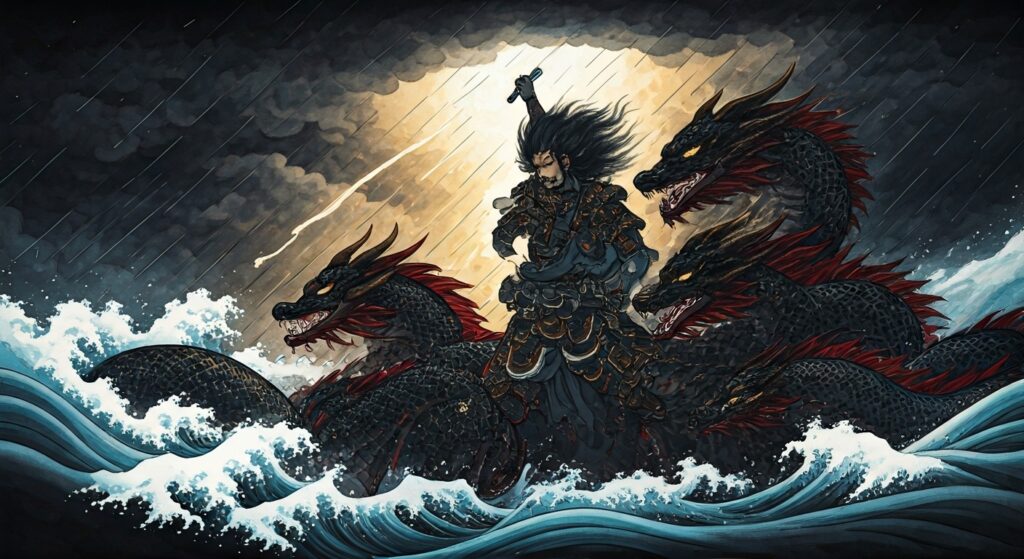
Imagine holding the most culturally significant artifact in your nation’s history—and being told that looking at it will cost you your life.\n\nDuring the 2019 enthronement of Emperor Naruhito, the world watched as a shrouded, rectangular box was presented with absolute reverence. Inside lay the Kusanagi-no-Tsurugi, Japan’s legendary “Grass-Cutting Sword.” Yet, nobody saw the blade. Not the public, not the high priests, not even the Emperor himself. As one of the Three Sacred Treasures of Japan, it represents the virtue of valor and the divine legitimacy of the Chrysanthemum Throne.\n\nBut beneath the silk wrappings lies one of history’s most guarded, mind-bending mysteries: the physical existence of the original Kusanagi is fiercely debated, and its true whereabouts remain a secret swallowed by time.\n\n## Forged in the Belly of a Beast\n\nTo understand the awe surrounding this weapon, one must look to the bloody dawn of Shinto mythology. Originally, the sword bore the terrifying name Ame-no-Murakumo-no-Tsurugi, or the “Heavenly Sword of Gathering Clouds.”\n\nAccording to ancient chronicles, the storm god Susanoo earned this weapon after a cataclysmic battle with the Yamata no Orochi—a monstrous, eight-headed serpent that devoured children. After intoxicating the beast with massive vats of sake, Susanoo hacked the serpent to pieces. Deep within one of its severed tails, his blade struck something hard. It was a divine sword, forged in the flesh of a monster. Susanoo gifted the blade to his sister, the sun goddess Amaterasu, who eventually passed it down to her earthly descendants: the Japanese imperial family.\n\n## The Inferno and the Wind\n\nThe sword earned its famous moniker, Kusanagi, during the reign of the legendary Prince Yamato Takeru.\n\nDuring a brutal military campaign, Takeru was ambushed by a treacherous warlord who set fire to the tall, dry grass surrounding his vanguard. Trapped in a roaring ring of fire, Takeru drew the divine blade. In a moment of desperate revelation, he discovered the sword could miraculously command the wind. He slashed frantically at the burning grass, summoning a gale that redirected the inferno back upon his enemies, incinerating them where they stood.\n\nFrom that day on, it was known as the Kusanagi—the Grass-Cutting Sword. It was no longer just a symbol of divine right; it was a weapon of mass destruction in ancient warfare.\n\n## Swallowed by the Sea\n\nBut myth crashed headfirst into brutal historical reality in the year 1185. The Genpei War was reaching its bloody climax at the Battle of Dan-no-ura, a massive naval clash in the Kanmon Straits. The Taira clan was facing total, devastating defeat at the hands of the rival Minamoto forces.\n\nRather than surrender and face humiliation, the grandmother of the six-year-old Emperor Antoku made a tragic, unthinkable decision. She clutched the young boy and the Imperial Regalia—the sacred mirror, the jewel, and the sword—and plunged into the churning, blood-stained ocean depths.\n\nThe victorious Minamoto forces frantically dredged the waters. They managed to recover the mirror and the jewel. But the Kusanagi? It was swallowed by the sea, seemingly lost to the abyss forever.\n\n## A Deadly Secret Kept in the Shadows\n\nIf the legendary blade is sitting at the bottom of the Kanmon Straits, what exactly was in that shrouded box during the 2019 enthronement?\n\nThis is where historians and Shinto scholars diverge into a labyrinth of theories. Some claim that the sword lost at Dan-no-ura was merely a ceremonial replica, and that the true, original Kusanagi was safely hidden at Atsuta Shrine in Nagoya the entire time. Others argue that the original was indeed lost to the waves, and a replacement was quietly forged—or chosen from a lineup of existing sacred blades—to keep the illusion of imperial continuity alive.\n\nToday, a sword representing the Kusanagi is kept under extreme, lock-and-key secrecy at Atsuta Shrine, with a purported replica housed at the Imperial Palace in Tokyo for coronation ceremonies.\n\nAnd before you think about trying to get a peek to settle the historical debate, consider the curse. According to an Edo-period account, a Shinto priest whose curiosity got the better of him secretly opened the box to gaze upon the blade. Shortly after, he died of a mysterious, agonizing illness.\n\nWhether it is the original divine weapon pulled from a serpent’s tail, a cleverly disguised replica, or a replacement steeped in centuries of desperate prayer, the Kusanagi remains a potent enigma. It is a legendary artifact that bridges Japan’s mythological past and its modern identity—commanding absolute reverence, entirely from the shadows.