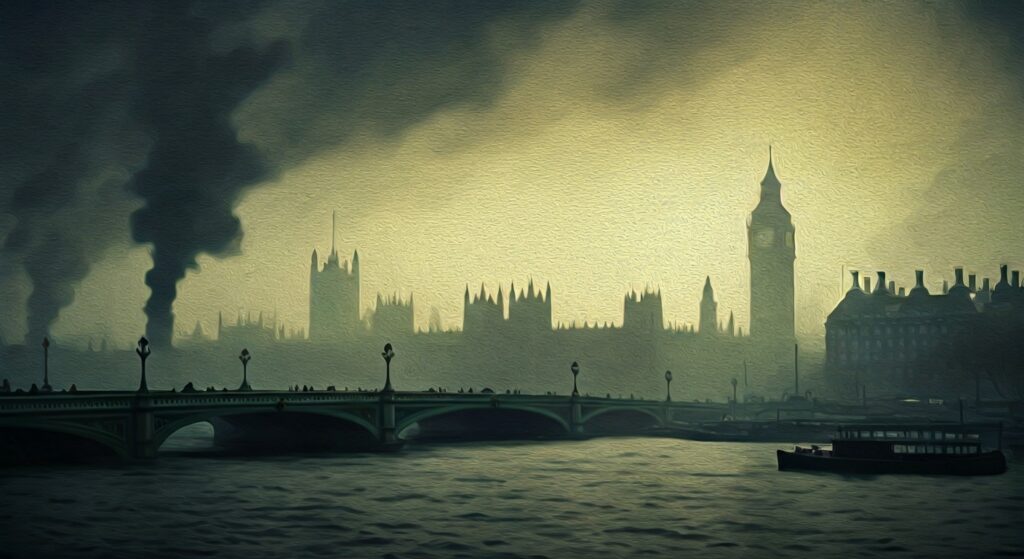
London has long been romanticized for its fog. For centuries, the swirling “pea-soupers” were a staple of Victorian lore, cloaking figures like Sherlock Holmes and Jack the Ripper in a veil of gray mystery. But what rolled into the British capital on December 5, 1952, was no romantic mist.
It was a dense, suffocating wall of yellow-black sludge.
In a matter of hours, the very air in one of the world’s greatest cities turned into a lethal weapon, plunging millions into a dystopian nightmare so bizarre it borders on science fiction.
The Perfect Meteorological Trap
To understand how a major metropolis essentially gassed itself, you have to look at a catastrophic collision of bad weather and desperate post-war economics. In 1952, Britain was still reeling from World War II debt. To keep the country afloat, the government exported its high-quality, clean-burning hard coal. What was left for the locals to heat their homes during a bitter winter cold snap was a cheap, low-grade fuel tragically known as “nutty slack.”
When burned, nutty slack belched out terrifyingly high levels of sulfur dioxide and thick, greasy smoke. Millions of Londoners, shivering in the freezing December air, shoveled this toxic garbage into their hearths, completely unaware of the invisible trap that was about to spring shut.
High above the city, a massive anticyclone had stalled, creating a deadly atmospheric phenomenon known as a temperature inversion. Normally, warm air rises, carrying smoke and pollutants up and away. But this anticyclone trapped a layer of freezing, stagnant air right at ground level, capping it with an impenetrable lid of warmer air above.
When the smoke from millions of chimneys, industrial smokestacks, and vehicle exhausts hit that freezing ceiling, it had nowhere to go. The sulfur dioxide reacted with the moisture in the air, brewing a toxic storm of sulfuric acid. The city was suddenly marinating in its own industrial waste.
Blinded in a Dystopian Nightmare
The physical experience of the Great Smog was pure, unadulterated horror. This wasn’t just a hazy afternoon where the skyline looked a bit fuzzy. Visibility plummeted to mere inches.
Imagine walking out your front door and being unable to see your own shoes.
The bustling city ground to a complete and eerie halt. Buses were abandoned in the middle of the street. Trains stopped running. Ambulances couldn’t navigate the roads, forcing desperate people to carry their sick and dying loved ones through the suffocating gloom on foot. The only thing that kept moving was the London Underground, operating deep beneath the toxic surface.
The smog was so insidious it refused to respect closed doors. It seeped into homes, leaving a greasy, black residue on furniture, skin, and clothes. In a scene straight out of an apocalyptic thriller, concerts and cinema screenings were abruptly canceled—not for lack of power, but because the audience literally could not see the screens through the indoor smog.
Drowning on Dry Land
While the visual of a blinded city is terrifying, the human toll was catastrophic. Breathing in the sulfurous, acidic air caused immediate and severe respiratory tract infections, hypoxia, and purulent bronchitis. People were essentially drowning on dry land.
At first, the British government tried to play it cool. Prime Minister Winston Churchill and Minister of Housing Harold Macmillan initially downplayed the severity, blaming the sudden spike in deaths on a natural influenza epidemic. But the sheer scale of the tragedy quickly became impossible to hide.
The death rate skyrocketed so fast that the city’s infrastructure broke down. Undertakers famously ran out of coffins. Florists ran out of flowers for funerals.
Initially, the government estimated that 4,000 people died as a direct result of those five days in December. However, modern epidemiological studies have since uncovered the true horror of the event. It is now estimated that between 10,000 and 12,000 people perished, with an additional 100,000 suffering severe, long-term respiratory illnesses.
The Legislative Reckoning
It took an unprecedented body count, but the Great Smog finally shattered the illusion that air pollution was just an inevitable, harmless byproduct of industry. The tragedy forced a massive paradigm shift in how the world viewed public health and the environment.
Mounting public outrage forced the government’s hand, culminating in the passing of the Clean Air Act of 1956. This landmark piece of legislation revolutionized urban living. It established “smoke control areas” where only smokeless fuels could be burned, offered subsidies to help homeowners transition away from open coal fires, and forced power stations to relocate away from city centers.
It was a grim, brutal lesson, but the Great Smog served as a vital catalyst for the modern environmental movement. It proved, with devastating clarity, that the things we pump into the sky don’t just disappear—they can come back down, and they can kill.