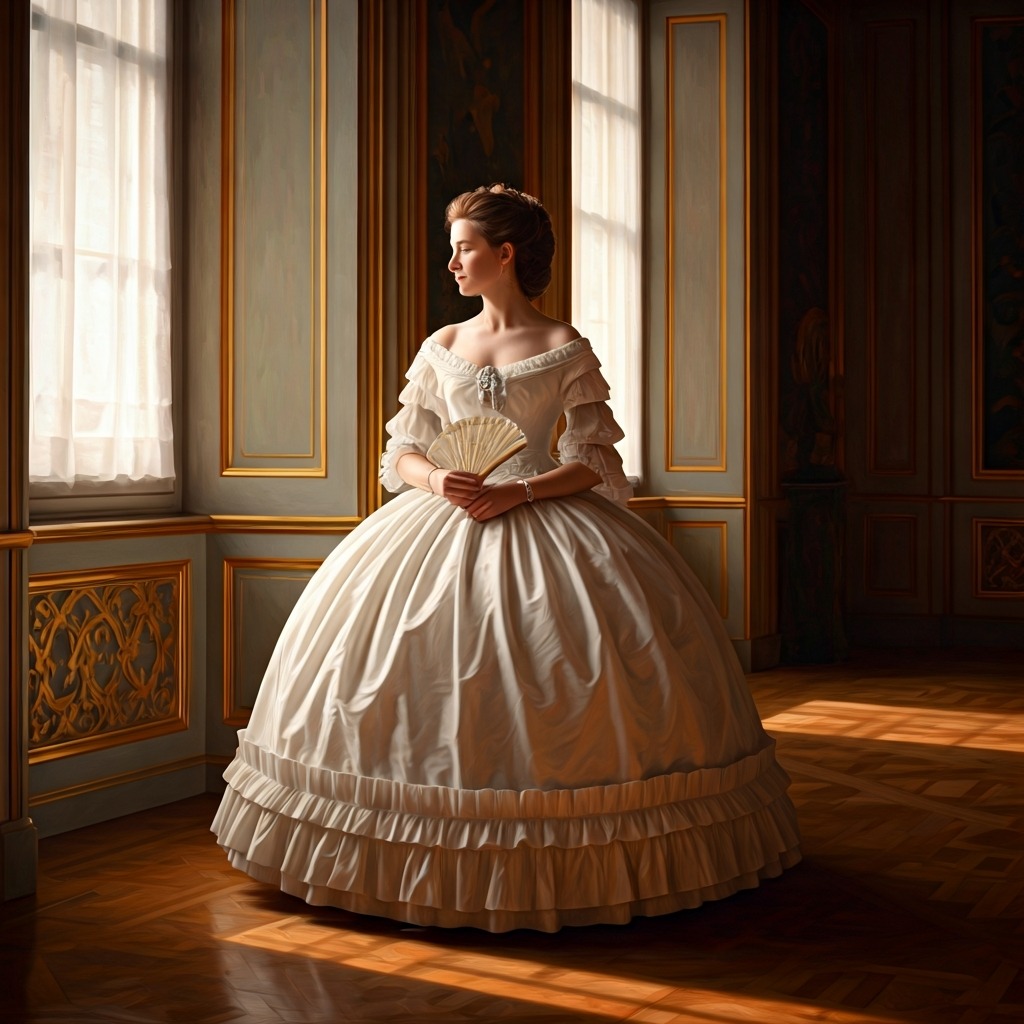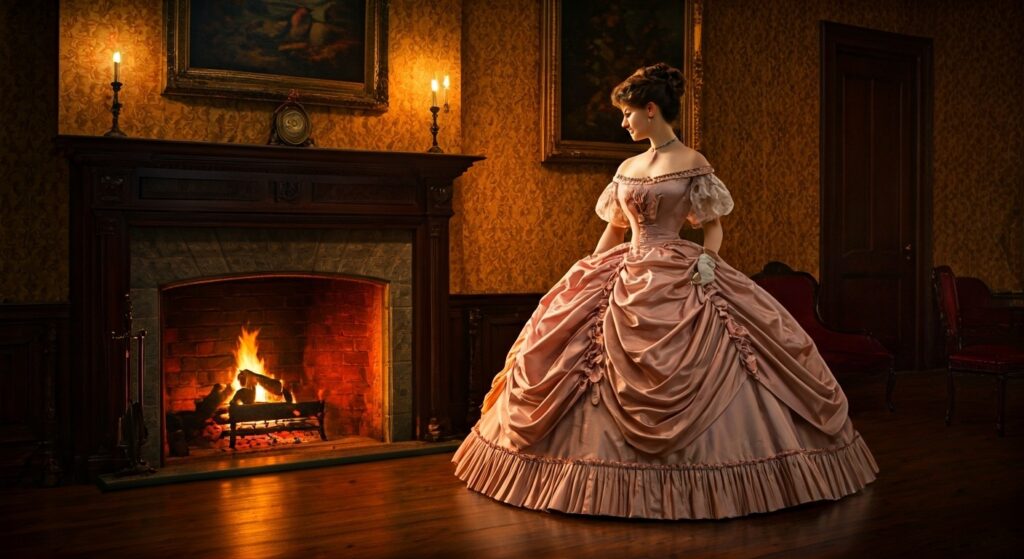
The mid-19th-century parlor was a masterpiece of cozy domesticity. The air hung heavy with the scent of beeswax and coal smoke. Gas lamps hissed softly against damask-papered walls, and a crackling hearth promised warmth against the evening chill. But beneath this veneer of elegant tranquility lurked a silent, merciless killer. For the women of the Victorian era, simply walking across their own drawing room carried a mortal risk. The culprit wasn’t poison or disease—it was their own clothing.
Welcome back to Riveting History Daily. Today, we are stepping into the era of the cage crinoline: a time when high fashion was quite literally a matter of life and death.
A Liberating Cage with a Lethal Flaw
To the modern eye, the cage crinoline, patented in 1856, looks like a medieval instrument of torture. Constructed of spring steel hoops suspended on fabric tapes, it formed a massive, rigid bell shape around a woman’s lower half.
Yet, sociologically, it was a paradox. For Victorian women, the crinoline wasn’t a prison; it was profound liberation. Before its invention, achieving the highly coveted bell-shaped silhouette required strapping on multiple heavy, suffocating cloth petticoats. The steel cage freed women from this exhausting, crushing weight, offering unprecedented freedom of leg movement. It required sheer athleticism to navigate the world inside skirts that could reach up to six feet in diameter—a staggering 18 feet in circumference.
But this newfound freedom came with a fatal, unforeseen flaw.
The Chimney Effect
The sheer, magnificent size of the crinoline stripped women of their spatial awareness. Because the steel hoops held the fabric so far away from their legs, they suffered a complete loss of proprioception. A woman simply could not feel when the hem of her dress brushed against a piece of furniture—or, more dangerously, the glowing grate of an open fireplace.
In a world illuminated by candles, newly introduced gas lamps, and heated by open flames, this was a recipe for absolute disaster. To make matters worse, the fashionable fabrics draped over these cages—muslin, tulle, tarlatan, and silk—were gossamer-thin and highly combustible.
When a stray ember caught a hem, the rigid structure of the crinoline acted exactly like a chimney. The hoops held the burning fabric away from the body just enough to allow a massive updraft of oxygen to feed the flames. Within seconds, a woman could be entirely engulfed in an inescapable inferno.
The death toll was staggering. While exact global numbers remain difficult to pin down, the British medical journal The Lancet estimated that in the span of just a decade, up to 3,000 women died in crinoline fires in the UK alone.
A Stolen Smoke and a Royal Tragedy
High-profile tragedies soon thrust the deadly nature of the crinoline into the public eye. In 1861, Fanny Longfellow, wife of the beloved American poet Henry Wadsworth Longfellow, died in agony after her dress caught fire in her home. Though she was wearing voluminous layers of flammable tulle rather than a steel cage, her horrific death became inextricably linked in the public consciousness with the era’s perilous fashions.
But perhaps the most bizarre and chilling case was that of the 18-year-old Archduchess Mathilde of Austria in 1867.
Mathilde was standing in the opulent halls of the Habsburg palace, secretly smoking a cigarette—a highly scandalous act for a young royal. Suddenly, she heard the heavy, echoing footsteps of her strict father approaching. Panicking, she thrust the lit cigarette behind her back to hide the evidence.
The cherry of the cigarette pressed directly into her expansive, glycerin-treated dress. In an instant, the fabric ignited. The chimney effect took over, and the young Archduchess suffered horrific, agonizing burns. She died shortly after, a victim of both strict royal etiquette and a lethal silhouette.
Mockery in the Face of the Macabre
You might expect society to rally together to ban such a dangerous garment. Instead, the cultural reaction was a bizarre, callous mix of horror and mockery.
Satirical publications like Punch magazine routinely published cartoons depicting women as oblivious, destructive hazards, knocking over tea tables or sweeping themselves into fireplaces. The media framed the epidemic of burnings not as a systemic failure of domestic safety, but as the inevitable, foolish consequence of female vanity.
Scientists did try to intervene. Prominent chemists, including William Crookes, worked desperately to develop flame-retardant chemical treatments, such as sodium tungstate, which could be washed into the delicate fabrics to prevent them from igniting.
However, Victorian sensibilities ultimately won out over survival. The public largely rejected the chemical treatments. They were expensive, washed out easily, and—worst of all to the fashion-conscious—they yellowed pristine white fabrics and made them stiff. Women preferred to risk the flames rather than ruin the elegant drape of their skirts.
By the 1870s, the crinoline finally began to fade into history, making way for the bustle. While the shift was heavily driven by the sheer, exhausting impracticality of trying to fit an 18-foot skirt through a standard doorway or carriage door, the haunting stories of women accidentally turning themselves into human torches undoubtedly helped extinguish the trend for good.