Forget Alexander the Great. Forget Napoleon. If you were drafting a team of historical commanders for a high-stakes, black-ops mission, your first overall pick should be Oishi Kuranosuke. Long before the era of encrypted messaging and satellite surveillance, Oishi managed an underground network of forty-six undercover operatives in 18th-century Japan with zero digital footprint and absolute, terrifying precision.
This is the story of the Akō incident, better known as the Forty-Seven Ronin. It is a saga of psychological warfare, mind-blowing logistics, and a revenge plot so perfectly executed it makes modern espionage look like amateur hour.
Blood Spilled in the Palace of Peace
To understand the vengeance, you must first understand the crime. In the spring of 1701, Japan was basking in a prolonged era of peace. The samurai class was slowly transitioning from battle-hardened warriors into government bureaucrats.
Asano Naganori, the young daimyo of the Akō Domain, was summoned to Edo (modern-day Tokyo) to host imperial envoys. To ensure he didn’t embarrass the Shogunate, he was assigned a tutor in court etiquette: a powerful, arrogant official named Kira Yoshinaka.
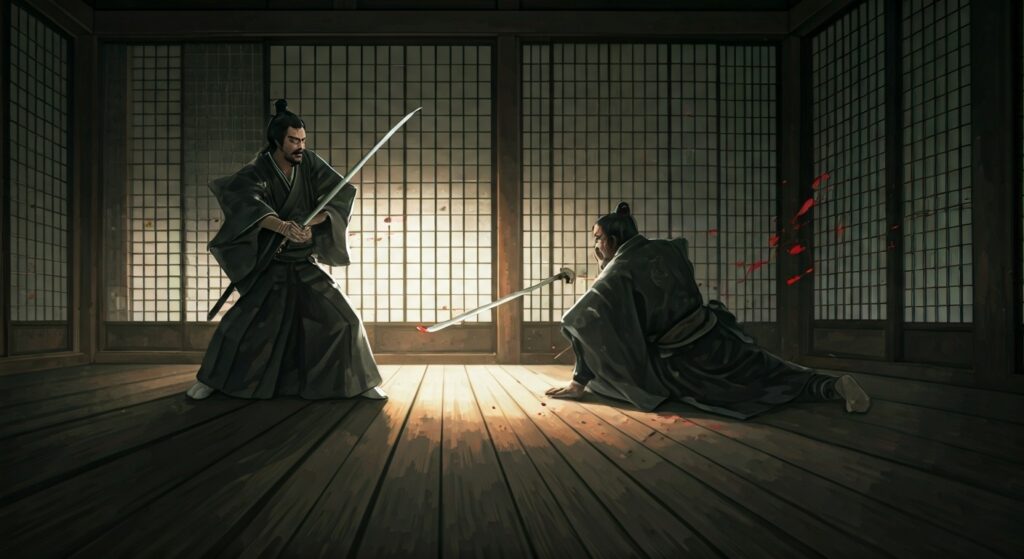
Historical accounts suggest Kira relentlessly bullied and provoked the younger lord, allegedly because Asano refused to pay him a hefty enough bribe. On April 21, 1701, Asano finally snapped. Inside the strictly weapon-free corridors of Edo Castle, Asano drew his short sword and slashed at his tormentor.
He only managed to wound the older official, but the physical damage was irrelevant; the political damage was absolute. Drawing a blade inside the shogun’s palace was an unforgivable offense. The Shogun ordered Asano to commit seppuku (ritual suicide) that very day. With the stroke of a blade, Asano’s lands were confiscated, his family was ruined, and his loyal samurai were stripped of their status, becoming ronin—leaderless drifters.
The Weaponization of Humiliation
Among the newly displaced men was Oishi Kuranosuke, Asano’s principal counselor. Oishi knew that Kira, expecting immediate retaliation, had surrounded himself with heavily armed guards. A frontal assault would be a massacre with zero return on investment.
So, Oishi forged a secret blood oath with forty-six of his most loyal men and initiated a masterclass in strategic patience. He ordered his men to scatter to the winds. For nearly two years, these elite warriors vanished into the populace, taking on menial jobs as street vendors, merchants, and monks. A few even married into the families of the craftsmen building Kira’s new estate just to get their hands on the architectural blueprints. It was a triumph of espionage and logistics—the 1701 equivalent of hacking the mainframe.
But Oishi’s personal cover story is the stuff of legend. To convince Kira’s network of spies that he was a broken, defeated man, Oishi moved to Kyoto, abandoned his wife, and became a fixture at local brothels and taverns. He played the part of a drunken, dishonorable fool flawlessly.
In one famous encounter, a samurai from Satsuma found Oishi passed out drunk in the street. Disgusted that Oishi had abandoned his duty to avenge his master, the samurai kicked the fallen counselor and spat in his face. Oishi took the boot in total silence. He didn’t just endure the humiliation—he weaponized it.
It worked. Convinced that the ronin were cowards, Kira finally relaxed his guard.
Midnight in the Falling Snow
On the snowy night of December 14, 1702, the ghost network activated.
The forty-seven ronin converged on Edo, donning matching uniforms and arming themselves to the teeth. Using the blueprints they had spent nearly two years acquiring, they launched a highly coordinated, two-pronged assault on Kira’s mansion.
Communicating their movements through the rhythmic beating of a drum, the ronin moved with surgical precision. They neutralized Kira’s samurai without harming a single non-combatant. After a frantic search of the sprawling estate, they finally found a trembling Kira hiding in a charcoal shed.
True to the samurai code, Oishi didn’t just slaughter him in the dark. He respectfully offered Kira the very same dagger Asano had used to end his own life, giving his enemy the chance to die with honor. When Kira refused, frozen in terror, Oishi pinned him down and took his head.
A Loophole in the Law of Honor
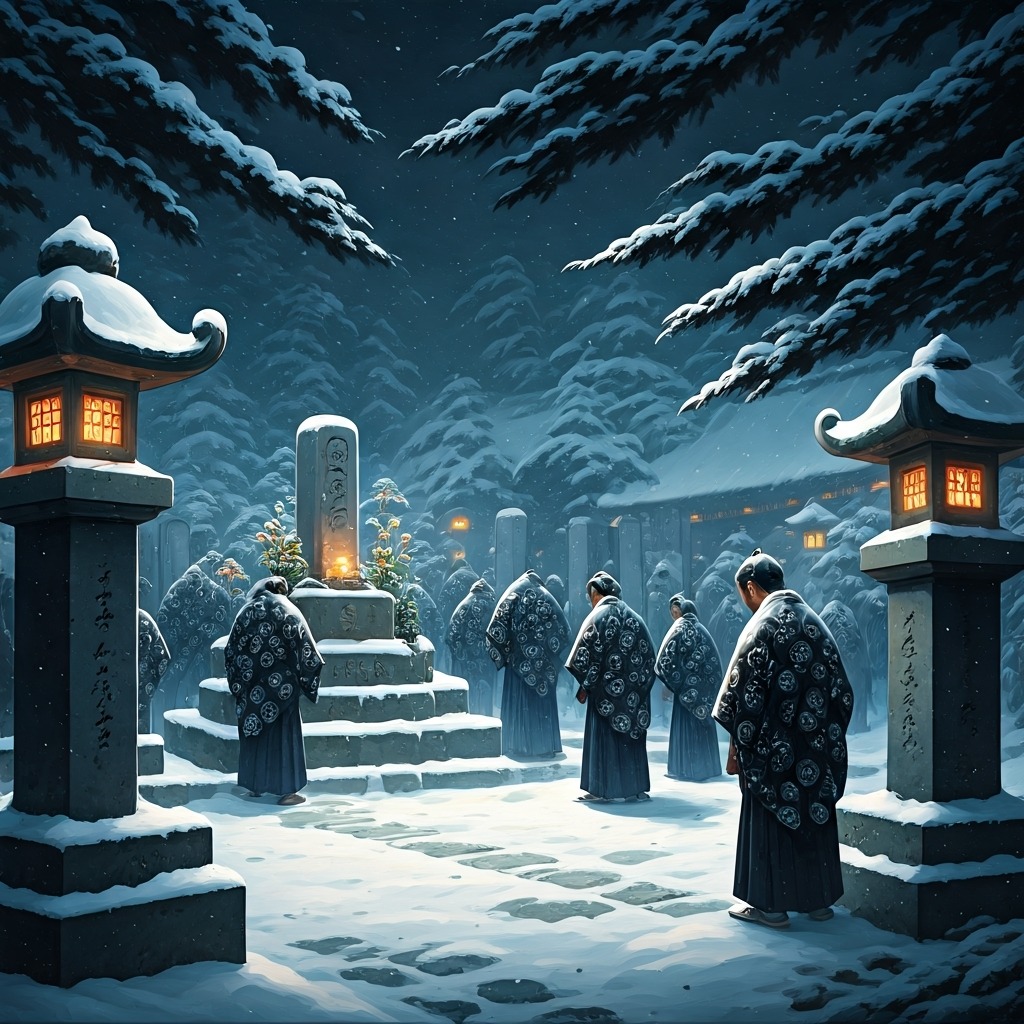
The raid was over, but the story wasn’t. The forty-seven men marched across Edo to Sengakuji Temple, where their master was buried. They washed Kira’s head in a nearby well, laid it at Asano’s grave, and then peacefully turned themselves in to the authorities.
The Shogunate was suddenly staring down a massive legal and moral headache. By exacting unsanctioned revenge, the ronin had blatantly broken the law. But by demonstrating absolute loyalty and filial piety, they had perfectly executed the highest ideals of bushido.
After months of intense debate, the Shogun found a loophole of respect. Rather than executing them as common criminals, he granted the men the right to die with dignity. On March 20, 1703, forty-six of the ronin honorably ended their lives by seppuku. The forty-seventh, Terasaka Kichiemon, was pardoned—likely sent away as a messenger to ensure the tale survived.
The men were buried shoulder-to-shoulder with their master at Sengakuji, where their graves remain a site of pilgrimage today.
Not everyone agreed with Oishi’s methods. Yamamoto Tsunetomo, the author of the famous samurai text Hagakure, later criticized Oishi for waiting so long. He argued that a true samurai should have attacked immediately; if Kira had died of natural causes during those two years, the ronin would have failed their master entirely.
But history favors the victor. Oishi’s calculated, agonizing patience is exactly what elevates this from a simple historical footnote into a national legend. It wasn’t just a crime of passion—it was a masterpiece of devotion.