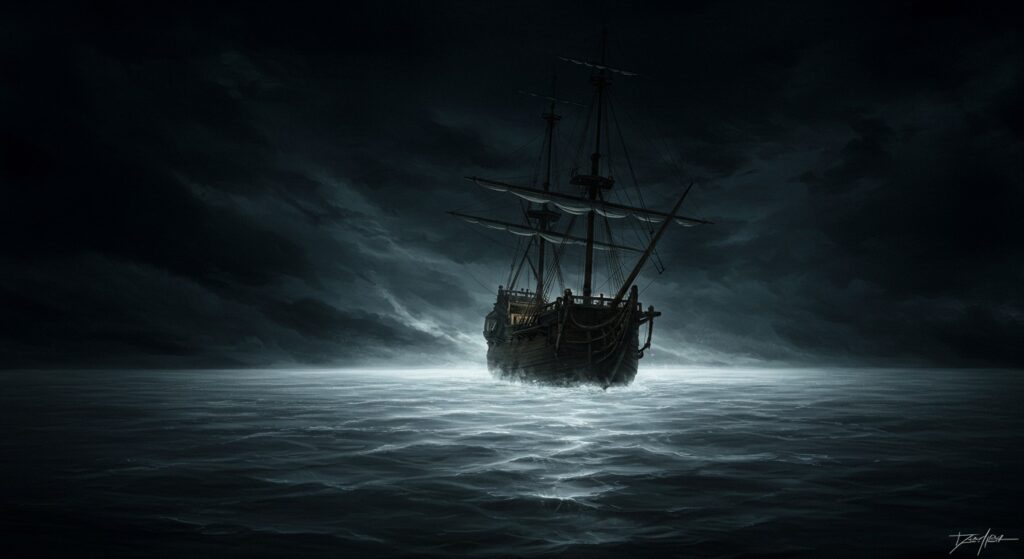
Imagine standing watch on a wooden galleon centuries ago. You have no GPS, no radio, and no rescue coming if things go wrong. There is only the wind, the stars, and the crushing, terrifying abyss of the night. Suddenly, the pitch-black water beneath your hull begins to change. It doesn’t just shimmer; it ignites. A steady, ethereal, milky-white luminescence swallows the horizon. You haven’t found land. You’ve sailed into a ghost story.
The Myth of the Mareel
For centuries, the scientific establishment laughed these accounts out of the room. Mariners returning to port whispered of “mareel”—milky seas that turned the ocean into a liquid phantom under moonless skies. These reports were logged, shared over ale in smoky taverns, and promptly dismissed by scholars as the fever dreams of exhausted, rum-soaked sailors.
Even Jules Verne treated it as the stuff of fantasy, sending Captain Nemo’s Nautilus through a glowing white ocean in his 1870 masterpiece 20,000 Leagues Under the Sea. For over a hundred years, the milky sea was nothing more than a brilliant maritime myth. Until it wasn’t.
A Bizarre Survival Strategy
The sailors weren’t hallucinating; they were sailing over the largest biological light show on Earth. Unlike the fleeting, blue-green sparks of common bioluminescence you might see when a paddle disturbs coastal waters, milky seas are a continuous, blinding glow that stretches for hundreds of miles.
The culprit? A microscopic bacterium called Vibrio harveyi. Through a fascinating phenomenon known as “quorum sensing,” these bacteria wait until their population reaches a critical mass in the water. Then, as if throwing a master switch, they communicate chemically and ignite in unison. Their motive is as dark as the abyss: they want to be eaten. By glowing, they attract fish, ensuring they are swallowed into a nutrient-rich gut where they can thrive. It is a brilliant, bizarre survival strategy executed on a staggering scale.
The Smoking Gun from Space
Proving the existence of milky seas was nearly impossible. They occur in the most remote, desolate stretches of the Indian Ocean and Indonesian waters, far from regular shipping lanes. You couldn’t just send a research vessel to find one; it was a matter of pure, blind luck.
But in 2005, scientist Dr. Steven Miller decided to look down from the heavens. Scouring archived data from a U.S. Defense Meteorological Satellite, he spotted a massive, unexplained glow in the Indian Ocean dating back to 1995. It was huge, persistent, and defied all known weather patterns.
Miller played detective, cross-referencing the satellite anomaly with historical maritime logs. He struck gold. On that exact night in 1995, the British merchant vessel SS Lima reported sailing through an eerie, glowing white sea for six terrifying hours. The ship’s log described the water as a “field of snow.” The myth was finally a documented reality. For the first time in history, a sailor’s wild tale was corroborated by the unblinking eye of a satellite.
The Glowing Leviathan
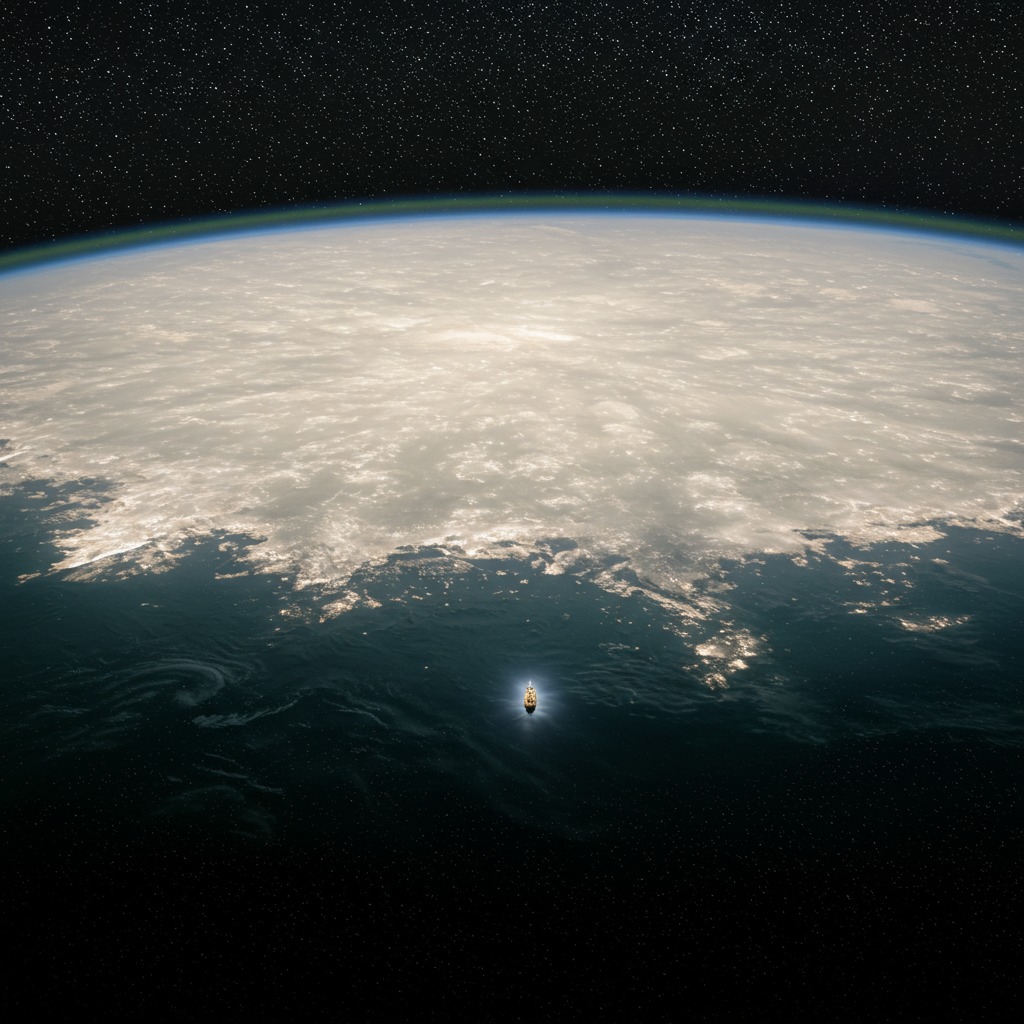
The SS Lima was just the beginning. Armed with highly sensitive Day/Night Band sensors on modern satellites, scientists are now hunting these phantom oceans in real-time.
In 2019, they tracked a monstrous milky sea south of Java, Indonesia. It spanned over 100,000 square kilometers—roughly the size of Kentucky—and glowed continuously for over a month. It stands as the largest known form of bioluminescence on the planet.
The old sailors hadn’t exaggerated the majesty of the milky seas; if anything, their terrified accounts barely scratched the surface. The ocean remains a realm of staggering mystery, proving that sometimes, the wildest ghost stories are entirely real—and you just have to sail right through them.
Dig Deeper
- Read the original 2005 scientific paper that first matched the log of the SS Lima with satellite imagery, providing the first concrete proof of the milky seas phenomenon. Proceedings of the National Academy of Sciences
- Explore a 2021 study that analyzed the massive 2019 milky sea event near Java, detailing how modern, highly sensitive satellites are used to track these occurrences in real-time. Nature Scientific Reports
- Learn about bioluminescence in general from the National Oceanic and Atmospheric Administration (NOAA), which explains the different types of light-producing organisms in the ocean. NOAA Ocean Exploration
- For a comprehensive overview of the history, science, and documented sightings of milky seas, consult the detailed entry on Wikipedia. Wikipedia: Milky seas effect