It sat in the classified shadows of the Los Alamos Laboratory in the late summer of 1945—a 14-pound, baseball-sized sphere of plutonium and gallium. To the naked eye, it was merely a heavy, warm orb of metal. But inside, it was a sleeping dragon, waiting for a reason to wake.
Originally designated by the unassuming nickname “Rufus,” this metallic sphere was forged to be the fissile heart of a third atomic bomb destined for Japan. When the war abruptly ended, Rufus was suddenly out of a job. Instead of being dropped from the bomb bay of a B-29, the core was kept at Los Alamos for hands-on research.
The physicists of the era were brilliant, but they operated with a terrifying hubris. They wanted to know exactly how far they could push the core before it achieved criticality—the exact threshold where a nuclear chain reaction becomes self-sustaining. To find out, they had to walk right up to the edge of a nuclear explosion, peek over the precipice, and step back.
A Midnight Miscalculation
The first tragedy struck on August 21, 1945. Harry Daghlian, a brilliant 24-year-old physicist, was working late into the night. In a blatant violation of laboratory safety protocols, he was experimenting entirely alone, save for a security guard seated at a nearby desk.
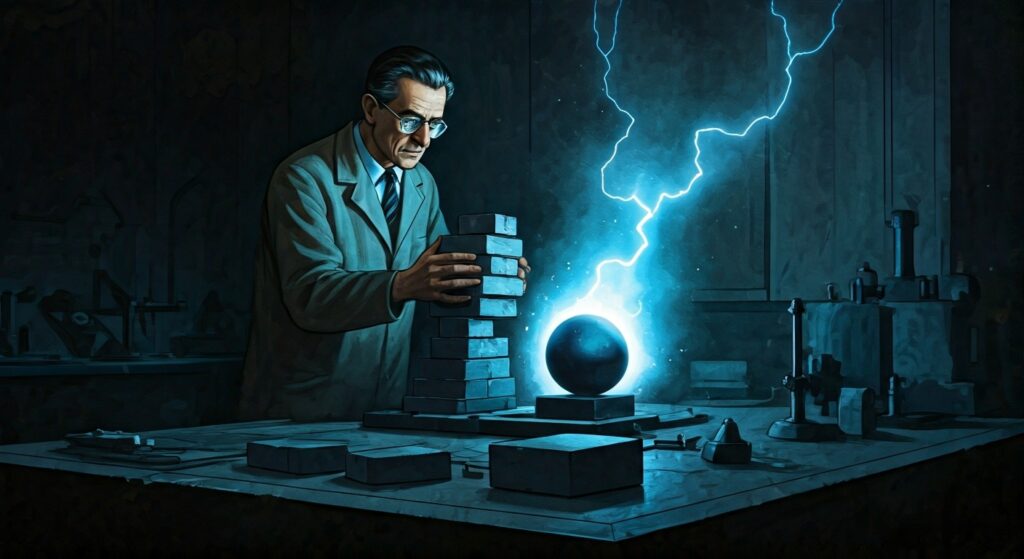
Daghlian was building a neutron reflector. By carefully stacking heavy tungsten carbide bricks around the plutonium sphere, he was bouncing escaping neutrons back into the core, inching it closer and closer to criticality. The experiment required the steady hands of a surgeon.
As Daghlian moved to place the final brick over the assembly, his neutron counters began to scream. The instruments warned him that if he placed the brick, the core would go supercritical. Realizing his fatal error, he attempted to pull his hand back.
He flinched.
The heavy brick slipped from his grasp and dropped directly onto the center of the core.
In a fraction of a second, the core went supercritical. A blinding, brilliant flash of blue light illuminated the darkened laboratory—a terrifying phenomenon known as Cherenkov radiation, caused by high-energy particles tearing through and ionizing the surrounding air. A wave of blistering heat washed over Daghlian’s body.
Panicking, he frantically disassembled the brick structure, successfully halting the reaction. But the invisible damage was already done. In that fleeting moment, Daghlian had absorbed a lethal dose of neutron radiation. He died an agonizing 25 days later.
Tickling the Dragon’s Tail
One might assume a gruesome, highly preventable death would prompt the world’s smartest scientists to implement unbreakable safety protocols. But this was the 1940s, an era where brilliant minds relied on intuition, bravado, and a dangerous amount of cowboy swagger.
The experiments continued, now led by chief physicist Louis Slotin. Slotin was a notoriously daring scientist who specialized in an experiment so inherently perilous that his colleagues referred to it as “tickling the dragon’s tail.”
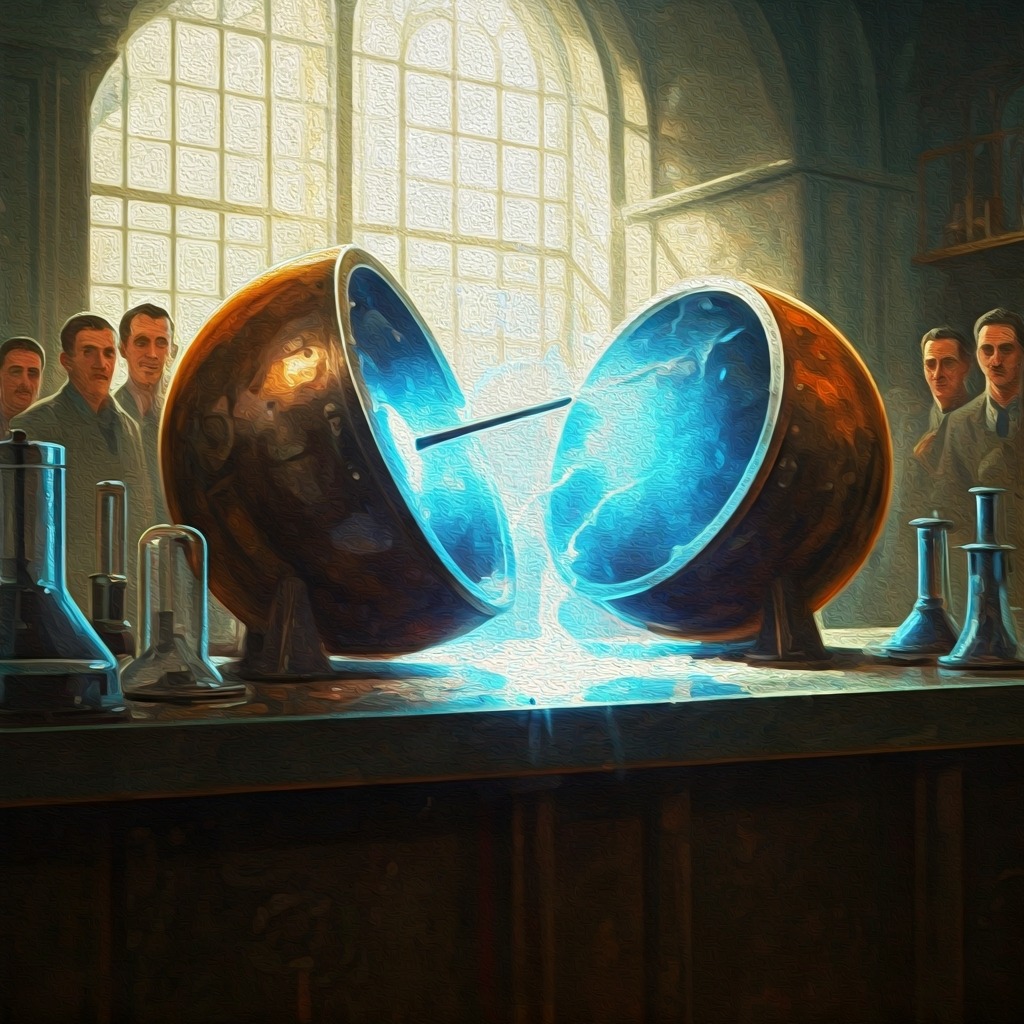
Instead of tungsten bricks, Slotin used two half-spheres of beryllium to reflect neutrons back into the core. If the top hemisphere ever closed completely over the bottom one, the neutrons would be trapped, and the core would instantly go prompt critical. Standard safety protocols dictated the use of metal shims to ensure the domes could never fully touch.
Slotin refused to use them.
Instead, he relied entirely on the blade of a standard flathead screwdriver, held in his bare hand, to maintain a tiny, millimeter-wide gap between the two domes. It was a terrifying balancing act. Prominent physicists were horrified. Enrico Fermi famously warned Slotin that if he kept using this reckless method, he would be “dead within a year.”
Slotin ignored the warnings.
The Screwdriver Slips
On May 21, 1946—just nine months after Daghlian’s fatal accident—Slotin was demonstrating his screwdriver technique to seven colleagues in a sunlit Los Alamos lab.
He manipulated the upper beryllium dome, the core resting silently inside. The room was dead quiet, save for the rhythmic, haunting clicks of the neutron counters.
Then, the unthinkable happened.
The flathead screwdriver slipped.
The beryllium dome dropped completely shut, sealing the core. Instantly, the plutonium went prompt critical. The room was bathed in that same dreadful, hard blue flash of Cherenkov radiation. Slotin felt a sudden, intense wave of heat on his skin and instantly tasted a sour, metallic flavor in his mouth—the immediate, undeniable signatures of extreme radiation exposure.
In a fraction of a second, Slotin reacted heroically. He thrust his hand forward, flipping the upper beryllium dome off the core and instantly stopping the chain reaction. His lightning-fast reflex undoubtedly saved the lives of the seven other men in the room.
But because he was leaning directly over the assembly, Slotin’s body absorbed the brunt of the invisible blast. He was hit with a staggering 21 Sieverts of radiation. He died nine days later in unimaginable pain.
The End of the Cowboy Era
The core had claimed its second victim, officially earning its chilling moniker: The Demon Core.
Slotin’s death finally shattered the reckless cowboy culture of early atomic research. Los Alamos immediately halted all hands-on criticality experiments. The era of steady hands and screwdrivers was over. Future tests were conducted using remote-controlled machines, operated by personnel situated safely a quarter-mile away behind thick concrete walls.
As for the Demon Core itself? It never claimed another life. After a mandatory period of radioactive cooling, the cursed sphere was melted down and recast into a different weapon core. It met its ultimate end in the summer of 1946, detonated during the Operation Crossroads nuclear tests at Bikini Atoll.
It remains a stark, haunting reminder that in the history of science, the universe doesn’t care how smart you are. Physics doesn’t grade on a curve, and it certainly doesn’t forgive a slipped screwdriver.