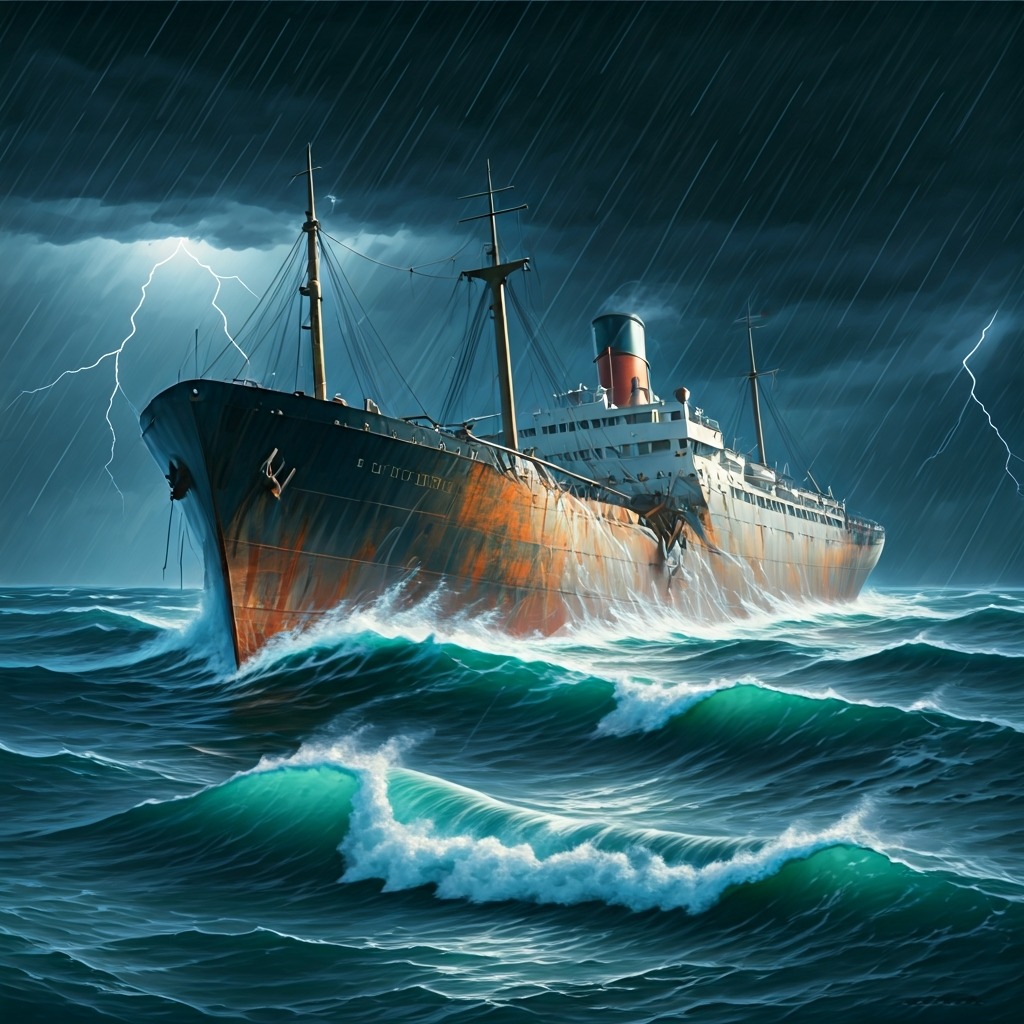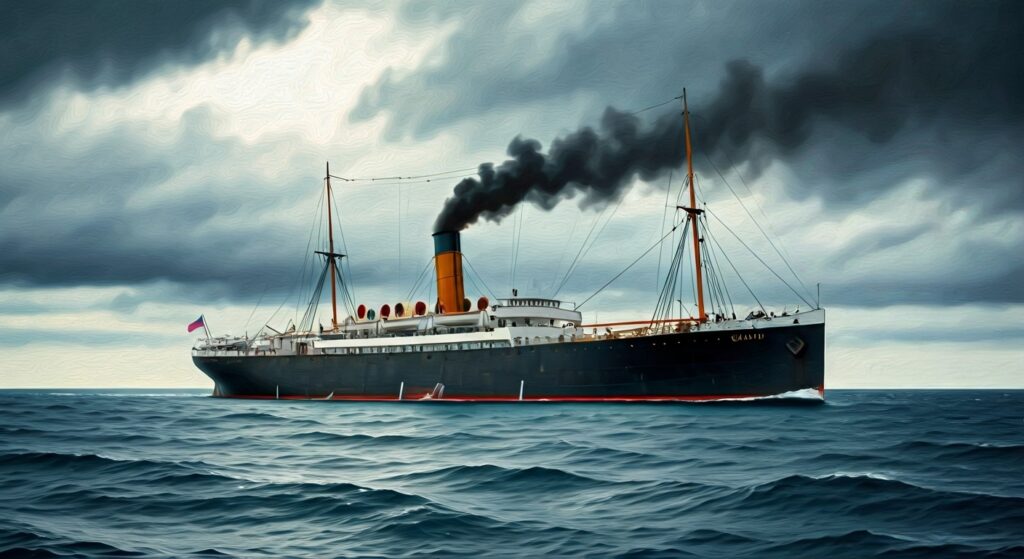
The ocean keeps its secrets. But few secrets are as massive, or as chilling, as the fate of the USS Cyclops.
In March 1918, a 542-foot naval behemoth sailed into the Atlantic Ocean and simply ceased to exist. No distress call was sent. No wreckage was ever found. To this day, the vanishing of the Cyclops and its 306 crew members remains the single largest non-combat loss of life in the history of the United States Navy.
A Behemoth Built for Coal
Launched in 1910, the USS Cyclops was a floating beast. As a Proteus-class collier, her primary job was to act as a mobile gas station for the Navy, hauling massive loads of coal across the ocean to refuel warships.
But in early 1918, with World War I raging, the Cyclops received a different, far more dangerous assignment. She was dispatched to Rio de Janeiro, Brazil, to pick up 10,800 tons of manganese ore—a hyper-dense mineral desperately needed to produce steel for the Allied war effort.
The ship was engineered to carry coal, a relatively light material that fills a cargo hold and distributes its weight evenly against the hull. Manganese ore is a completely different beast. Immensely heavy and compact, the crushing weight of the ore was concentrated directly at the bottom of the ship’s belly.
The Mad Captain in the Bowler Hat
Adding a layer of deep psychological intrigue to this powder keg of a voyage was the man at the helm: Commander George W. Worley.
Born Johan Frederick Wichmann in Germany, Worley was an eccentric and harsh disciplinarian, deeply unpopular with his crew. He was known to patrol the decks of the Cyclops dressed in nothing but his long underwear and a bowler hat, screaming at subordinates for minor infractions.
Because of his German heritage and the ongoing war, whispers followed Worley wherever he went. Was he a German sympathizer? Was he pushing his crew to the brink of mutiny? When the ship later vanished, rumors immediately swirled that Worley had intentionally surrendered his vessel to the enemy—or that his tyrannical behavior had sparked a violent, fatal uprising.
The Dead Engine and the Heavy Load
The Cyclops departed Rio on February 16, 1918. By the time the ship made an unscheduled stop in Barbados on March 3 to replenish its coal supplies, disaster was already looming.
Reports from the island painted a grim picture. The Cyclops was sitting dangerously low in the water, overloaded well beyond its plimsoll line. Worse, she was limping. The ship was operating on only one functioning engine due to a cracked cylinder.
Despite the improper cargo, the dead engine, and the groaning hull, Commander Worley ordered the ship back out to sea on March 4. They were scheduled to arrive in Baltimore on March 13.
Swallowed by the Abyss
They never made it.
No SOS crackled over the radio waves. Despite a massive, frantic naval search that scoured the Atlantic, the USS Cyclops had vanished without a trace.
Because it was 1918, the immediate assumption was enemy action. Had a German U-boat torpedoed the behemoth? It was a comforting thought—at least it provided an explanation. But after the war, a meticulous review of German naval records revealed a chilling truth: there were no German submarines operating anywhere near the Cyclops’s route. No enemy vessel ever claimed the kill.
Decades later, sensationalist writers would use the Cyclops as a foundational pillar for the myth of the Bermuda Triangle, blaming supernatural forces or alien abductions. But the real answer is likely much more terrifying, simply because it is so brutally mundane.
The Terrifying Truth of Physics
Maritime historians and naval engineers almost universally agree on the ship’s fate: catastrophic structural failure.
Picture a 542-foot steel ship, crippled by a dead engine, riding low in rough Atlantic swells. In its belly sits 10,800 tons of hyper-dense manganese ore, pressing down on the ship’s longitudinal I-beams with localized, unimaginable force.
As the ship rode up over a massive wave, the bow and stern would have been supported by the water, leaving the heavy, overloaded center suspended in thin air for a fraction of a second. The I-beams simply couldn’t take the stress. With a deafening crack, the USS Cyclops likely snapped completely in half.
When a ship breaks in two, it doesn’t sink slowly. It drops like a stone. The Cyclops would have plunged to the bottom of the Atlantic in a matter of minutes, taking all 306 souls with it before anyone even had time to reach the radio room.
If you want proof of this terrifying theory, you only have to look at history. Years later, during World War II, the Cyclops’s two sister ships—the USS Proteus and the USS Nereus—both vanished without a trace in the exact same manner, while carrying the exact same heavy metallic ores.
The ocean does not care about deadlines, cargo, or the eccentricities of a captain. If you push industrial machinery beyond its limits, the sea will swallow you whole and keep your secrets forever.