The year is 1940. Across the shattered landscape of Europe, the mechanized terror of the German blitzkrieg is rewriting the rules of modern warfare. Tanks crush the earth, machine guns tear through the air, and artillery turns cities to ash.
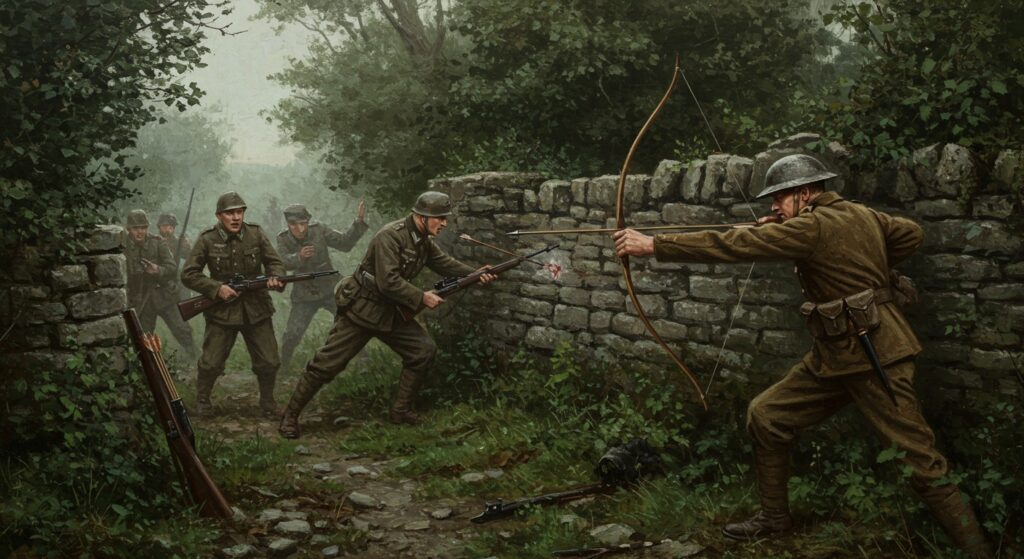
But in the quiet French village of L’Epinette, a German Feldwebel (sergeant) leading a patrol through the countryside is about to be felled by a weapon that hasn’t seen a European battlefield since the Middle Ages.
There is no crack of a rifle. No roar of a grenade. Just the sharp, sudden twang of a bowstring, followed by the wet thud of a barbed broadhead arrow burying itself deep into the sergeant’s chest.
The man holding the bow in the shadows wasn’t a time traveler. He was John Malcolm Thorpe Fleming Churchill, and he had just orchestrated the last recorded longbow kill in modern military history.
“Mad Jack” Churchill was terrifyingly real, and his life reads like a fictional adventure novel that editors would reject for being too unbelievable.
The Making of a Medieval Phantom
Before the outbreak of the Second World War, Churchill’s life was already a masterpiece of eccentricity. Born into an old Oxfordshire family, he graduated from the Royal Military College, Sandhurst, and served in Burma. But the slow, predictable rhythm of peacetime military life bored him to tears.
So, he quit.
He moved to Nairobi to work as a newspaper editor. He became a male model. He even worked as a movie extra, securing a role in The Thief of Bagdad simply because he was a savant with a bow. His archery skills were so finely tuned that he represented Great Britain at the 1939 World Archery Championships in Oslo.
But when Germany invaded Poland in 1939, the adventurer immediately resumed his military commission. He lived by a singular, unshakeable philosophy: “Any officer who goes into action without his sword is improperly dressed.”
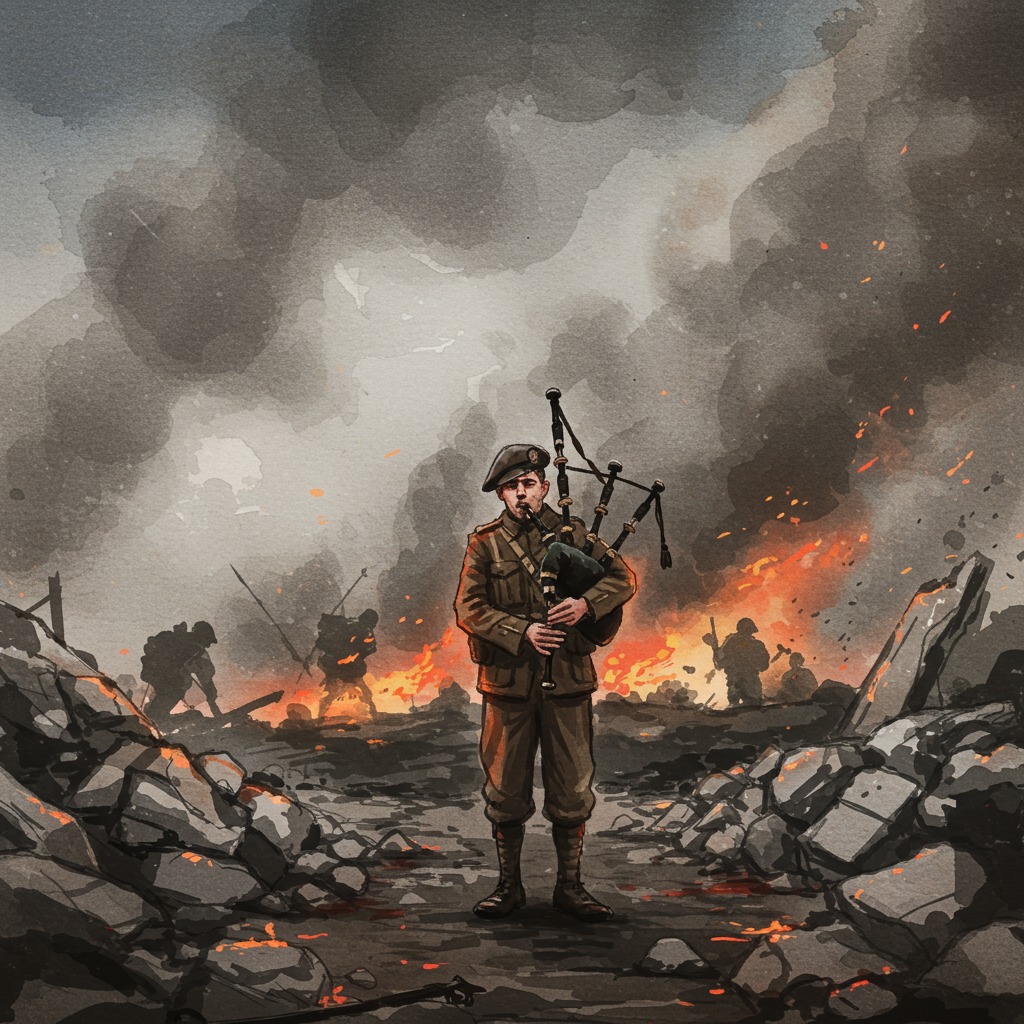
True to his word, he marched into the mechanized slaughter of WWII armed with a Scottish broadsword, a longbow, and a set of bagpipes.
The Highland Dirge at Vaagso
After the fall of France, Churchill volunteered for the newly formed Commandos. It was a match made in military heaven—a unit designed for aggressive, unconventional, and highly dangerous raids.
During Operation Archery in 1941, British forces launched a daring amphibious assault on the German-garrisoned Norwegian island of Vaagso. As the landing craft breached the freezing waters and enemy fire began to rain down, the ramp dropped. Out leaped Mad Jack.
He didn’t hit the dirt. He didn’t fire a rifle. Instead, he stood in the open, playing ‘March of the Cameron Men’ on his bagpipes. After finishing the tune, he hurled a grenade into the German defenses, drew his broadsword, and charged screaming into the fray.
His weapons were not mere theatrical props; they were calculated psychological tools. In the chaos of combat, the sheer absurdity and terror of a screaming man swinging a medieval blade shattered the enemy’s nerves and whipped his own men into a fighting frenzy.
Shadows and Steel in Salerno
If Vaagso proved his courage, the 1943 Salerno landings in Italy proved his tactical genius.
In the dead of night, Churchill was tasked with infiltrating German lines. Armed with nothing but his broadsword, and accompanied by only a single corporal, he melted into the darkness. Moving like a ghost from sentry post to sentry post, Churchill would suddenly materialize out of the blackness, his massive blade raised to the moonlight.
The sheer shock of the ambush paralyzed the German guards. Without firing a single shot, Churchill and his corporal captured 42 German soldiers and a mortar squad, marching the terrified prisoners back to British lines. For this stunning display of stealth and raw terror, he was awarded the Distinguished Service Order.
The Last Tune on Brac Island
By 1944, Churchill’s luck finally caught up with him in Yugoslavia. Sent to support Josip Broz Tito’s Partisans, Churchill led an attack on the German-held island of Brac.
It was a disaster. Under heavy bombardment, his unit was systematically wiped out. Soon, Churchill was the only man left conscious on the battlefield. Surrounded by the dead and dying, with German forces closing in, he didn’t surrender. He picked up his bagpipes and began playing the mournful Scottish lament, ‘Will Ye No Come Back Again?’
He played until a German grenade exploded nearby, knocking him unconscious.
Believing they had captured a direct relative of Prime Minister Winston Churchill, the Germans flew Mad Jack to Berlin for interrogation before throwing him into the notorious Sachsenhausen concentration camp.
Naturally, a concentration camp couldn’t hold him. Churchill tunneled out. Though he was eventually recaptured and transferred to a camp in Austria, the end of the war was near. When the SS guards abandoned the camp, Churchill casually walked 150 kilometers to Verona, Italy, to link up with advancing American forces.
“Those Damn Yanks”
With Europe liberated, Churchill was entirely unsatisfied. The war wasn’t over yet in the Pacific, and he requested an immediate transfer to go fight the Japanese.
But by the time he arrived in India, atomic bombs had leveled Hiroshima and Nagasaki. The Second World War was over. Rather than celebrating survival, Churchill famously complained to a friend, “If it wasn’t for those damn Yanks, we could have kept the war going another 10 years!”
His post-war life refused to quiet down. In 1948, serving with the Highland Light Infantry in Palestine, he bravely coordinated the evacuation of Jewish doctors and patients during the horrific Hadassah medical convoy massacre, putting himself in the crossfire to save civilian lives.
When he finally retired from the military, he found a new thrill: surfing. He designed his own surfboards and cemented his legacy in a completely different arena by becoming the first person to ride the tidal bore on the River Severn.
To look back at Mad Jack Churchill is to view a fascinating duality. To his enemies, he was a reckless, anachronistic demon who belonged in the Middle Ages. But to military historians—and to the men who followed him into hell—he was a brilliant tactician with an unshakeable offensive mindset. He survived impossible odds not just through luck, but through supreme physical fitness and an absolute mastery of the unexpected.
He was a man who looked at the deadliest war in human history, drew his sword, and charged.