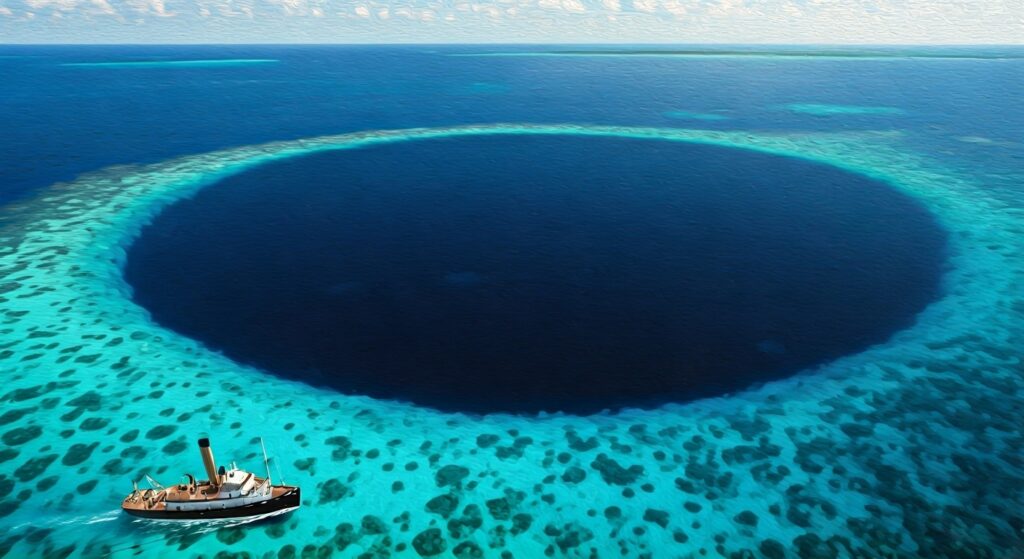
Imagine sailing through the crystal-clear, shallow turquoise waters of the Caribbean. The sun is shining, the reefs are teeming with life, and suddenly, the ocean floor simply drops out from under you. You are staring into a giant, unblinking black eye.
Welcome to the Great Blue Hole.
The Eye of the Caribbean
Located 70 kilometers off the coast of mainland Belize, near the center of Lighthouse Reef, sits a near-perfect circle of pitch-black water. The contrast is jarring. One second you are gliding over a vibrant, shallow reef, and the next, you are hovering over a marine sinkhole measuring 318 meters across and 124 meters deep.
For centuries, sailors navigated around this eerie dark patch, whispering tales of sea monsters and bottomless whirlpools. It wasn’t until 1971 that a legendary maritime explorer decided to find out what was actually lurking down there.
Oceanic pioneer Jacques Cousteau navigated his famous research ship, the Calypso, directly into the sinkhole to chart its depths. Driving a large vessel into an uncharted, seemingly bottomless oceanic void requires a specific brand of unhinged bravery. Cousteau was so mesmerized by what he found that he famously declared it one of the top ten scuba diving sites in the world.
But what Cousteau discovered at the bottom of the Great Blue Hole wasn’t just marine life. It was a geological impossibility.
The Impossible Underworld
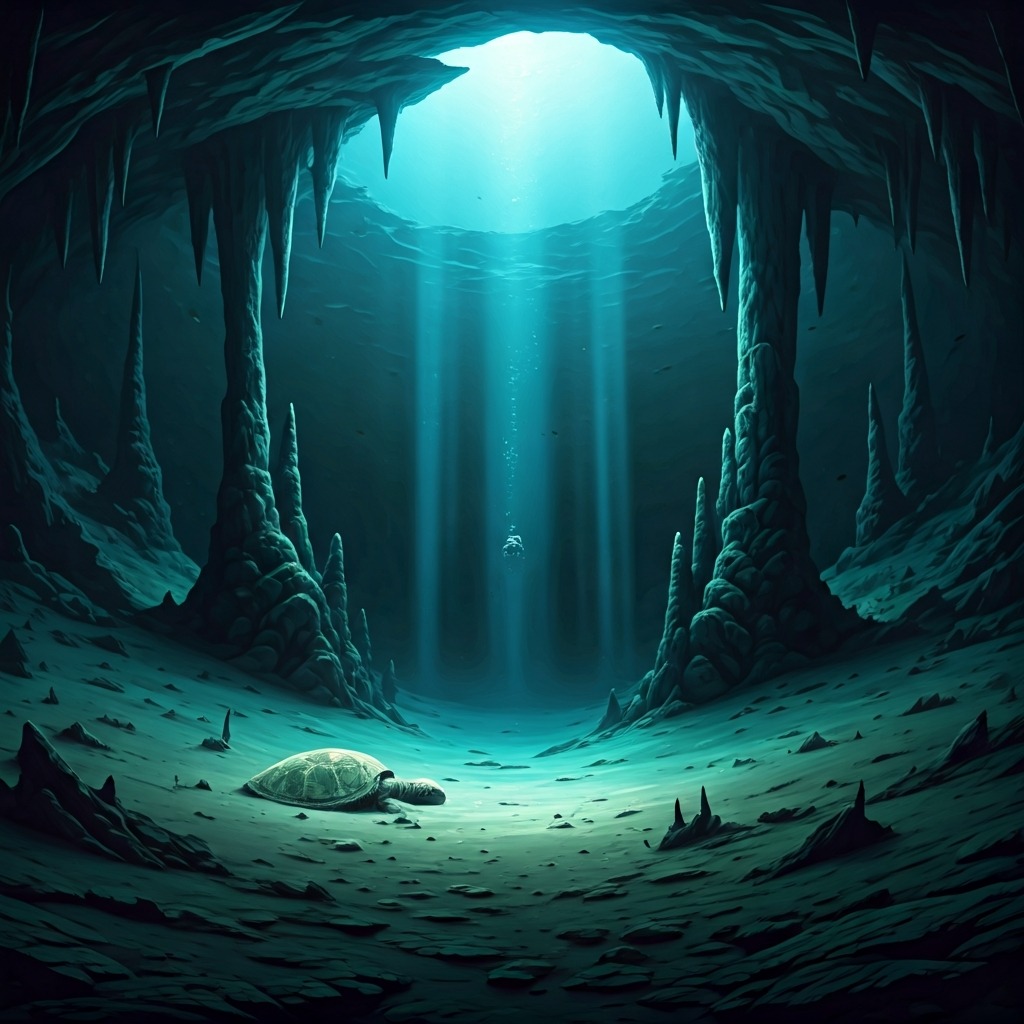
As Cousteau’s divers descended into the gloom, their lights illuminated massive stalactites and stalagmites suspended in the deep.
If you know anything about geology, that detail should send a shiver down your spine. Stalactites can only form through the slow, steady dripping of mineral-rich water in a dry, air-filled environment. Finding them 100 meters underwater is absolute proof that this abyssal pit used to be dry land.
Geologically, the Great Blue Hole is a submerged karst landscape. During multiple episodes of Quaternary glaciation—when the world was locked in the grip of the last Ice Age—global sea levels were up to 120 meters lower than they are today. Back then, this wasn’t a hole in the ocean; it was a massive, dry limestone cave system.
As the ice melted and the ocean violently reclaimed the land, the cave system flooded. The immense weight of the water caused the cave’s roof to collapse, leaving behind the massive sinkhole. Scientific analysis of these underwater stalactites reveals they formed during distinct, freezing epochs approximately 153,000, 66,000, 60,000, and 15,000 years ago.
It is a literal time capsule. But as modern explorers recently discovered, it is also a deadly trap.
The Toxic Graveyard at 90 Meters
In 2018, the Great Blue Hole received another set of daring visitors. A high-tech expedition featuring Richard Branson and Fabien Cousteau (Jacques’ grandson) utilized advanced submersibles to create a high-resolution 3D map of the sinkhole.
As their submersible sank deeper into the abyss, the vibrant marine life of the Caribbean slowly vanished. At a depth of about 90 meters, the submarine breached a thick, murky barrier.
They had hit a layer of toxic hydrogen sulfide.
This toxic blanket completely blocks oxygen from reaching the bottom of the sinkhole. Below this 90-meter mark lies an anoxic graveyard. There is zero oxygen, meaning nothing can survive. The expedition found a barren, alien landscape completely devoid of marine life, yet perfectly preserving the remains of unfortunate creatures—like sea turtles and reef sharks—that accidentally swam too deep, suffocated, and sank into the dark.
Echoes of a Fallen Empire
Beyond being a premier diving destination and a protected UNESCO World Heritage Site, the Great Blue Hole holds one more devastating secret in its darkest depths.
Researchers have extracted sediment cores from the very bottom of the sinkhole. Because the anoxic environment prevents anything from decomposing or disturbing the mud, these cores offer a perfect, undisturbed climate record going back millennia.
Hidden in that mud was the answer to one of history’s greatest mysteries. The sediment cores revealed evidence of catastrophic, prolonged historical droughts. When researchers aligned the dates of these extreme dry spells, they found they coincided perfectly with—and likely contributed to—the collapse of the ancient Maya civilization. The same climate shift that starved an empire left its signature at the bottom of a toxic oceanic pit.
Nature is wildly unforgiving. Whether it is the freezing waves that battered early explorers, or a hidden climate disaster recorded in the depths of a collapsed cave, the earth always keeps the score.