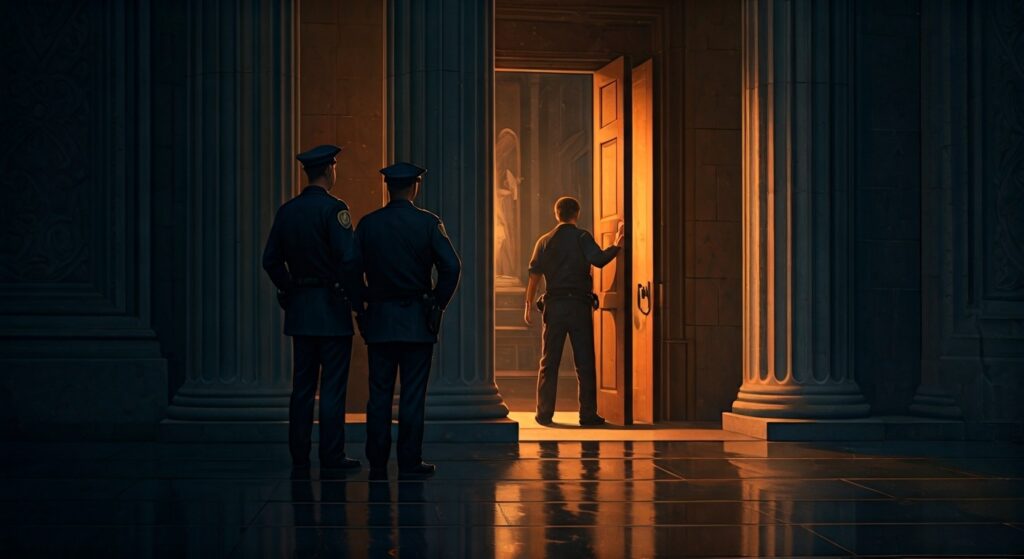
The early hours of March 18, 1990. Boston was deep in the throes of a collective St. Patrick’s Day hangover. The streets were quiet, the revelers had stumbled home, and the city slept. But in the shadows of the Isabella Stewart Gardner Museum, a plot was unfolding that would soon become the largest unsolved property theft in human history.
“Officers, We Have a Disturbance”
At 1:24 AM, a vehicle idled near the museum’s side entrance. Two men stepped out, impeccably disguised as Boston police officers. They buzzed the intercom, their voices steady as they informed the night watchmen they were responding to a disturbance call in the courtyard.
Museum protocol was absolute: the doors were never to be opened for anyone after hours. But human error is the ultimate wildcard in any true-crime saga. Security guard Rick Abath made a fateful decision and turned the lock.
The moment the fake officers stepped inside, the illusion vanished. They demanded Abath step away from the panic button. Within minutes, they overpowered him and a second guard, Randy Hestand. The thieves slapped handcuffs on the young men, marched them into the cavernous basement, and bound them to pipes with duct tape. The trap was sprung. The museum was theirs.
81 Minutes of Brutality and Bizarre Choices
Hollywood heist movies condition us to expect laser-focused professionals who slip in and out like phantoms. These thieves were something else entirely.
For a staggering 81 minutes, they roamed the quiet, dimly lit galleries. Their behavior was a baffling mix of calculated intent and sheer amateurism. Bizarrely, they completely bypassed the museum’s most valuable painting—Titian’s The Rape of Europa—which hung right in front of them.
Instead, they went after specific targets with a brutality that still makes art historians shudder. Rather than carefully removing the fragile canvases from their wooden stretchers, the thieves took box cutters and violently slashed the masterpieces free. By the time they vanished into the Boston night, they had absconded with 13 items.
A Half-Billion Dollar Haul
The loot was staggering, a haul currently valued at over $500 million. They took Johannes Vermeer’s The Concert—one of only 34 known Vermeers in the world, making it the most valuable unrecovered stolen object on the planet. They grabbed Rembrandt’s The Storm on the Sea of Galilee (his only known seascape) and another Rembrandt titled A Lady and Gentleman in Black.
They also snatched Edouard Manet’s Chez Tortoni, five delicate sketches by Edgar Degas, a landscape by Govaert Flinck, an ancient Chinese Gu (beaker), and, inexplicably, a bronze eagle finial from a Napoleonic flag.
The Ghostly Empty Frames
If you visit the Isabella Stewart Gardner Museum today, you won’t just see the art that was left behind; you will see the ghosts of what was taken. The empty wooden frames still hang exactly where the masterpieces used to be.
This isn’t merely a dramatic memorial—it is a strict legal necessity. Isabella Stewart Gardner was a fiercely independent visionary, and her will came with an ironclad stipulation: her collection must be kept exactly as she arranged it. If anything was permanently moved or altered, the entire collection was to be packed up, shipped to Paris, and auctioned off. To honor her dying wish and keep the museum intact, the empty frames remain mounted on the walls, a haunting daily reminder of the loss.
Mobsters, Dead Men, and a $10 Million Bounty
So, who did it? The investigation has spanned decades and crossed continents, led by a relentless tag-team of the FBI and museum security directors.
For years, the primary suspects were heavy hitters in New England organized crime. Names like Carmello Merlino, Robert Guarente, and Robert Gentile floated through FBI files and grand jury testimonies. The feds even tore apart Gentile’s Connecticut home searching for hidden compartments, but came up empty-handed.
In a shocking twist, the FBI announced in 2013 that they had finally identified the thieves, confirming they belonged to a criminal organization based in the Mid-Atlantic and New England. The catch? Both men were already dead.
With the thieves in the grave, the trail to the art has gone ice cold. The greatest fear in the art world today is that these fragile, brutally cut canvases were rolled up and stashed in a damp basement or a hot attic, where poor conditions may have already destroyed them.
Yet, the hope for their return refuses to die. The museum continues to offer a staggering $10 million reward for information leading directly to the safe recovery of the stolen works. Somewhere out there, hidden in the shadows, sits half a billion dollars’ worth of history. Until someone talks, the frames in Boston will remain empty, waiting for their masterpieces to finally come home.