History is teeming with monarchs who clung to the crown until their dying breath, terrified of losing their grip on absolute power. But in the winter of 1654, a twenty-seven-year-old woman looked at the ultimate seat of authority, decided it was a gilded cage, and orchestrated the most spectacular, scandalous exit the world had ever seen.
Meet Queen Christina of Sweden: a brilliant, sword-wielding sovereign who shattered every rule of the 17th century, leaving a trail of dead philosophers, bloody assassinations, and baffled popes in her wake.
The Girl Ordered to Be a Prince
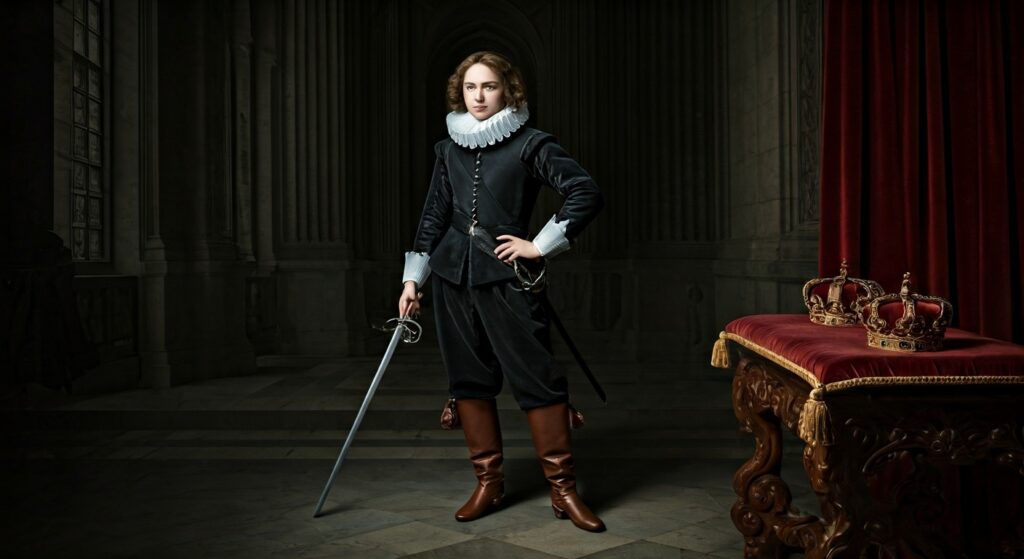
When Christina was born in 1626, the Swedish royal court braced for a crisis. Her father, King Gustav II Adolf, desperately needed a male heir to secure his lineage. But instead of sidelining his new daughter, the King did something entirely unprecedented: he ordered that she be raised, educated, and treated exactly as a prince.
When Gustav was killed at the Battle of Lützen in 1632, six-year-old Christina became Queen-Elect. She didn’t just step into a man’s world; she completely dominated it. Subjected to a grueling, traditionally masculine education, she mastered fencing, horseback riding, theology, and a dizzying array of languages. Fiercely independent, Christina possessed a booming voice and a lifelong habit of eschewing feminine decorum in favor of men’s clothing. She was bold, she was brilliant, and she was already making the Swedish parliament very, very nervous.
The Lethal Pursuit of Genius
By the time she took full control of the throne, Christina was determined to transform Stockholm into the “Athens of the North.” A voracious intellectual, she dragged the brightest minds of Europe into her freezing, formidable orbit.
Her most famous prize was the legendary French philosopher René Descartes. But Christina’s relentless thirst for knowledge came with a lethal catch. She demanded that Descartes tutor her in philosophy at 5:00 AM, in a drafty palace library, in the dead of the brutal Swedish winter. Descartes, whose frail constitution was no match for Christina’s ruthless academic schedule, caught a chill and died of pneumonia shortly after arriving. It was a tragic accident, but it was also the world’s first real glimpse of a sovereign who operated entirely on her own terms—regardless of the human cost.
A Treasonous Secret and the Great Escape
As Christina entered her twenties, the pressure to marry and produce an heir reached a boiling point. But Christina had absolutely no intention of sharing her power, famously declaring a deep distaste for the subjugation of marriage. Her heart, it seems, was already occupied. Her passionate, romantic letters to her lady-in-waiting, Ebba Sparre, strongly suggest she was bisexual or lesbian, making a traditional royal marriage utterly unappealing.
But her refusal to wed wasn’t the only secret she was keeping. In fiercely Protestant Sweden, where religious conformity was a matter of national security, Christina had begun secretly studying Roman Catholicism. Converting would be an act of high treason. With the walls closing in, Christina knew she had to make a drastic move.
In 1654, she shocked all of Europe. She named her cousin, Charles X Gustav, as her successor, abdicated her throne, and slipped out of the country under the cover of darkness, disguised as a man using the pseudonym ‘Count Dohna.’
Blood on the Floor of Fontainebleau
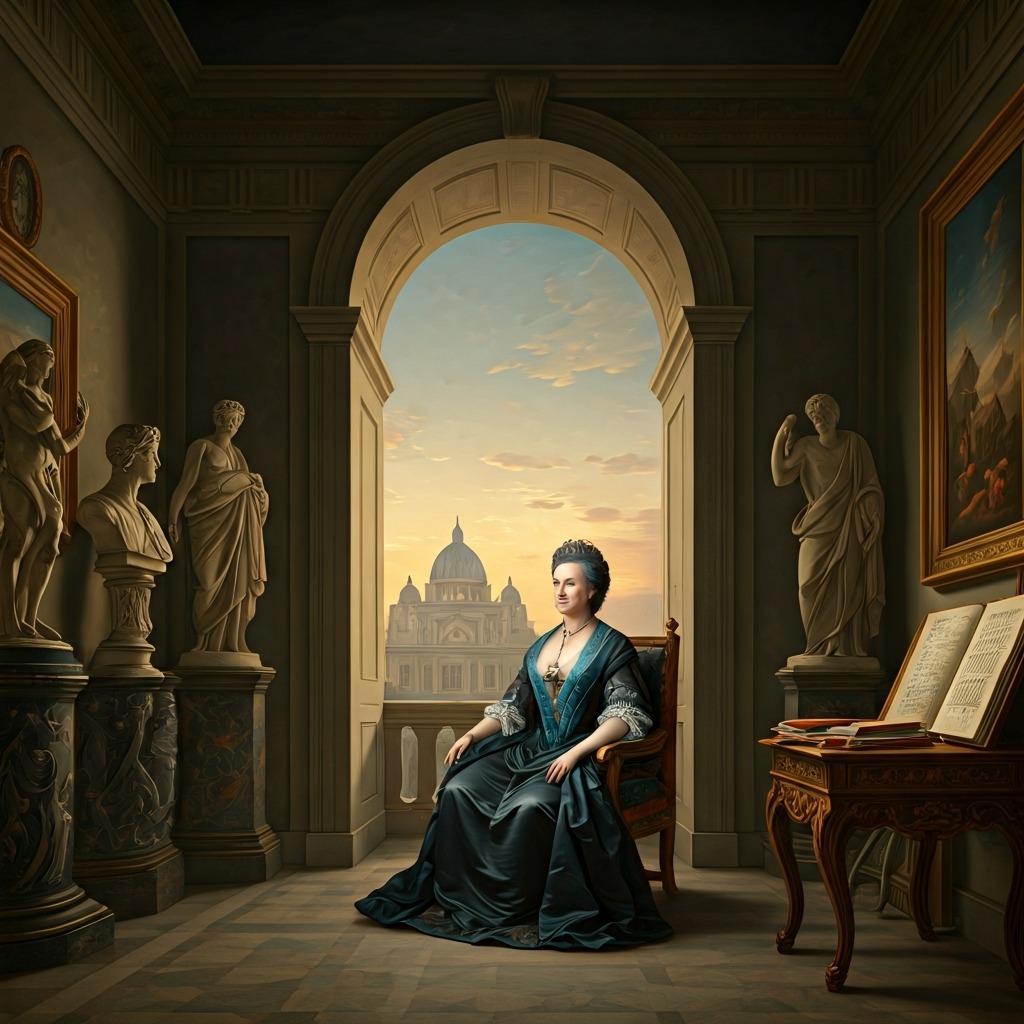
Christina’s journey to Rome was a highly publicized spectacle. The Vatican, still reeling from the devastating Thirty Years’ War, viewed her conversion as the ultimate PR victory. Pope Alexander VII welcomed her with open arms in 1655, expecting a pious, compliant trophy convert.
What he got was a geopolitical wild card.
Christina quickly became the center of Roman high society, but she couldn’t resist the dark allure of political intrigue. She began secretly plotting with the French to seize the Kingdom of Naples. The plot unraveled in 1657 during a visit to the Palace of Fontainebleau in France, when Christina discovered that her own equerry, the Marchese Gian Rinaldo Monaldeschi, was intercepting her secret correspondence and selling her out to the Spanish.
Most former monarchs would have appealed to their host, King Louis XIV, for justice. Not Christina. Claiming she still possessed the divine right of a sovereign, she ordered Monaldeschi’s execution right there in the palace. The assassination was a botched, bloody, and brutal stabbing that horrified European nobility. Practically overnight, Christina morphed from a celebrated intellectual rebel into a ruthless, unpredictable pariah.
The Unapologetic Exile
Despite alienating the French King and terrifying half of Europe, Christina simply refused to be shamed into the shadows. She returned to Rome and spent her later years doing exactly what she loved: throwing her weight around the art world, sponsoring legendary composers like Arcangelo Corelli, and amassing one of the greatest art collections of the era.
When she died in 1689 at the age of 62, the Vatican had to acknowledge that, despite her scandals and her absolute refusal to behave, she was a titan of her age. In a final, jaw-dropping testament to her unprecedented life, she was granted a lavish funeral by the Pope. Today, she remains one of the very few women to be buried in the sacred Vatican grottoes beneath St. Peter’s Basilica—a fitting resting place for a queen who built a throne entirely of her own making.