The Deadly Origins of a Lazy Sunday Staple
Picture a brightly colored hammock strung between two oak trees. To the modern eye, it is the ultimate symbol of leisure—a canvas cradle for lazy Sunday afternoons, iced tea, and afternoon naps. But this suspended piece of fabric harbors a dark, blood-soaked secret. It wasn’t invented for relaxation. It was a brilliant, life-saving piece of survival technology that conquered the jungle, crossed the Atlantic, and ultimately revolutionized global warfare.
Escape from the Jungle Floor
Long before European galleons cast their shadows across the Atlantic, the Taíno people of the Caribbean were locked in a daily battle with a lethal tropical environment. If you have ever stepped foot in a dense, humid rainforest, you know the ground is the absolute last place you want to close your eyes.
The forest floor was a treacherous, rotting landscape teeming with venomous snakes, scorpions, and disease-carrying insects. Add the suffocating humidity and damp soil that devoured anything left resting upon it, and a good night’s sleep was a logistical nightmare.
Enter the hamaca.
Derived from the Arawakan language, these suspended beds were a stroke of environmental genius. Originally woven from the bark of the hamack tree, the hamaca elevated the sleeper above the creeping, crawling threats of the jungle. Better yet, the ingenious open-weave design allowed for maximum air circulation, providing cooling relief that a solid mattress never could. It was a floating fortress of woven bark.
An Alien Encounter in the Trees
The rest of the world remained entirely oblivious to this technology until Christopher Columbus stumbled upon the Bahamas.
Imagine being a 15th-century European explorer. You are accustomed to sleeping on heavy, stationary wooden beds or rotting piles of straw. You hack your way into a dense tropical forest, only to look up and see people comfortably floating in the air. In his ship’s log on October 17, 1492, Columbus recorded the bizarre, almost alien sight, noting with fascination that “people were sleeping in nets gathered between the trees.”
Recognizing a brilliant idea, Columbus and his crew gathered several hammocks and brought them back to Spain. But it wouldn’t be the Spanish who unlocked the hammock’s most devastatingly effective use. It would be the European naval powers, who were about to turn this indigenous Caribbean artifact into a revolutionary weapon of war.
The Floating Hellscapes of the 16th Century
To understand why the hammock was a maritime game-changer, you must first understand the absolute misery of being a European sailor.
Life below deck was a waking nightmare. Sailors slept directly on hard, wooden decks that were perpetually freezing, soaking wet, and crawling with rats. These horrific, unsanitary conditions were a breeding ground for deadly infections. Worse still, the ocean is violently unpredictable. When a ship pitched and rolled in a storm, sleeping sailors were routinely thrown across the wooden decks, resulting in shattered bones and severe injuries.
In 1597, the English Royal Navy officially authorized the use of canvas hammocks for its sailors. It was a desperate decision that changed the course of maritime history overnight.
The Canvas Revolution and the Bulletproof Bed
For the Royal Navy, the maritime hammock was nothing short of a miracle. It instantly elevated the crew above the filthy, rat-infested decks. Hygiene improved; morale skyrocketed.
But the hammock’s true mechanical brilliance was ergonomic: it acted as a natural gimbal. When a warship violently pitched in rough seas, the hammock simply swayed in tandem with the ship’s center of gravity. Sailors remained perfectly cradled, completely immune to being violently tossed against the bulkheads.
Then, the story takes a truly wild turn.
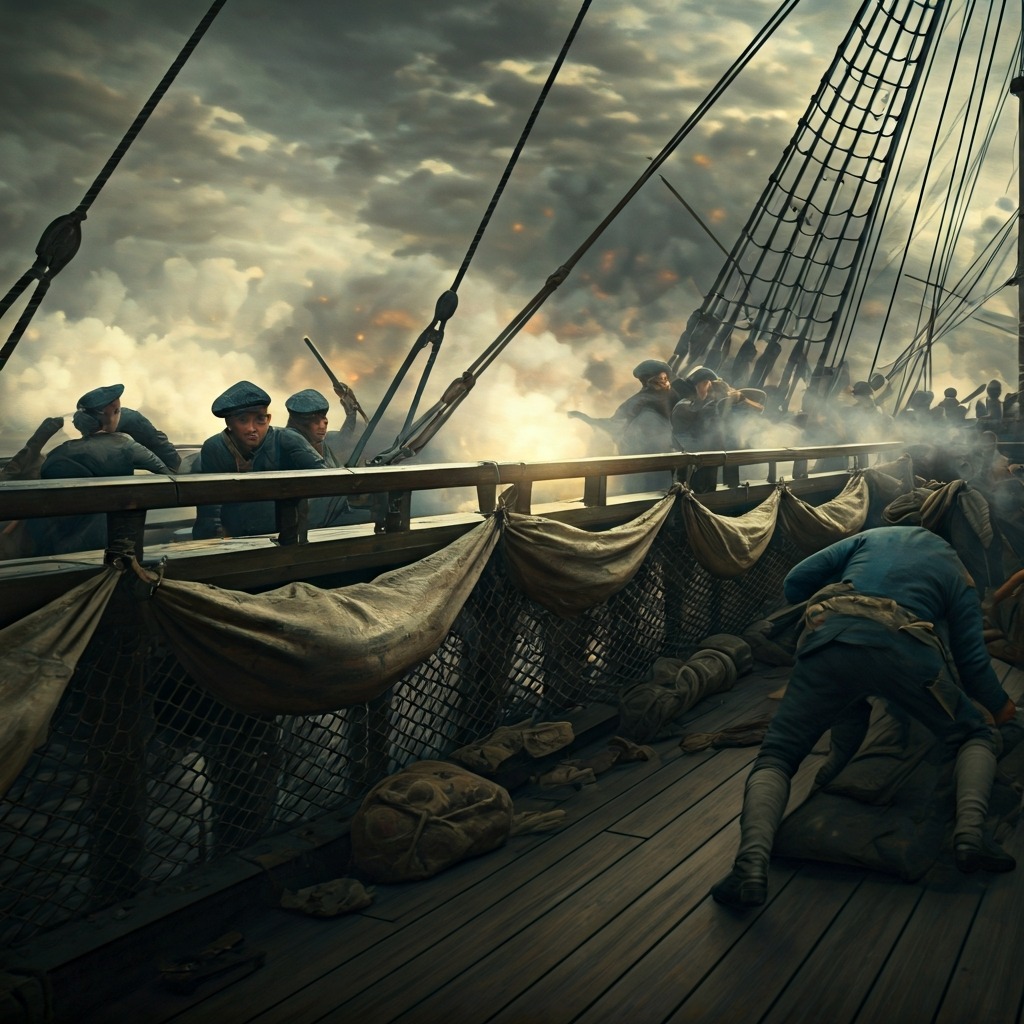
The hammock didn’t just save lives by preventing disease and falls—it literally stopped bullets. When a warship prepared for battle, sailors were ordered to tightly roll their canvas hammocks and pack them into the “hammock nettings” running along the ship’s upper rails.
This created a dense, tightly packed wall of heavy canvas. During the deafening chaos of naval combat, this makeshift barricade absorbed enemy musket balls. Even more crucially, it caught the deadly, jagged wooden splinters that exploded through the air whenever a cannonball smashed into the ship’s hull. Historically, these flying splinters were the leading cause of death and dismemberment in naval warfare.
So, the next time you stretch out in a backyard hammock, take a second to appreciate the wild history beneath you. You aren’t just lounging in a piece of patio furniture. You are resting in an ancient, bulletproof survival tool that conquered the jungle and shaped the course of global naval supremacy.