How do you lose a 180-kilometer-wide scar on the face of the Earth?
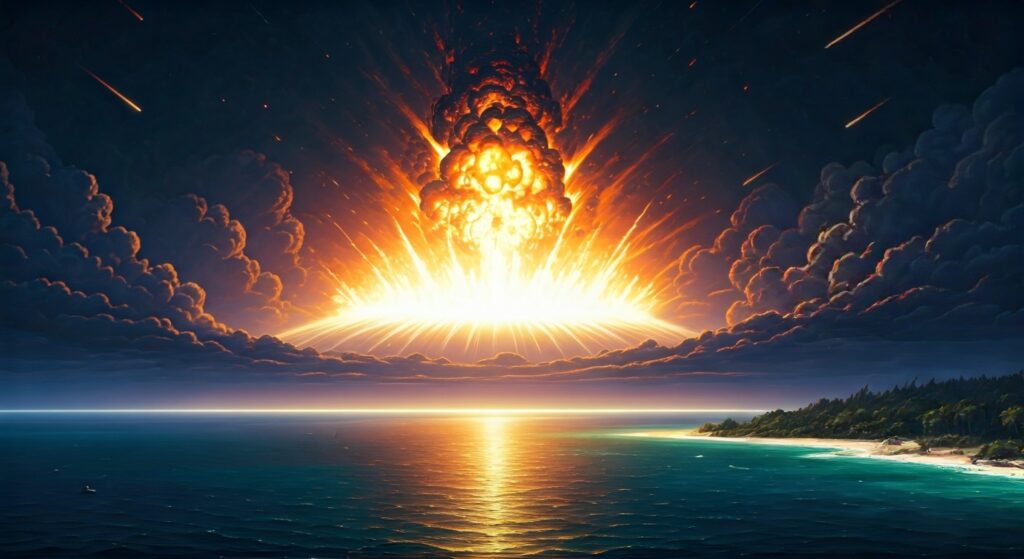
For millions of years, the ultimate crime scene lay perfectly hidden beneath the dense limestone of the Yucatan Peninsula and the shimmering waters of the Gulf of Mexico. It was the impact site of the asteroid that triggered the Cretaceous-Paleogene extinction event—the apocalyptic firestorm that wiped out the non-avian dinosaurs and 75 percent of all life on Earth.
But the wildest part of this 66-million-year-old cold case? The people who finally found the impact zone weren’t paleontologists hunting for dinosaur killers. They were oil prospectors.
The Gunpowder Without a Gun
By the late 1970s, the scientific community was deeply puzzled by the sudden, violent disappearance of the dinosaurs. Theories abounded, but concrete proof was nonexistent. Then, in 1980, physicist Luis Alvarez and his geologist son Walter published a groundbreaking hypothesis: a massive asteroid impact had caused the extinction.
Their proof was a global layer of iridium—an element rare on Earth but common in meteorites—found exactly at the geological boundary marking the dinosaurs’ demise. They had found the gunpowder. But where was the gun?
Throughout the 1980s, scientists frantically scoured the globe for a crater of the right age and size. They checked every known impact site, but nothing fit. The tension in the scientific community was palpable. The Alvarez hypothesis was brilliant, but without a crater, it remained just that—a hypothesis.
A Blast Radius in the Data
Meanwhile, entirely unaware of the paleontological drama unfolding in academia, Glen Penfield was working for PEMEX, Mexico’s state-owned oil company.
It was 1978. Penfield, a geophysicist, was analyzing aeromagnetic survey data of the Gulf of Mexico, hunting for potential offshore drilling sites. Staring at the data, he noticed something incredibly strange: a massive, semi-circular anomaly pointing southward. It didn’t look like a standard geological formation. It looked like a blast radius.
Intrigued, Penfield dug into the PEMEX archives and pulled up older gravity maps of the Yucatan Peninsula compiled by contractors back in the 1960s. On these dusty, forgotten maps, he found a corresponding northward-pointing arc. When he laid the data together, the two arcs formed a flawless circle nearly 180 kilometers in diameter.
Its dead center? A sleepy coastal town called Chicxulub.
Penfield and his colleague Antonio Camargo immediately suspected they had stumbled upon a massive impact crater. But there was a catch, and it was a big one.
Silenced by Corporate Gold
PEMEX was fiercely protective of its data. In the high-stakes world of petroleum exploration, geological maps are as valuable as gold. The company’s strict corporate secrecy policies meant Penfield and Camargo were strictly forbidden from publishing their raw data.
They were granted a tiny concession: they could present their findings at the 1981 Society of Exploration Geophysicists conference. But because they couldn’t share the proprietary maps, and because they lacked physical geological evidence, their presentation was a dud. The broader scientific community, completely unaware of the magnitude of what the two men had found, largely ignored them.
The crater went back into hiding.
The Tsunami Hunter
The breakthrough finally came in 1990. Enter Alan Hildebrand, a Canadian geologist who had been tracking down evidence of a massive, ancient tsunami in the Caribbean region. The debris field he was mapping pointed toward the Gulf of Mexico, but he couldn’t find the source.
Through the academic grapevine, Hildebrand somehow learned of Penfield and Camargo’s obscure, largely forgotten 1981 presentation. Realizing this could be the exact impact site he was looking for, Hildebrand tracked Penfield down.
Together, the two men realized that to prove the Chicxulub structure was an asteroid crater, they needed physical rock samples. Penfield remembered that PEMEX had drilled exploratory wells in the region decades earlier. If they could just find those old drill cores, they might have their proof.
The Holy Grail in a Dusty Shed
The search led them to a storage facility where the old PEMEX drill cores had been sitting, gathering dust, for decades. When Hildebrand and Penfield finally analyzed the samples, it was like hitting the scientific jackpot.
The cores contained definitive, undeniable proof of an extraterrestrial impact. They found tektites—glass naturally formed from terrestrial debris during meteorite impacts—and gravity anomalies perfectly consistent with a massive crater. Most importantly, they found the holy grail of impact geology: shocked quartz, which only forms under the intense, mind-boggling pressure of a cosmic collision.
By 1991, the scientific community formally recognized the Chicxulub structure as the long-sought smoking gun of the dinosaur extinction.
One of Earth’s greatest natural wonders, the site of the most consequential day in our planet’s biological history, was masked by millions of years of sediment. It wasn’t uncovered by a single genius in a lab, but through a messy, decades-long collision of oil prospectors, corporate secrecy, tsunami hunters, and forgotten drill cores. It just goes to show—sometimes the most earth-shattering secrets are right beneath our feet, just waiting for the right person to look down.