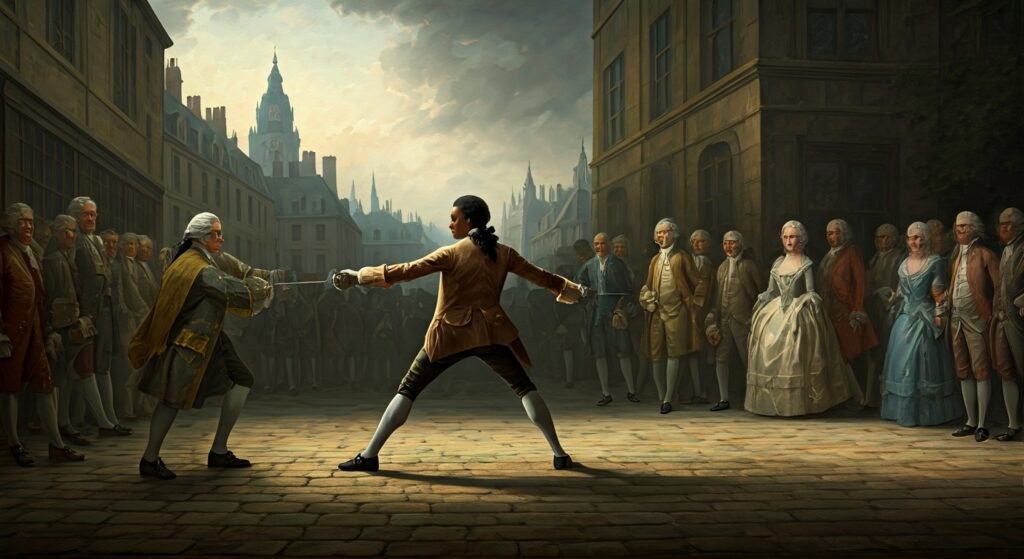
The cobblestones of Rouen were primed for a slaughter. A seasoned fencing master named Alexandre Picard had publicly challenged a teenager to a duel, mockingly dismissing the boy as a “mulatto” upstart. The aristocratic crowd gathered, eager to watch the veteran humiliate the outsider.
Instead, they witnessed a dismantling.
With lethal speed and terrifying grace, the teenager humiliated Picard, leaving the veteran master in disgrace. The boy who walked away from that duel would soon become the most dangerous man in pre-revolutionary France. But his blade was only his second most impressive instrument.
History tried to erase him. Society tried to break him. It is time you met Joseph Bologne, the Chevalier de Saint-Georges.
The Boy With a Target on His Back
Born in 1745 on the sweltering sugar plantations of Guadeloupe, Joseph was thrust into a world designed to reject him. He was the illegitimate son of Georges de Bologne Saint-Georges, a wealthy French planter, and Nanon, an enslaved woman of Senegalese descent.
In a highly unusual move for the era, Georges acknowledged his son. When Joseph was seven, his father moved the family across the Atlantic to the glittering, cutthroat epicenter of the world: Paris. Georges purchased an elite education for the boy, but in a society obsessed with bloodlines and pedigree, wealth could not buy acceptance. Joseph was an outsider with a target on his back. To survive the aristocratic snake pit of 18th-century France, he needed an equalizer.
He found it at the end of a rapier.
Enrolled in the academy of legendary arms master Nicolas Texier de La Boëssière, Joseph proved to be a prodigy. By the time he was seventeen, his precision was lethal. He routinely defeated established masters who had been wielding swords since before he was born. Following his humiliating defeat of Picard, Joseph was catapulted to superstar status. Thanks to his father’s position in the King’s Chamber, he was knighted, officially becoming the Chevalier de Saint-Georges.
A Symphony of Sabotage
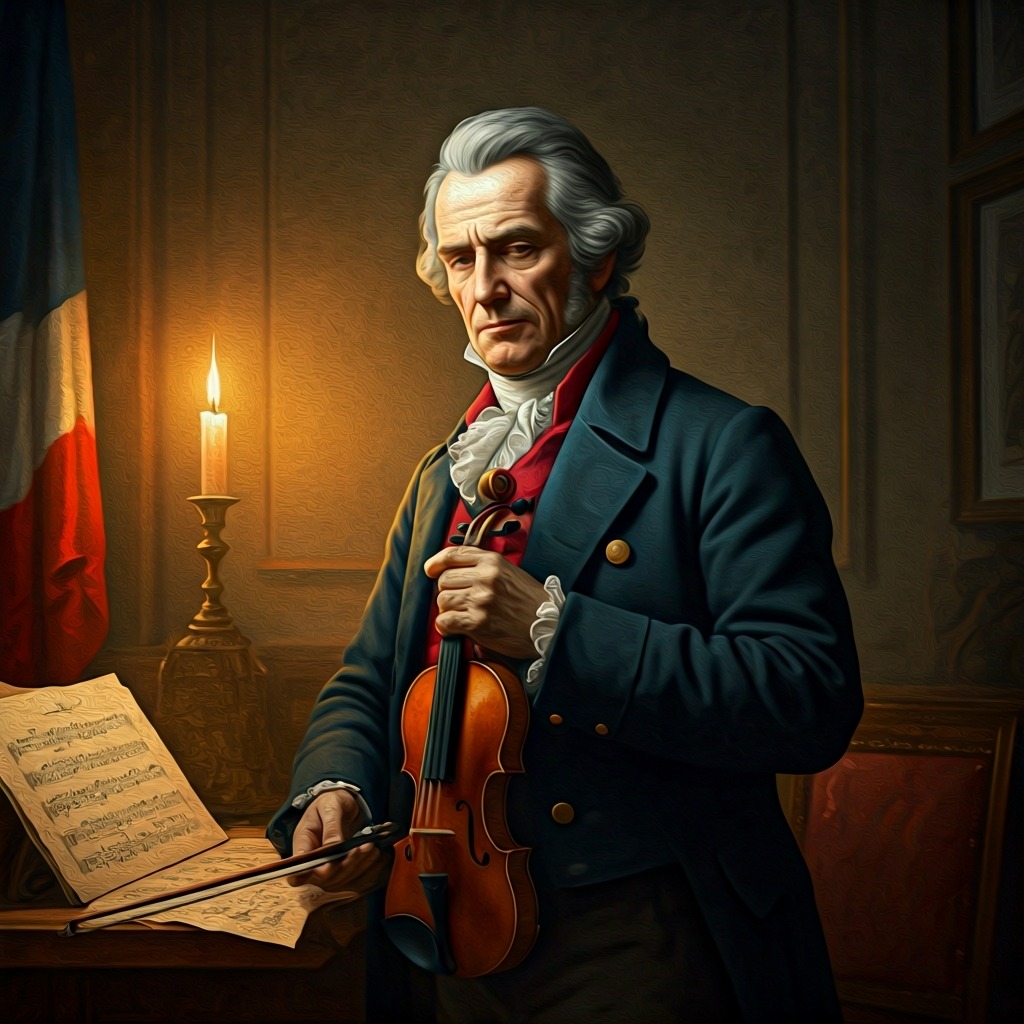
If being the deadliest blade in France wasn’t enough, Joseph harbored a secret weapon: he was a musical genius.
By the 1770s, he burst onto the Parisian scene as a virtuoso violinist and a groundbreaking composer. He pioneered a dazzling new genre called the symphonie concertante and took the helm of Le Concert des Amateurs, transforming it into one of the finest orchestras in all of Europe. His influence was so vast that he later directed the Concert de la Loge Olympique and famously commissioned Joseph Haydn’s six ‘Paris Symphonies.’
But the Enlightenment-era elite could only tolerate so much brilliance from a man of mixed race.
In 1776, Bologne was the undisputed leading candidate to take over the prestigious Paris Opera. It was the appointment of a lifetime. But a cabal of leading female performers—the powerful divas of their day—conspired against him. In a move of breathtaking racism, they petitioned Queen Marie Antoinette, declaring they would never take orders from a person of his heritage.
To spare the Queen a public scandal, Joseph swallowed his pride and withdrew his name. It was a crushing blow, a stark reminder that no amount of genius could completely shield him from the systemic bigotry of his time.
The Legion of Liberty
When the French Revolution exploded in 1789, Joseph did not flee like so many of his aristocratic peers. He leaned in. He embraced the ideals of liberty and equality—because who understood the desperate need for equality better than he did?
By 1792, the maestro had traded his baton for a military command. He was appointed colonel of the Légion franche des Américains et du Midi, which soon became known as the Légion Saint-Georges. It was Europe’s first all-Black military regiment. Fighting to defend the northern borders of France from Austrian forces, Joseph proved to be a brilliant tactician.
Among his officers was Thomas-Alexandre Dumas, a man who would go on to become a legendary general and the father of the celebrated author who penned The Count of Monte Cristo.
The Shadow of the Guillotine
But the Revolution soon devolved into a paranoid, blood-soaked nightmare. Enter the Reign of Terror—an era where a mere whisper of suspicion could send you to the executioner.
Despite his fierce loyalty to the Republic, Joseph’s past came back to haunt him. The revolutionaries could not forget that he had once rubbed elbows with Marie Antoinette and the now-dead aristocracy. In 1793, he was hit with fabricated charges of misusing funds and harboring royalist sympathies.
For eighteen agonizing months, the greatest fencer and composer in France rotted in a prison cell without a trial. Every single day, he listened to the wooden wheels of the executioner’s carts rolling over the cobblestones, wondering if his name would be called next.
He narrowly escaped the guillotine. When Maximilien Robespierre finally fell, Joseph was released. But the damage was done. His health was shattered, his military command was stripped away, and the country he had bled for had moved on without him. He spent his final years directing a new orchestra, slipping into relative obscurity before his death in 1799.
For centuries, lazy historians have slapped him with the moniker “the Black Mozart.” It is an insulting title that ignores the fact that Joseph Bologne was an older contemporary who deeply influenced the music of his era. If anything, Mozart should be called the “Austrian Bologne.”
Joseph Bologne was a polymath, a warrior, a maestro, and a pioneer. He stared down the racial barriers of his time with a violin in one hand and a rapier in the other, and it is long past time history remembered his actual name.