When we picture the heroes of World War II, we envision daring spies, brilliant codebreakers, and fearless soldiers storming beaches. We rarely picture a rotting, fuzzy melon sitting in a Midwestern grocery store. Yet, one of the most pivotal victories in human history didn’t happen on a blood-soaked battlefield. It happened in a laboratory, and it started with a piece of garbage.
The Miracle That Refused to Grow
In 1928, Alexander Fleming left a petri dish out, mold grew, bacteria died, and modern medicine was supposedly born. But the textbook version leaves out a maddening detail: Fleming’s original strain of mold, Penicillium notatum, was incredibly stingy. It produced the antibiotic in such microscopic, pitiful quantities that it was nearly impossible to isolate. For over a decade, penicillin was a biological tease—the equivalent of having the blueprints for a superweapon but only enough materials to build a toaster.
By the early 1940s, the world was plunging into the darkest conflict in human history. Soldiers weren’t just dying from shrapnel; they were succumbing to the microscopic killers of gangrene and sepsis. At Oxford University, a brilliant team led by Howard Florey, Ernst Chain, and Norman Heatley finally managed to purify penicillin, proving its miraculous potential.
But there was a massive catch. Growing the mold in shallow pans yielded laughably small amounts. With Britain’s resources decimated by the Blitz, industrial scaling was a pipe dream. If they were going to save the Allied forces, they needed a miracle. In 1941, Florey and Heatley packed up their precious mold and braved the U-boat-infested Atlantic.
The Secret Sauce of Peoria
The British scientists were directed to the USDA’s Northern Regional Research Laboratory (NRRL) in Peoria, Illinois. The scientists there were absolute wizards at fermentation.
Enter Andrew Moyer and his team. They looked at the British method of shallow pans and realized the mold was starving. They decided to feed it a biological super-serum: a broth containing lactose and corn steep liquor, a sticky, nutrient-packed byproduct of corn wet-milling. The results were instantaneous. Penicillin yields skyrocketed. The team then engineered deep-vat fermentation, pumping sterile air into massive, multi-story tanks so the mold could grow throughout the liquid, not just on the surface.
The engineering puzzle was solved. But the biological engine—Fleming’s original mold—was still too weak. They needed a hyper-productive mutant.
The Global Dragnet and “Moldy Mary”
What followed was a biological scavenger hunt of epic proportions. The US military initiated a global dragnet, flying in soil and mold samples from around the world on top-secret military transports.
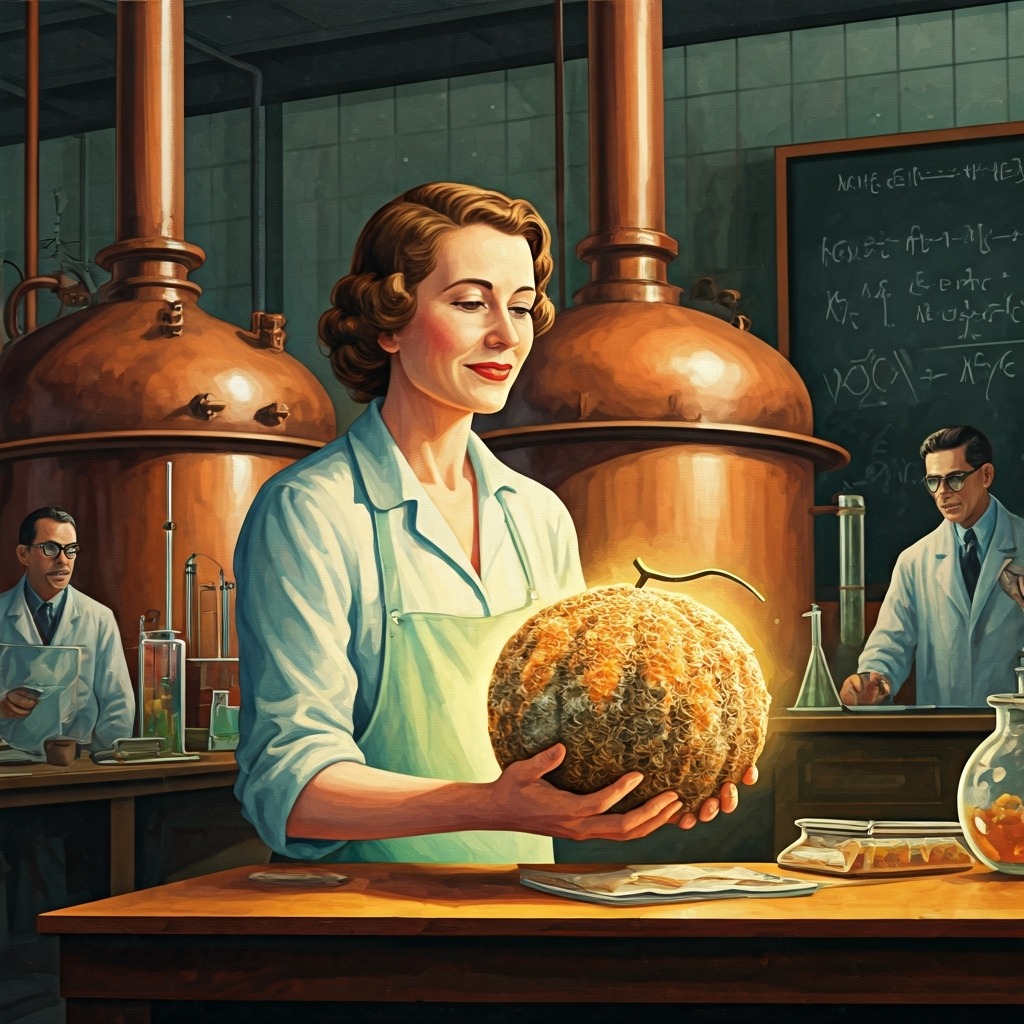
But the real hero wasn’t a globetrotting spy. It was a laboratory assistant named Mary Hunt, who soon earned the affectionate nickname “Moldy Mary.” While the military scoured the continents, Hunt was given a decidedly less glamorous assignment: scour the local grocery stores, bakeries, and cheese shops of Peoria, looking for the nastiest, most fungus-covered produce she could find. Day after day, she brought rotting garbage back to the lab.
Then, in the summer of 1943, she hit the jackpot.
The Golden Cantaloupe
The prize was a rotting, foul-smelling cantaloupe. To the untrained eye, it was compost. To the scientists at the NRRL, the “pretty, golden mold” covering the fruit was breathtaking.
When they tested the cantaloupe mold—identified as Penicillium chrysogenum—the lab instruments practically broke. This single, localized strain was an absolute powerhouse, naturally yielding roughly 200 times more penicillin than Fleming’s original strain.
But the scientists didn’t stop there. In a move straight out of a mad-science thriller, researchers at the Carnegie Institution and the University of Wisconsin took the cantaloupe strain and subjected it to X-rays and ultraviolet radiation to force mutations. It was pure, unadulterated biological tinkering. And it worked. One resulting mutant strain produced a staggering 1,000 times more penicillin than Fleming’s original mold.
The Dawn of a New Era
This one moldy melon from Illinois changed the course of human history.
Combined with deep-vat fermentation and corn steep liquor, American pharmaceutical giants like Pfizer, Merck, and Squibb scaled up production to unimaginable levels. By D-Day in June 1944, the United States was pumping out enough penicillin to treat every single severe casualty in the Allied forces.
Countless soldiers who would have died agonizing deaths from gangrene and sepsis were saved, returning home to their families. The modern antibiotic era was born, effectively doubling human life expectancy in the decades that followed.
So, the next time you leave a piece of fruit on the counter a little too long and it starts growing a fuzzy sweater, don’t just throw it away in disgust. Give it a little salute. Because once upon a time, a moldy melon just like that one saved the world.