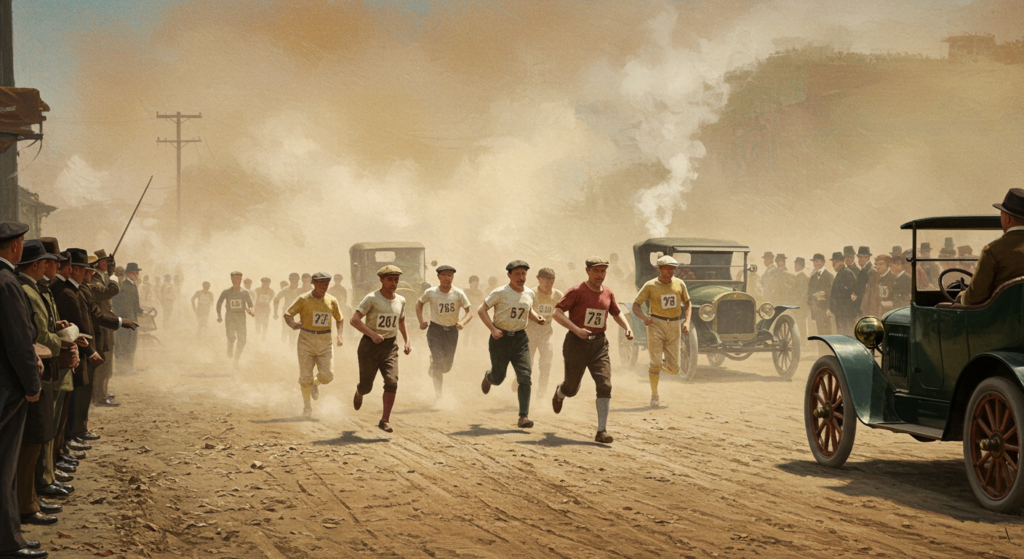
It was a stage set for a horror story. The air on August 30, 1904, was a suffocating blanket of 90-degree heat and crushing humidity. The course was a 24.85-mile gauntlet of unpaved country roads, choked with dust and teeming with oblivious civilian traffic. This wasn’t just a race; it was a cruel, twisted experiment in human suffering. Of the 32 athletes who stepped up to the starting line of the St. Louis Olympic Marathon, only 14 would see the finish. What happened in between was a fever dream of poison, fraud, feral dogs, and sheer, unhinged chaos.
The Architect of Agony
To understand the madness, you must first meet its mastermind: James E. Sullivan, the chief organizer of the games. Sullivan wasn’t interested in a simple footrace. He wanted to stage a live physiological experiment to test the limits of human endurance. His central, and deeply dangerous, hypothesis was that purposeful dehydration would reveal a man’s true willpower.
To test this, he scheduled the race for the hottest part of the day and designed a course with exactly one water source: a well located a staggering 11 miles from the start. As if that weren’t enough, officials decided to drive alongside the runners in early-model automobiles, which kicked up enormous, blinding clouds of dust. The air became a thick, gritty poison. For one runner, William Garcia, it was nearly a death sentence. He was found unconscious on the roadside, his esophagus and stomach lining literally ripped apart by the sheer volume of dirt he had inhaled. He had been coughing up blood for miles.
A Joke, a Joyride, and a Roadside Nap
Faced with such brutal conditions, some runners simply broke. American Fred Lorz was out of the race by mile 9, crippled by cramps. He flagged down a car and hitched a ride, cheerfully waving at spectators and his struggling competitors as he passed. But when his ride broke down at the 19-mile mark, a refreshed Lorz simply hopped out and jogged the final stretch. He crossed the finish line first, to a thunderous ovation. Alice Roosevelt, the President’s daughter, placed a wreath on his head. He was moments from receiving the gold medal when a witness exposed the fraud. Lorz, with a straight face, claimed it was all just a “practical joke.”
Then there was Félix Carvajal, a Cuban postman who had lost his travel money gambling in New Orleans and hitchhiked to St. Louis. He arrived at the starting line in heavy trousers, a long-sleeved shirt, and street shoes, forcing a fellow Olympian to hastily cut his pants into makeshift shorts. Unfazed by the grueling conditions, Carvajal charmed the crowd, stopping to chat and practice his English. At one point, famished, he detoured into an orchard to snack on some apples. They were rotten. Wracked with stomach cramps, he did the only logical thing: he lay down and took a nap. Incredibly, after his mid-race snooze, Carvajal still managed to finish in fourth place.
The Barefoot Pioneers
Amid the circus, a story of quiet defiance unfolded. Two Tswana tribesmen, Len Taunyane and Jan Mashiani, were in St. Louis as part of a racist World’s Fair exhibition. They entered the marathon on a whim, becoming the first Black Africans to ever compete in the Olympics. They ran barefoot over the sharp, rocky roads. Taunyane was running a brilliant race and was on pace for a medal when he was suddenly confronted by a new terror: a pack of aggressive, wild dogs. The dogs chased him more than a mile off course, forcing him to fight for his life. Despite this terrifying detour, he battled back to finish 9th. Their remarkable performance was a powerful rebuke to the very organizers who saw them as inferior.
A Deadly Cocktail at the Finish Line
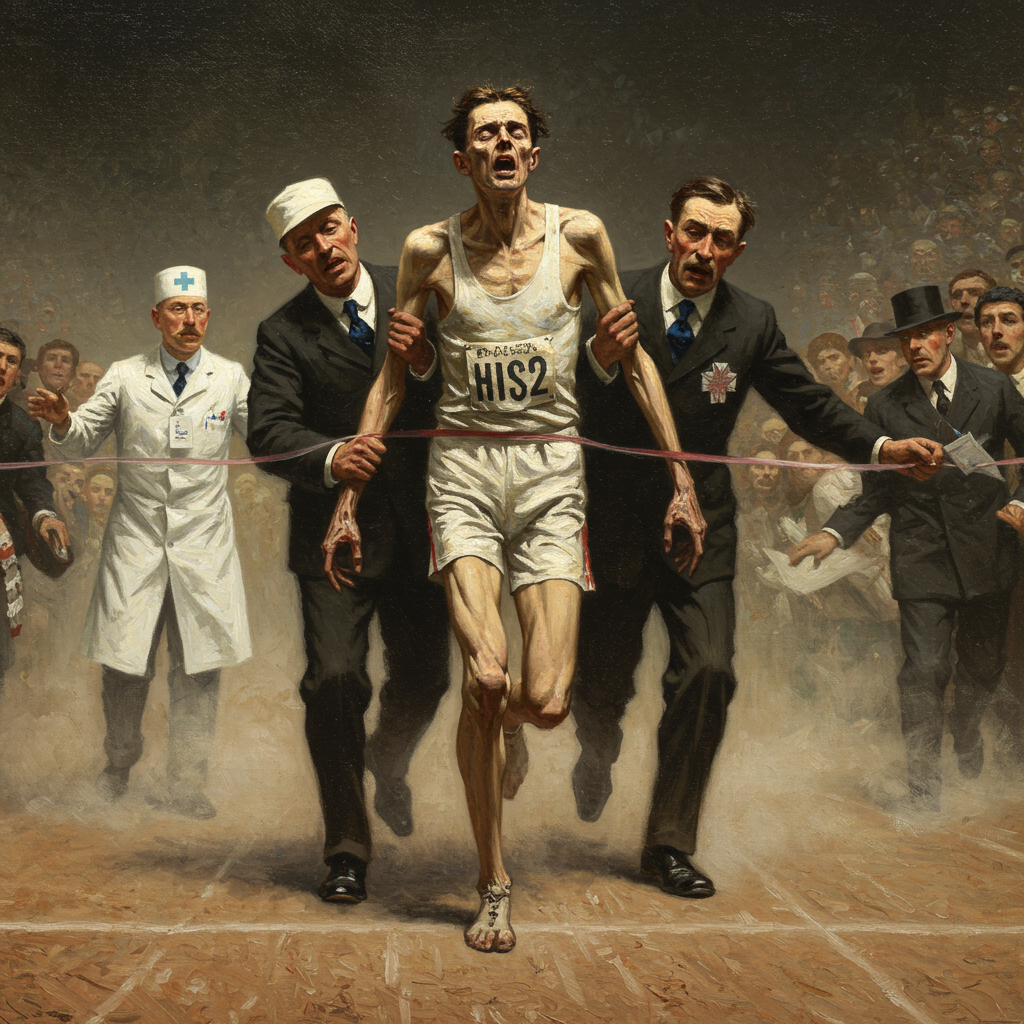
The most sinister chapter of the day belongs to the man who was ultimately declared the winner: Thomas Hicks. By mile 10, Hicks was delirious and begging for water. His handlers refused. Instead, they administered the era’s cutting-edge performance enhancer: a raw egg white mixed with strychnine sulfate. Rat poison.
They believed a micro-dose of the deadly neurotoxin would act as a stimulant. When the first dose wore off and Hicks began to collapse again, they gave him a second, this time with a swig of brandy. The concoction sent Hicks into a full-blown hallucination. He began shuffling his feet like a zombie, his body no longer under his own control. His trainers had to physically carry him across the finish line, holding him aloft as his feet dragged lifelessly in the dirt. He had won, but he was nearly dead. It took a team of doctors to revive him.
The Legacy of a Nightmare
The 1904 St. Louis Marathon was such an unmitigated disaster that Olympic officials seriously considered abolishing the event for good. They deemed it too dangerous for human physiology. They weren’t wrong, but they failed to see that the danger wasn’t the distance; it was their own hubris and ignorance. The race remains a horrifying and fascinating monument to human endurance—and a chilling reminder of just how wrong an experiment can go.
Dig Deeper
-
The World’s Fair and “Anthropology Days”
- History.com: 8 Unusual Facts About the 1904 St. Louis Olympics
- The marathon was just one part of the massive Louisiana Purchase Exposition, which featured controversial “Anthropology Days.” This article provides crucial context on how Indigenous peoples were forced to compete in events designed to “prove” white athletic superiority, highlighting the significance of the performances by runners like Len Taunyane and Jan Mashiani.
-
Strychnine, Brandy, and Early “Sports Science”
- Smithsonian Magazine: The 1904 Olympic Marathon May Have Been the Strangest Ever
- Thomas Hicks’s strychnine cocktail wasn’t considered cheating at the time; it was seen as cutting-edge science. This detailed account explores the shocking state of early 20th-century sports medicine and how the concept of “purposeful dehydration” and performance-enhancing drugs turned the race into a near-fatal experiment