The Cipher Hiding in Plain Sight
Take a look around you. You are surrounded by a secret code. It is a cipher so ubiquitous, so perfectly integrated into the fabric of modern life, that it has become entirely invisible. It dictates the flow of global commerce, tracks the movement of trillions of dollars, and relies entirely on lasers.
But the origin of this invisible matrix isn’t a story of sterile boardroom meetings or corporate planning. It is a tale of obsession, an eavesdropping student, a massive fire hazard, and a sudden epiphany drawn in the sand.
The Eavesdropper and the Arrogant Dean
The story begins in 1948 at Philadelphia’s Drexel Institute of Technology. A local grocery chain executive was at his wit’s end. Post-war supermarkets were booming, but the checkout process was a manual, agonizingly slow nightmare that was bleeding profits. Desperate, he marched into the university dean’s office and pleaded for a technological miracle: an automated system to capture product information at the register.
The dean, viewing the request as a trivial commercial problem beneath the institution’s grand academic pursuits, flat-out rejected him.
But the dean wasn’t the only one listening.
A graduate student named Bernard Silver happened to be within earshot. Captivated by the sheer impossibility of the problem, Silver immediately relayed the overheard conversation to his good friend and fellow grad student, Norman Joseph Woodland.
Woodland wasn’t just interested—he became consumed. In a move of eccentric genius, Woodland abruptly dropped out of graduate school, packed his bags, and moved into his grandfather’s apartment in Miami, Florida. He needed total isolation to crack the code.
Four Fingers in the Miami Sand
During the winter of 1948, Woodland spent his days sitting on the Miami beach, wrestling with the mechanics of data encoding. He needed a system that could be read quickly, cheaply, and without human error.
His mind drifted back to his childhood as a Boy Scout, specifically to the dots and dashes of Morse code. Absentmindedly, he began poking his four fingers into the sand, tracing out the familiar dots and dashes.
Then, in a flash of absolute brilliance, he dragged his fingers downward.
The dots and dashes stretched through the sand, transforming into a series of thin and thick parallel lines. Woodland stared at the grooves in the beach. He hadn’t just drawn lines; he had drawn the blueprint for modern global logistics. The linear barcode was born right there, next to the crashing waves.
A 500-Watt Fire Hazard
Woodland quickly realized that straight lines might be tricky for early, primitive scanners to read from different angles. To fix this, he warped his linear design into a “bullseye” pattern of concentric circles.
On October 20, 1949, Woodland and Silver confidently filed a patent for their “Classifying Apparatus and Method.” But there was a massive catch: they were decades ahead of their time. Microprocessors didn’t exist. Lasers were the stuff of science fiction comic strips.
To actually read their new code, the duo had to rely on early photomultiplier tubes and a monstrous 500-watt incandescent lightbulb. The resulting scanner was bulky, obscenely expensive, and generated terrifying amounts of heat. The 1950s checkout counter simply wasn’t ready for a machine that doubled as a fire hazard.
Defeated by the limits of their era’s hardware, Woodland and Silver eventually sold their world-changing patent to Philco for a mere $15,000.
The Juicy Fruit Revolution
It wasn’t until the 1970s that technology finally caught up to Woodland’s beach epiphany. Affordable lasers and microprocessors had arrived, and the retail industry was desperate to revive the automated checkout dream.
Woodland was now working at IBM, where a brilliant engineer named George Laurer was tasked with refining the concept. Laurer noticed a fatal flaw in Woodland’s circular bullseye design: when run through a high-speed printing press, the ink smeared, rendering the concentric circles unreadable.
Laurer’s solution? He ditched the circles and returned to Woodland’s original, linear vision—the lines in the sand. Laurer developed the rectangular Universal Product Code (UPC) that we all know today. Woodland, thrilled to see his brainchild finally coming to life, fully supported the revision.
The ultimate test arrived on the morning of June 26, 1974.
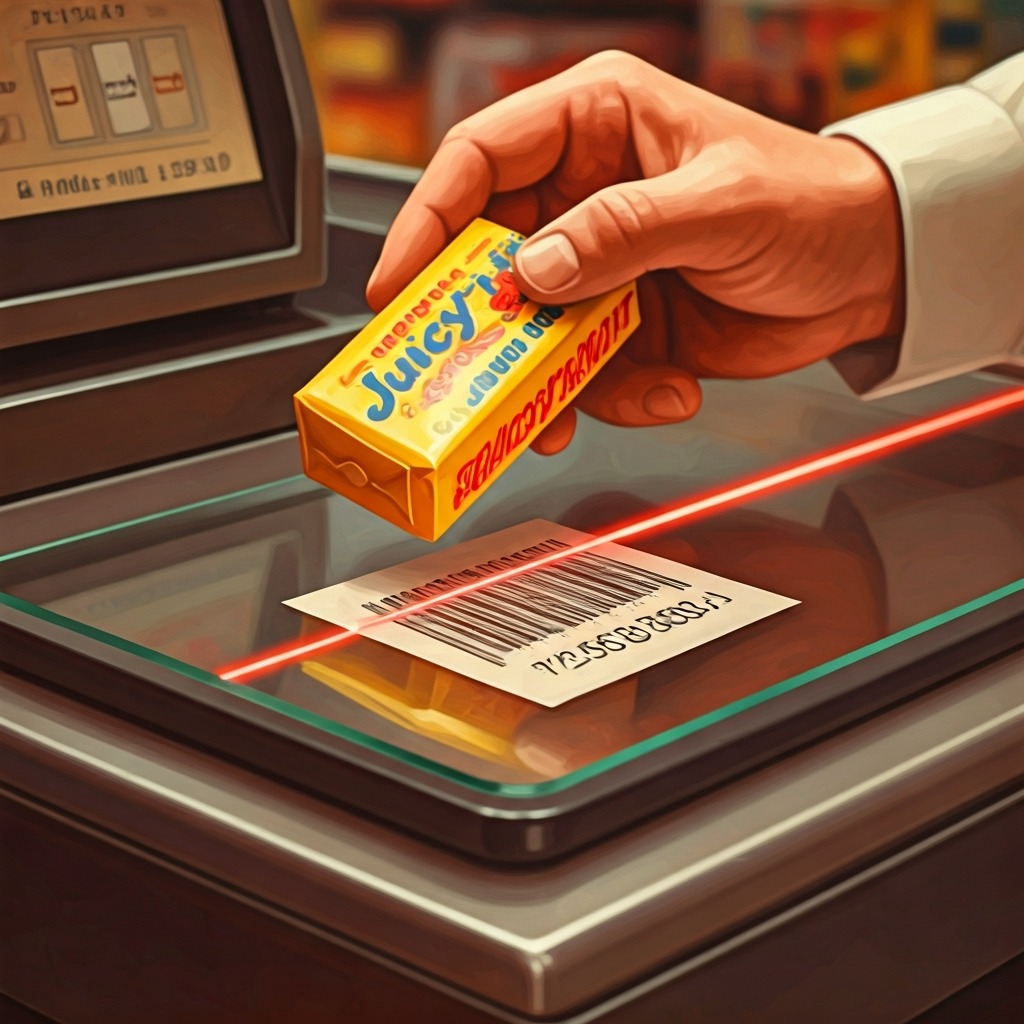
At a Marsh Supermarket in Troy, Ohio, a shopper placed a 10-pack of Wrigley’s Juicy Fruit chewing gum on the conveyor belt. The cashier dragged it across a built-in laser scanner.
Beep.
With that single, high-pitched electronic chirp, retail history was made. The system worked perfectly. Today, those simple lines facilitate billions of transactions every single day. It remains one of the most significant technological leaps in human history—all because a grad student overheard a conversation, dropped out of school, and dragged his fingers through the sand.