Imagine being a high-ranking Roman senator. You hold the power of life and death, command legions, and possess unimaginable wealth. Then, a dinner invitation arrives. You are summoned to dine with the Emperor’s most esteemed companion. You arrive, trembling, only to find the guest of honor eating gold-laced oats from an ivory trough. The host? A literal horse.
Welcome to the reign of Emperor Caligula. For two millennia, the tale of Incitatus the horse has been cited as the ultimate symbol of imperial madness. But beneath the marble stables and purple blankets lies a darker, far more calculating mystery.
A Stable Fit for a God
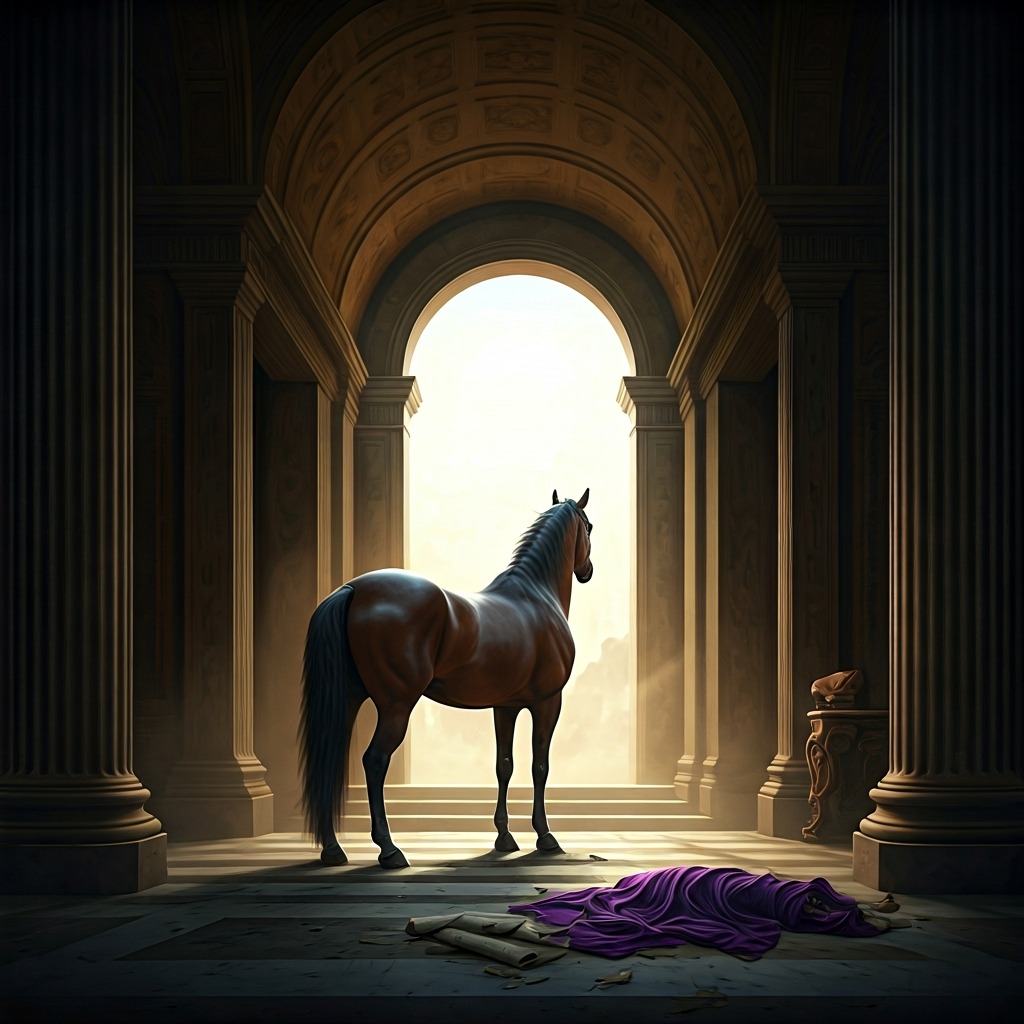
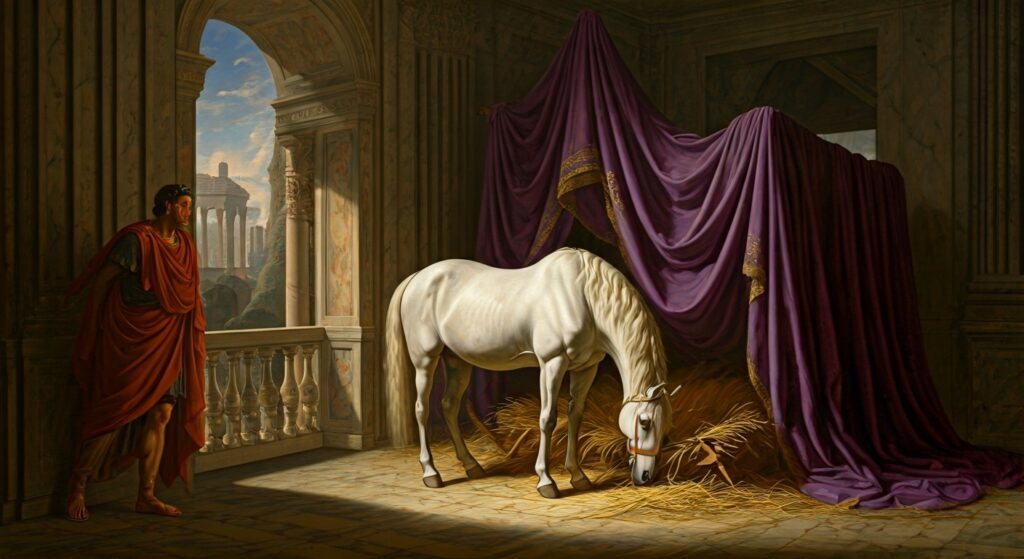
To understand the sheer absurdity of this story, you have to grasp the lifestyle of the ancient world’s most pampered pet. According to the Roman biographer Suetonius, Incitatus didn’t just live in a nice barn. He resided in a stable constructed entirely of gleaming marble. He ate his meals from an ivory manger and slept under blankets dyed in imperial purple—a pigment so fiercely guarded in ancient Rome that a commoner caught wearing it could be executed.
But Caligula’s obsession didn’t stop at lavish interior design. He gifted the stallion his own fully furnished estate, complete with a dedicated team of enslaved servants. Why? So that when Caligula sent out formal dinner invitations in the horse’s name, the terrified Roman elite could be entertained in high society style. To decline an RSVP from this four-legged aristocrat was to court the Emperor’s wrath—and likely, the executioner’s blade. The historian Cassius Dio noted that Incitatus wasn’t just chewing standard hay; his oats were mixed with actual gold flakes.
The Most Dangerous Promotion in Rome
Spoiling a pet is one thing, but the true terror of Caligula’s reign lay in his lethal unpredictability. The Emperor wasn’t content with throwing lavish parties for his stallion; he began weaving Incitatus into the very religious and political fabric of the Empire.
First, Caligula ordained the horse as a priest in his own imperial cult. Then came the rumor that sent a collective chill down the spine of the Roman aristocracy: Caligula announced his intention to appoint Incitatus to the office of Consul.
To grasp the sheer audacity of this threat, one must understand the Consulship. It was the highest elected political magistracy of the Roman Empire, the absolute pinnacle of a politician’s career, wielding immense military and political power. And Caligula was preparing to hand it to a farm animal. Only the Emperor’s bloody assassination in 41 AD supposedly prevented the horse from taking the oath of office.
A Masterclass in Imperial Shade
For centuries, historians took this bizarre narrative at face value. The “Mad Emperor” theory reigned supreme: Caligula was clinically insane, his mind shattered by a severe illness early in his rule, leaving him a delusional tyrant who genuinely believed his horse was a political prodigy.
But modern historians—and those who understand the dark art of a toxic power play—view this narrative through a different lens. They propose a chilling alternative: the story of Incitatus wasn’t madness at all. It was calculated political satire.
Caligula despised the Roman Senate. He viewed them as a sycophantic, hypocritical, and utterly useless body of men who cared only for their own prestige. By threatening to make Incitatus a Consul, Caligula delivered a devastating, humiliating insult. He was looking the most powerful men in Rome dead in the eye and declaring, My horse could do your job. It was the ultimate flex of absolute autocracy, a terrifying reminder that their elite titles meant nothing and existed entirely at his whim.
The Final Spin of the History Books
There is, however, a third perspective—the “Hostile Historiography” theory. History is written by the victors, and in Caligula’s case, the victors were the very people who murdered him. Suetonius and Cassius Dio wrote their accounts decades, even centuries, after Caligula’s death. They relied on the journals and letters of the senatorial class—the exact aristocrats who despised the Emperor.
Many scholars now believe the entire “Consul” plot was originally nothing more than a sarcastic joke made by Caligula at a dinner party. But after his assassination, his political enemies weaponized that joke. They twisted a dark piece of sarcasm into a literal, deranged plan to permanently discredit his memory. They couldn’t just kill the man; they had to immortalize him as a monster.
Whether it was genuine madness, a brilliant piece of satirical theater, or a rumor spun out of control by salty politicians, the legend of Incitatus remains perfectly intact today. It stands as the ultimate symbol of unchecked power—a riveting reminder that the political circus has always hidden a profound and terrifying reality behind the curtain.