The Spanish Empire of the 16th century was an unstoppable juggernaut. Within a few short decades, their steel-clad conquistadors had toppled the mighty Aztec Empire in Mexico and shattered the vast Inca domain in Peru. To the European mind, the Americas were a boundless expanse waiting to be claimed, and Spanish military supremacy was an absolute law of nature.
But at the edge of the known world, deep in the labyrinthine forests of present-day Chile, the unstoppable force finally met an immovable object.
This is the story of the Arauco War, a bloody, three-century conflict where the indigenous Mapuche people achieved the impossible: they fought the world’s greatest superpower to a standstill.
The Arrival of the Iron Monsters
The conflict began in earnest in 1540 when the ambitious conquistador Pedro de Valdivia marched south of the Atacama Desert, eager to carve out a fiefdom for himself. When his forces clashed with the Mapuche, the initial encounters were absolute massacres.
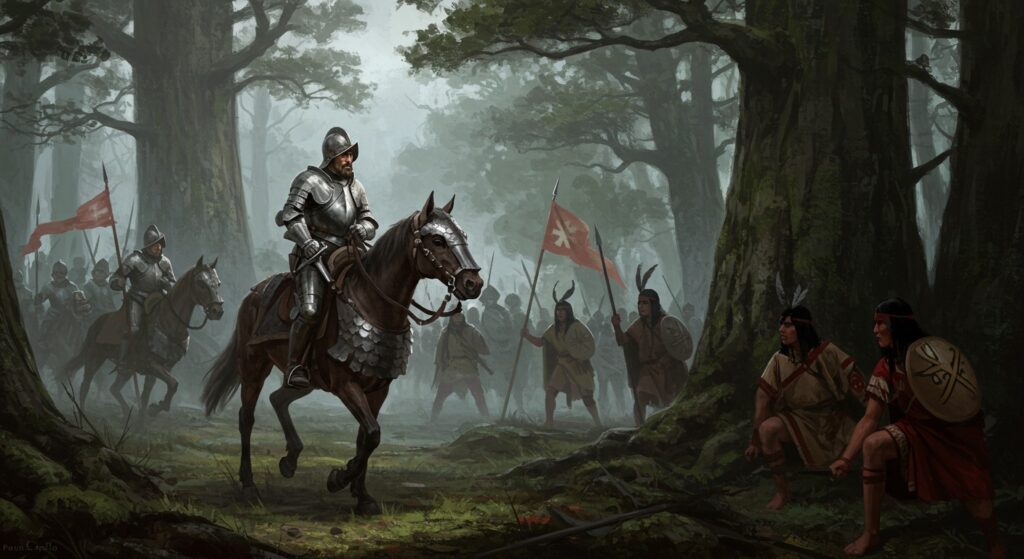
The Mapuche were entirely unprepared for the Spanish war machine. They were cut down by the thunderous crack of early firearms and the impenetrable gleam of steel armor. But the ultimate terror was the horse.
Imagine the absolute horror of facing a charging, armor-clad warhorse when the largest animal you have ever seen in your life is a llama. To the Mapuche, the Spanish cavalry were monstrous, supernatural entities—half-man, half-beast, and entirely invincible.
Capitalizing on this terror, the Spanish drove deep into Mapuche territory. They erected forts, established settlements, and forced the indigenous population into the brutal encomienda system of forced labor. The Mapuche were seemingly destined for the same tragic fate as the civilizations to their north.
But the Spanish had unknowingly forged the instrument of their own destruction.
The Invisible Spy
During these early campaigns, the Spanish captured a Mapuche teenager and forced him into servitude. His name was Lautaro, and he was assigned to be Pedro de Valdivia’s personal page.
It was a fatal mistake.
While Valdivia saw only a subjugated servant, Lautaro was quietly watching, analyzing, and dismantling the myth of Spanish invincibility. As he tended to the Spaniards’ mounts, he realized the terrifying beasts were not gods; they were flesh and blood. They bled, they panicked, and crucially, they grew exhausted when forced to navigate the dense, muddy, mountainous terrain of southern Chile. He noted how heavily armored men tired quickly in the humid forests.
Armed with the closely guarded secrets of the Spanish military apparatus, Lautaro escaped his captors and vanished back into the wilderness. His unparalleled intelligence on the enemy earned him the title of Toqui—a wartime leader.
The Wilderness Weaponized
Under Lautaro’s brilliant command, the Mapuche revolutionized their entire way of war. They abandoned their traditional massed infantry charges, which had made them easy targets for Spanish muskets and cavalry. Instead, they melted into the landscape.
The Mapuche weaponized the dense swamps and forests, engaging in sophisticated guerrilla warfare that neutralized the Spanish cavalry’s momentum. When the Spanish tried to force open-field battles, they were met with a startling new tactic: the Mapuche had developed long pikes, forming disciplined, schiltron-like defensive formations. They would brace their pikes to unhorse the charging Spanish riders, then swarm the fallen conquistadors with heavy wooden clubs called macanas.
Most remarkably, Lautaro taught his people not just to kill horses, but to steal, breed, and ride them. Within just a few decades, the Mapuche transformed themselves into some of the finest light cavalry in the world, executing rapid, devastating surprise attacks known as malóns before vanishing back into the shadows.
Furthermore, the Spanish found themselves fighting a ghost. Unlike the centralized Aztec or Inca empires, the Mapuche had a highly decentralized political structure. There was no single capital city to capture, no absolute emperor to hold hostage. If one Toqui fell in battle, another immediately took his place.
The Christmas Day Trap
The effectiveness of this radical military adaptation exploded into the historical record on Christmas Day, 1553, at the Battle of Tucapel.
Pedro de Valdivia, confident in his superiority, marched a column of men toward a destroyed Spanish fort. Lautaro was waiting. Using sequential waves of fighters to exhaust the Spanish horses and troops, the Mapuche sprang a brilliant, inescapable ambush. The Spanish column was annihilated. Valdivia was captured and, in a brutal twist of poetic justice, executed by the very people he had sought to enslave.
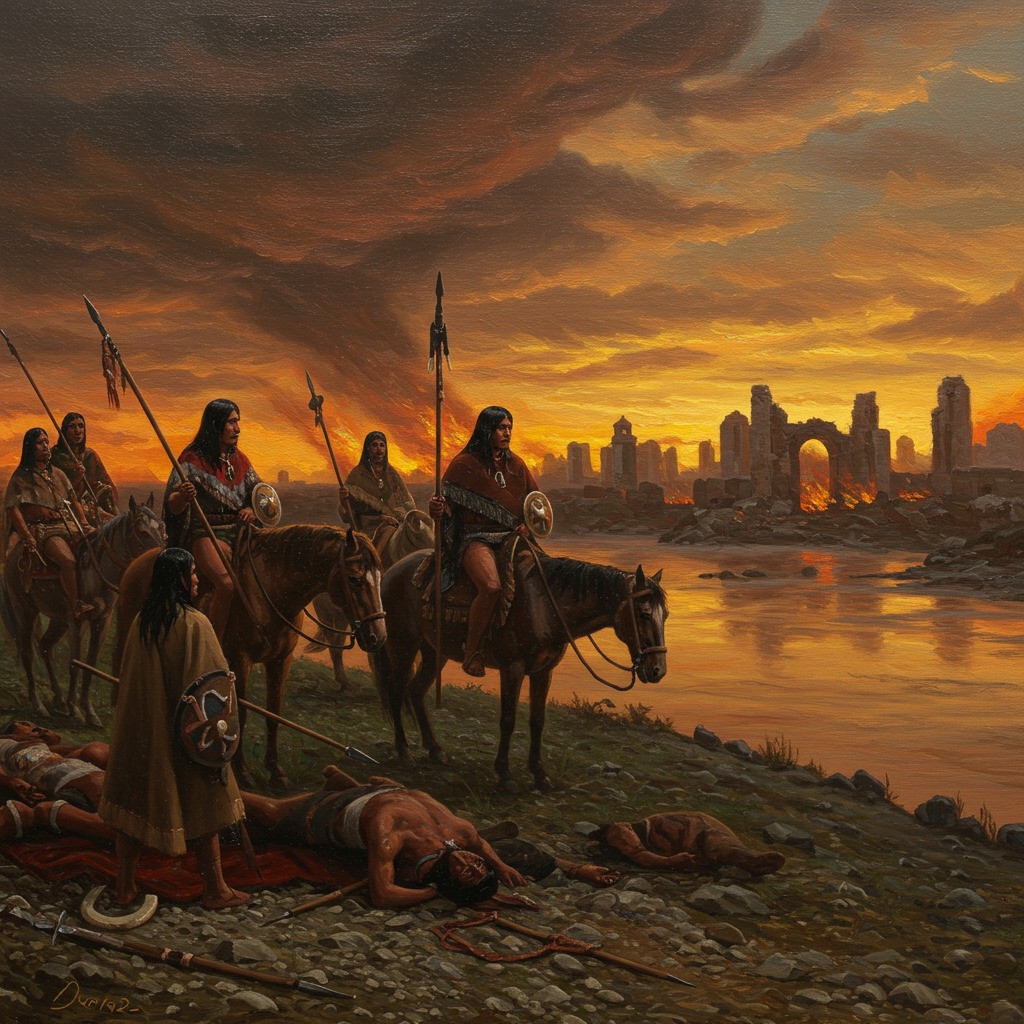
Decades later, the Mapuche proved Tucapel was no fluke. In 1598, under the leadership of Toqui Pelantaro, they achieved a monumental victory at the Battle of Curalaba. This catastrophic Spanish defeat triggered a massive indigenous uprising known as the “Destruction of the Seven Cities.”
The Mapuche systematically burned Spanish settlements to the ground, forcing the empire to do the unthinkable: retreat. The Spanish entirely abandoned their colonial ambitions south of the Bío Bío River.
An Empire Forced to Bow
The Spanish Crown finally realized that conquering the Mapuche was a military and economic black hole. To hold the line, they were forced to establish a standing, professional army in Chile, funded by a massive royal subsidy.
The Bío Bío River became a heavily fortified, de facto border. The war of conquest morphed into a tense frontier standoff characterized by cross-border raids and, shockingly, formal diplomacy.
In 1641, the Spanish Empire did something they had never done before, and would rarely do again. At the Parliament of Quillín, Spanish officials sat down with Mapuche leaders and formally signed a treaty recognizing the independence of the Mapuche nation south of the Bío Bío River. It was a stunning legal concession. The indigenous people had drawn a line on the map that the world’s most powerful empire agreed not to cross.
For the entirety of the colonial period, the Mapuche successfully defended their sovereignty. It wasn’t until the late 19th century that the newly independent Republic of Chile finally annexed the region, requiring the overwhelming technological advantage of the Industrial Revolution to finally break the Mapuche resistance.
But for over 300 years, the Mapuche stood as a defiant anomaly in the history of the Americas: a people who looked the conquering Spanish war machine in the eye, learned its secrets, and forced an empire to its knees.