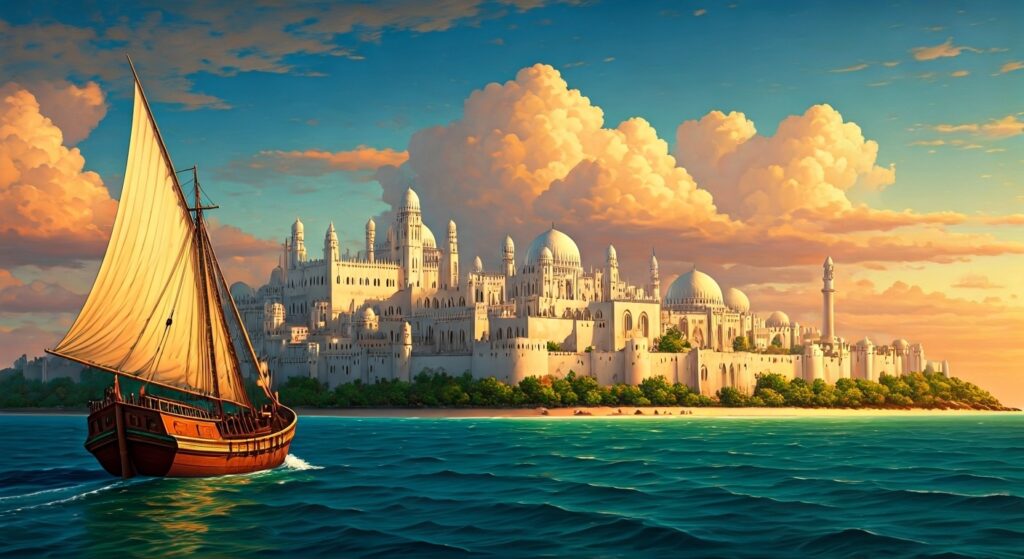
Long before modern billionaires built their sprawling mega-mansions, a glittering island empire off the coast of present-day Tanzania possessed wealth so staggering it would make today’s tech moguls look like paupers. This was the Kilwa Sultanate, the undisputed jewel of the Indian Ocean. For centuries, it operated in the shadows of mainstream history, quietly bankrolling the medieval world. But the true marvel of Kilwa isn’t just the sheer scale of its riches—it is the tantalizing mystery of how far its golden tentacles truly reached.
A Dynasty Born from the Sea
Every great empire demands a legendary origin story, and Kilwa’s beginnings are steeped in myth. According to the ancient Kilwa Chronicle, the city-state was founded in the 10th century by Ali ibn al-Hassan Shirazi, a Persian prince who fled his homeland to forge a new dynasty on the East African coast.
Yet, modern archaeology reveals a truth far more compelling than a simple tale of royal exile. Kilwa was not merely a foreign outpost; it was deeply rooted in indigenous Bantu culture. Over generations, this local foundation seamlessly intertwined with Arab and Persian Islamic influences. The result was the birth of a vibrant, cosmopolitan Swahili identity—a maritime powerhouse poised to take the medieval world by storm.
The Ultimate Medieval Monopoly
How does a tiny island transform into an unfathomably rich superpower? By executing one of the most ruthless economic masterstrokes in history.
Between the 13th and 15th centuries, the sultans of Kilwa looked down the coast to the southern port of Sofala in modern-day Mozambique and saw an opportunity. By capturing Sofala, Kilwa seized absolute control over the vast rivers of gold flowing out of the inland Kingdom of Great Zimbabwe.
They forged an unbreakable monopoly. Anyone seeking African gold, ivory, or iron had to go through Kilwa. In exchange, the island’s merchants imported exquisite Chinese porcelain, Indian cotton textiles, and Arabian glassware. The sultanate’s coffers swelled to such extremes that they began minting their own copper and silver currency—an economic infrastructure centuries ahead of its time.
Palaces of Fossilized Coral
With infinite wealth came infinite style. The sultans channeled their massive fortunes into an architectural wonderland, constructing breathtaking structures from local coral rag—fossilized coral held together with lime mortar.
The crown jewel of the island was the Great Mosque of Kilwa. Featuring intricate domed and vaulted ceilings, it stood as the largest mosque in sub-Saharan Africa. Imagine sailing the treacherous Indian Ocean in the Middle Ages, only to be greeted by blindingly white coral domes rising majestically from a tropical island.
In the early 14th century, Sultan al-Hasan ibn Sulaiman decided to push the boundaries of luxury even further by commissioning the Husuni Kubwa. This grand palace complex was a labyrinth of opulence, boasting over a hundred rooms, sprawling commercial courtyards, and a striking octagonal swimming pool carved directly into the cliffside. It was designed to inspire awe, and it succeeded flawlessly.
The Shipwreck at the Edge of the World
The Kilwa Sultanate’s economic reach was undeniably vast, but a recent archaeological discovery has transformed its history into a genuine thriller.
Kilwa coins have been unearthed far and wide, including deep inland at the ruins of Great Zimbabwe. But the most mind-blowing discovery occurred thousands of miles away. A handful of medieval Kilwa coins were recently found buried in the sand of the Wessel Islands—off the northern coast of Australia.
Did Kilwa’s maritime trade network stretch all the way to the Land Down Under? Did a shipwrecked Swahili trader wash ashore centuries before Captain Cook ever set sail? The presence of these coins remains one of history’s most tantalizing unsolved mysteries, hinting at a global reach that defies conventional history.
The Cannons That Shattered the Coral
When the legendary Moroccan explorer Ibn Battuta visited Kilwa in 1331, he had already seen the greatest empires of the known world. Yet, he was completely awestruck, recording that Kilwa was one of the most beautiful and well-constructed cities on earth.
But immense wealth, no matter how closely guarded, eventually attracts vultures.
Whispers of an African city paved with gold inevitably reached Europe. In 1505, the suspense broke with the deafening roar of cannons. A heavily armed Portuguese fleet, commanded by Francisco de Almeida, sailed into the harbor. They had not come to trade; they had come to conquer.
The Portuguese ruthlessly sacked the beautiful coral city, erected a military fort, and violently seized control of the lucrative gold trade. Stripped of its economic lifeblood, the dazzling Kilwa Sultanate was thrown into an irreversible decline. The coral palaces were abandoned, the cliffside pool ran dry, and the jungle slowly reclaimed the greatest metropolis of the Swahili Coast.
Today, the ruins of Kilwa stand in quiet defiance—a haunting, fossilized reminder of an African empire that once held the world’s economy in the palm of its hand.