The Megacity Hiding in Plain Sight
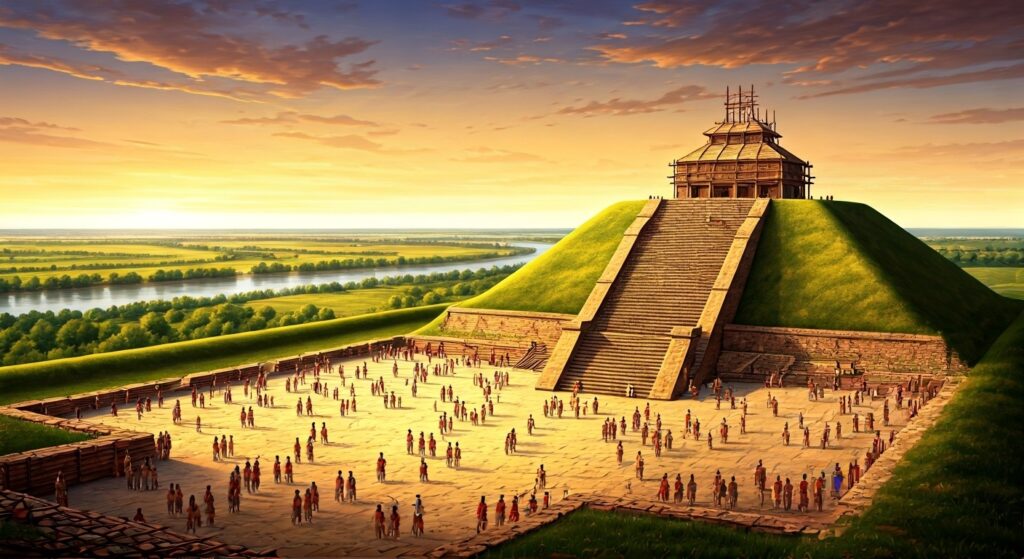
Imagine standing on the banks of the Mississippi River in the 12th century. If you looked across the water toward modern-day St. Louis, you wouldn’t see an untamed wilderness. You would see a skyline.
Long before European ships ever grazed the shores of the New World, a sprawling, vibrant metropolis dominated the fertile floodplains of the American Bottom. It was called Cahokia, and at its peak between 1050 and 1200 CE, it was the undisputed crown jewel of the Mississippian culture. Spanning over six square miles, this pre-Columbian powerhouse boasted a population that dwarfed London at the time. With up to 40,000 inhabitants bustling through its plazas and sprawling suburbs, Cahokia was a medieval megacity hiding in plain sight.
The “Big Bang” of North America
Cahokia didn’t just grow; it exploded. Archaeologists refer to its sudden, violent emergence around 1050 CE as the “Big Bang” of Cahokia.
Driven by a mastery of maize cultivation, a highly favorable climate, and a brilliant strategic location at the confluence of major rivers, people flocked to the area in droves. What emerged overnight was a highly stratified society ruled by a divine elite—god-kings who commanded an almost unfathomable amount of human labor and absolute devotion.
A Pyramid of Earth and Sweat
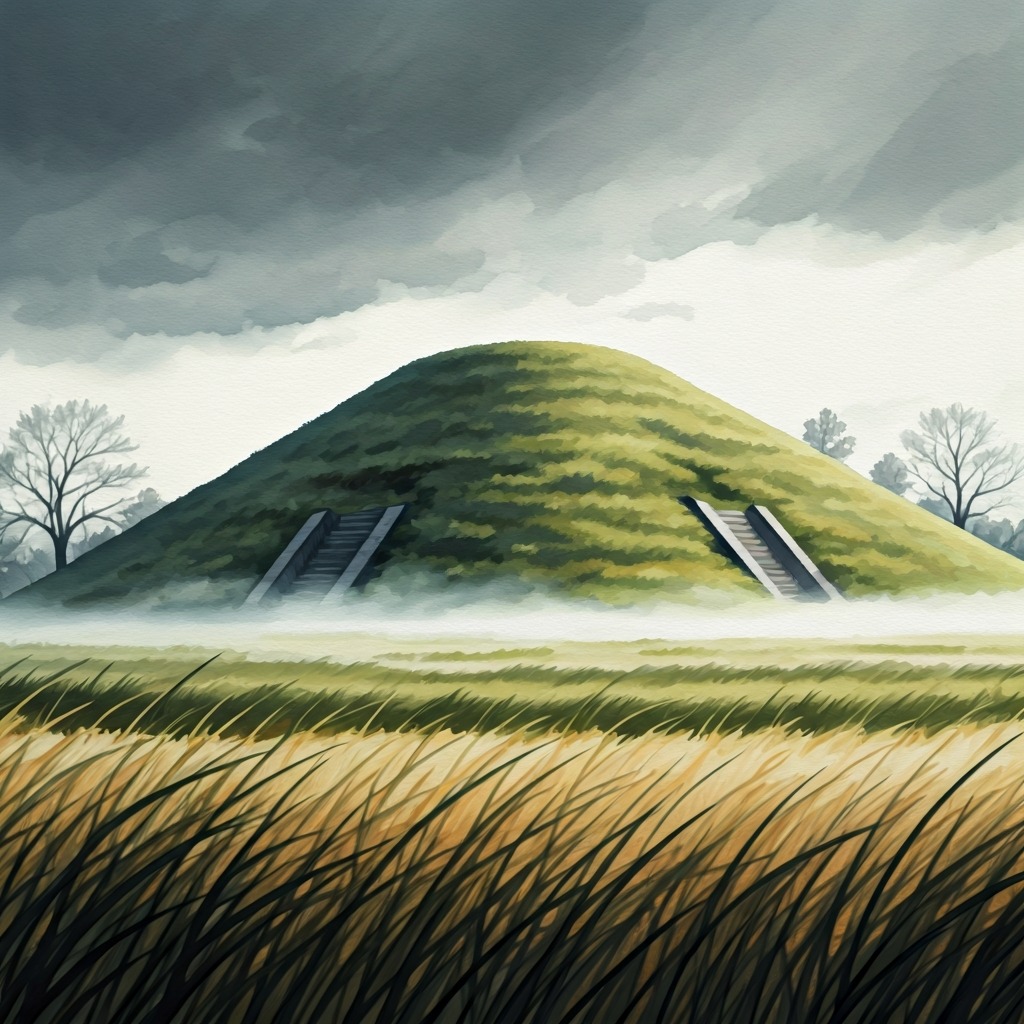
The most awe-inspiring testament to Cahokia’s staggering ambition is Monks Mound. Rising 100 feet into the sky and covering a massive 14 acres at its base, it remains the largest prehistoric earthwork in the Americas. To put its sheer scale into perspective: its footprint is actually larger than that of the Great Pyramid of Giza.
But here is the detail that defies belief: Monks Mound was built entirely by hand. The Mississippians had no wheels, no pulleys, and no beasts of burden. Over several decades, laborers moved an estimated 55 million cubic feet of earth using nothing but woven baskets. Atop this colossal earthen pyramid stood a massive wooden temple where the paramount chief could quite literally look down upon the sprawling urban grid of his empire.
The Continental Beating Heart
Cahokia wasn’t just massive; it was a marvel of ancient engineering. Just west of Monks Mound, the city’s architects constructed “Woodhenge,” a sophisticated solar calendar made of massive timber circles. By tracking the solstices and equinoxes, Cahokian priests could perfectly time their agricultural cycles and orchestrate grand religious ceremonies.
The city also served as the beating heart of a vast continental trade network. Excavations have unearthed copper from the Great Lakes, mica from the Appalachian Mountains, and marine shells from the Gulf of Mexico. People, goods, and ideas flowed through Cahokia like blood through a continental artery.
The Blood-Soaked Secret of Mound 72
But absolute power casts a long, dark shadow, and Cahokia was no exception. The most terrifying evidence of the rulers’ unquestioned authority was unearthed at a burial site known as Mound 72.
Here, archaeologists discovered the mysterious “Birdman” burial. A high-status male was laid to rest atop a spectacular cape fashioned from more than 20,000 marine shell beads, meticulously arranged in the shape of a falcon. But the Birdman did not go into the afterlife alone.
Surrounding him were the remains of hundreds of sacrificed individuals. Among the chilling discoveries were a mass grave containing over 50 young women and a separate group of decapitated men. It was a stark, gruesome display of ritual human sacrifice on a massive scale, proving that the divine rulers of Cahokia held absolute power over life and death.
A Civilization’s Sudden Ghost Town
And then, the fires went out.
By 1350 CE, this thriving, bustling metropolis was largely abandoned, its great plazas empty and silent. The collapse of Cahokia remains one of North American archaeology’s most tantalizing mysteries. What could bring down a society so powerful?
Scholars believe it was a lethal cocktail of catastrophes. Deforestation—driven by the need to build massive wooden palisades and fuel countless fires—likely led to severe soil erosion and catastrophic flooding. Combine that environmental degradation with the climate change brought on by the onset of the Little Ice Age, and the resulting crop failures almost certainly sparked violent internal social and political upheaval. The center could no longer hold.
The Myth That Tried to Erase History
Centuries later, when European settlers stumbled upon the overgrown mounds, they looked at the monumental architecture and simply refused to believe that Native Americans were capable of such engineering.
Instead, they invented the pervasive and deeply racist “Mound Builder myth.” They spun wild tales attributing the colossal earthworks to lost tribes of Israel, roaming Vikings, or ancient Europeans. It was a convenient fiction, designed to justify the displacement of indigenous peoples by painting them as mere conquerors of a “superior” lost race.
Today, the truth has finally reclaimed the American Bottom. Now recognized as a UNESCO World Heritage site, Cahokia stands as a profound corrective to the myth of an “empty” North America. It is a silent, towering monument to the breathtaking complexity, ingenuity, and ambition of ancient Native American civilizations—a ghost city whose echoes are impossible to ignore.