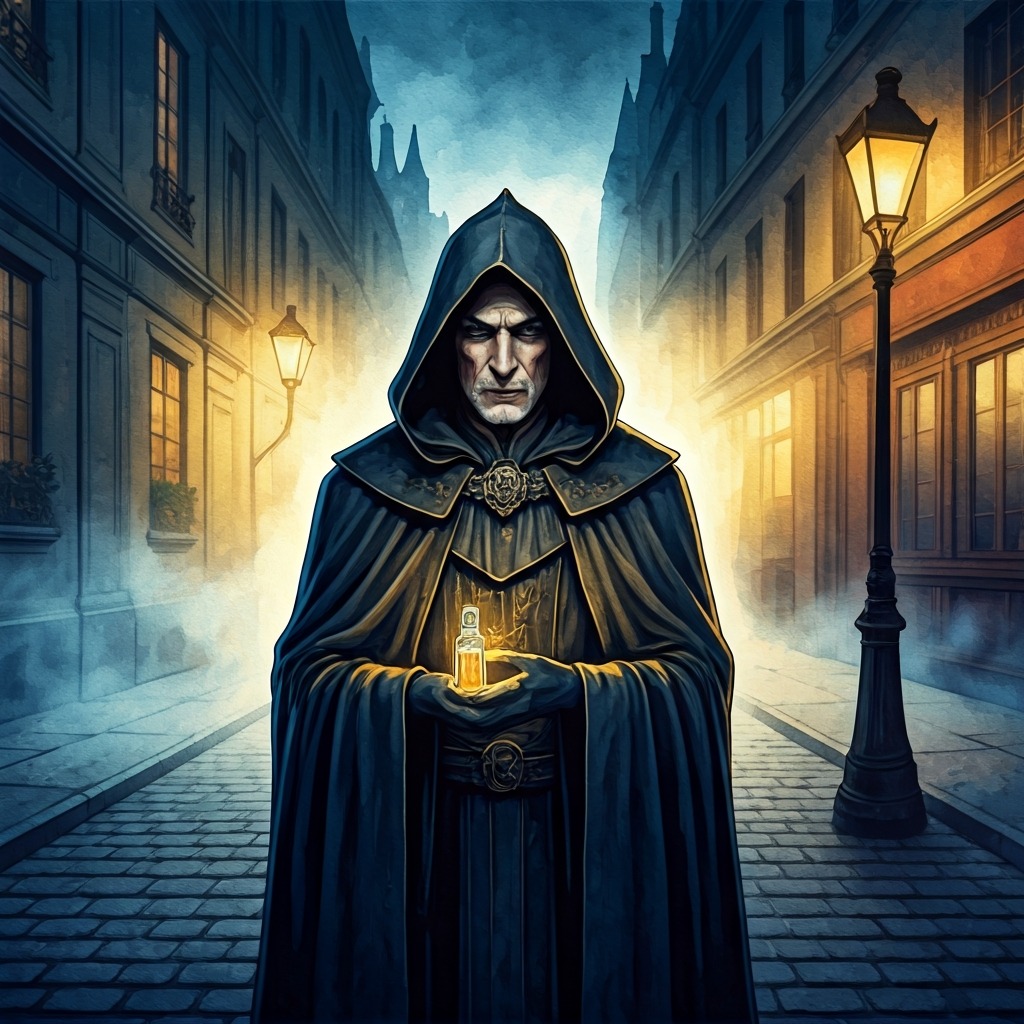
The opulent, cutthroat royal courts of 18th-century Europe were a breeding ground for scandal, but nothing could have prepared the Enlightenment era for the arrival of its greatest enigma. He was a man of terrifying wealth, impossible intellect, and a face that defied time itself. He was the Count of St. Germain—and he might just be the most successful, audacious grifter in human history.
To this day, his true identity remains a ghost story. But his legacy is a masterclass in manipulation, mystery, and the intoxicating power of a perfect lie.
The Phantom of the High Court
Imagine the most exclusive, velvet-roped gala of the 1740s. The doors swing open, and a stranger walks in. He is impeccably dressed, dripping in flawless diamonds, and radiates an aura of absolute authority. He introduces himself simply as the Count of St. Germain.
When pressed about his origins, his answers were maddeningly vague. Was he the illegitimate son of the Prince of Transylvania? The last heir of hidden Portuguese royalty? A Spanish-Jewish exile? No one knew. But he completely captivated the European elite because he was, quite frankly, infuriatingly perfect at everything.
He was a virtuoso violinist who could bring a crowded ballroom to dead silence. He was a master painter. He casually switched between over a dozen languages, speaking fluent French, German, English, Italian, Russian, Sanskrit, and Arabic.
But what truly cemented his legendary status wasn’t his resume. It was his face.
The Elixir of Deception
As the decades rolled by, a creeping, unsettling realization began to dawn on the European aristocracy: the Count wasn’t aging.
Year after year, decade after decade, contemporaries noted that he perpetually appeared to be a man in his mid-forties. His hairline never receded; his wrinkles never deepened. St. Germain knew exactly what the courts were whispering, and he leaned into the theatricality with brilliant precision. He fueled rumors of his own immortality by dropping casual, first-hand accounts of historical events from centuries past—speaking of long-dead monarchs as if they were old drinking buddies.
He strongly implied that he had unlocked the ultimate alchemical secrets: the philosopher’s stone and the elixir of life. He quickly became the favorite obsession of King Louis XV and Madame de Pompadour, who were so thoroughly bewitched that they granted the Count his own private laboratory space at the grand Château de Chambord.
A Clash of Titans: Casanova and Voltaire
Of course, the Enlightenment era was packed with brilliant, cynical minds who loved nothing more than to expose a fraud.
Voltaire, the undisputed king of 18th-century snark, famously and sarcastically described St. Germain in a letter to Frederick the Great as “a man who never dies, and who knows everything.”
Then there was Giacomo Casanova. If anyone could spot a charismatic hustler, it was history’s most legendary seducer. Casanova encountered St. Germain several times and immediately clocked him as a brilliant charlatan. Yet, even Casanova admitted he was absolutely mesmerized. St. Germain would perform mind-bending alchemical parlor tricks, like seemingly taking flawed diamonds and magically purifying them out of thin air. Casanova knew it was an illusion, but the execution was so flawless he couldn’t help but applaud the sheer audacity.
The Death That Wasn’t
Every great mystery requires a shocking finale, but St. Germain refused to give history a clean wrap-up.
Officially, the Count died on February 27, 1784, in Eckernförde, Schleswig, while staying with his latest wealthy patron, Prince Charles of Hesse-Kassel. But death is merely a technicality when your entire brand is built on immortality.
His passing only amplified the myth. Apocryphal stories soon exploded across Europe. He was reportedly seen appearing to Marie Antoinette and Louis XVI, desperately warning them of the impending French Revolution. He was spotted lurking in the shadows during the Reign of Terror. He was supposedly seen pulling strings at the Congress of Vienna. The sightings continued throughout the 19th and even into the 20th century.
Ascended Master or Master Manipulator?
The Count’s refusal to stay dead eventually caught the attention of the 19th-century occult crowd. Helena Blavatsky and the Theosophical Society officially adopted St. Germain into their cosmology, labeling him an “Ascended Master”—a spiritually enlightened, immortal being who guides humanity’s evolution from the shadows.
So, who was he really? A brilliant, multilingual con artist who finessed the wealthiest people in Europe out of their fortunes? Or a genuine esoteric master who actually unlocked the secrets of the universe?
Perhaps he was simply a deeply misunderstood genius who realized that the best way to survive in a chaotic, fleeting world was to make himself entirely unforgettable. Either way, the Count of St. Germain remains one of history’s most fascinating enigmas—a man who proved that with enough charisma, a little sleight of hand, and an air of absolute mystery, you truly can live forever.