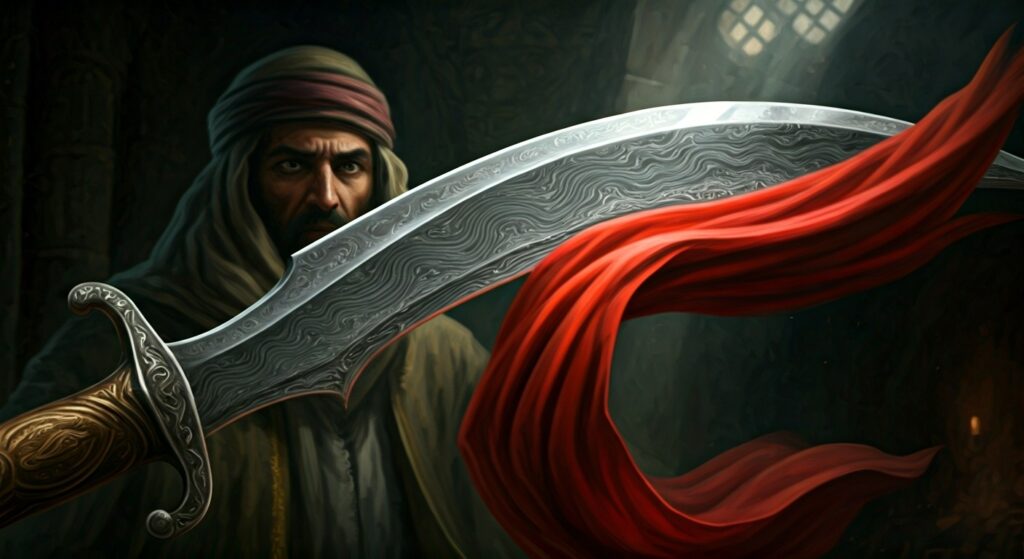
When European Crusaders clashed with Islamic warriors in the Middle Ages, they brought home terrifying tales of a weapon that defied the laws of physics. It was a blade that could allegedly cleave through solid rock without dulling, slice a falling silk scarf in mid-air, and bend at a perfect right angle only to spring back to a deadly, razor-straight edge.
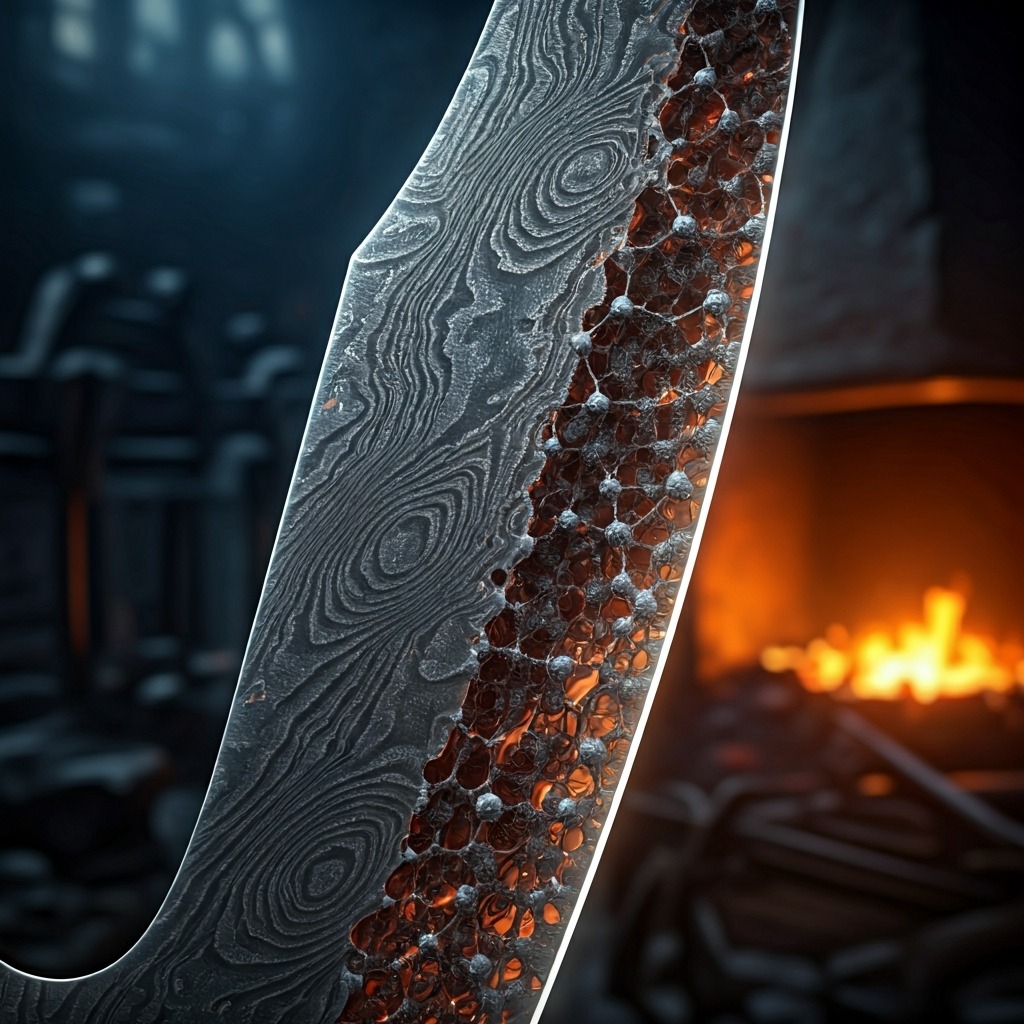
Even more mesmerizing than its lethal physics was its appearance. The dark metal bore a swirling, hypnotic pattern, like water flowing over stones or rippling silk.
They called it Damascus steel. For centuries, it was the deadliest, most beautiful weapon on earth. And for centuries, its creation remained one of history’s most impenetrable mysteries.
The Secret in the Soil
The enigma of Damascus steel began thousands of miles away from the Syrian city that gave it its name. The raw material was a crucible steel known as Wootz, imported from India and Sri Lanka as early as the 3rd century.
Wootz was a metallurgical anomaly. It boasted a remarkably high carbon content—around 1 to 2 percent—and was naturally laced with a highly specific cocktail of trace elements, including vanadium, molybdenum, and tungsten.
But possessing the right dirt was only half the equation. High-carbon steel is notoriously temperamental; strike it too hard or heat it a fraction too much, and it shatters like glass. The true magic had to be coaxed out in the dark of the forge.
A Recipe Whispered in the Dark
Middle Eastern blacksmiths developed a highly secretive thermal cycling process to tame the brittle Wootz. Working by the glow of the coals, they forged the metal at highly specific, relatively low temperatures.
This careful, rhythmic thermal dance forced iron carbide particles—known as cementite—to form micro-segregations in distinct bands. When the final blade was polished and etched with acid, those microscopic bands revealed the legendary watered-silk pattern.
It was a masterpiece of medieval engineering, guarded with lethal jealousy. The smiths passed their techniques down entirely by word of mouth. There were no manuals, no written recipes, no blueprints.
It was a brilliant strategy for maintaining a monopoly. It was also the exact reason the metal was doomed.
The Day the Forges Went Cold
In the 18th century, the legendary blades simply stopped being made. The secret vanished into the desert air.
The blacksmiths knew how to work the steel, but they didn’t know why it behaved the way it did. When the specific Indian ore veins containing those crucial trace elements began to run dry, and global trade routes fractured, the traditional techniques suddenly stopped producing the signature wavy patterns.
Without the vanadium and tungsten acting as invisible catalysts, the recipe failed. Unable to adapt, the master smiths took their secrets to the grave. The forges went cold, and true Damascus steel became a ghost of the past. (If you buy a “Damascus” chef’s knife today, you are buying pattern-welded steel—a beautiful, but fundamentally different, modern approximation).
The Microscopic Truth
The true nature of original Damascus steel remained locked away until a stunning breakthrough in 2006. Researchers at the Technical University of Dresden took a sample from a 17th-century Damascus blade and placed it under an electron microscope.
What they found completely shattered our understanding of historical technology. Hidden within the ancient steel were carbon nanotubes and nanowires.
During the repeated heating and cooling cycles, the trace elements in the Wootz steel had acted as catalysts, unwittingly allowing these medieval smiths to grow carbon nanotubes—microscopic cylinders of carbon that remain among the strongest, stiffest materials known to modern science.
The supernatural strength and impossible sharpness of Damascus steel wasn’t just Crusader folklore. Centuries before the word was even invented, Islamic and Indian metallurgists were literally wielding nanotechnology. They were forging the future, one strike at a time.