If you think modern sports fans are intense, you have no idea how deadly a rivalry can truly be. In 532 AD, a chariot race didn’t just end in a drunken brawl—it ended with 30,000 fans slaughtered in the dirt, half a capital city reduced to ash, and the Byzantine Empire pushed to the absolute brink of collapse.
Welcome to Constantinople. Welcome to the Nika Riots.
The Deadliest Fan Base in History
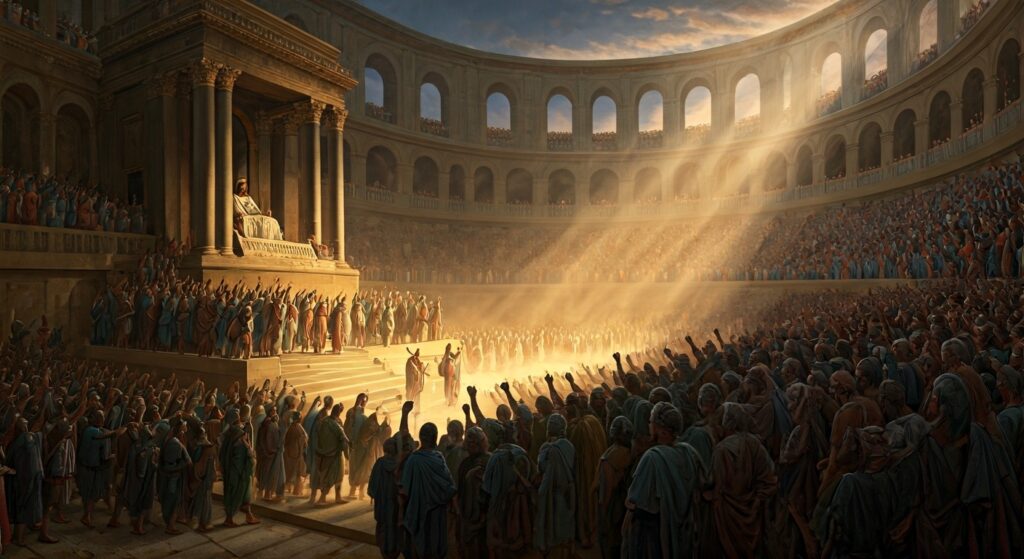
To understand how a sporting event could topple a government, you have to understand the Hippodrome. In the Byzantine era, chariot racing wasn’t just mass entertainment; it was a total societal obsession. The races were held in a massive, roaring arena connected directly to the Emperor’s palace, serving as the beating heart of the empire.
The fans were divided into four factions based on the colors their drivers wore, but by the time Emperor Justinian I took the throne, only two mattered: the Blues and the Greens. These weren’t just fan clubs. They had evolved into massive, organized syndicates that functioned as street gangs, political parties, and social militias.
Justinian, in a dangerously biased move, favored the Blues. This usually meant they could get away with absolute murder—sometimes literally. But the Emperor was already skating on thin ice with the public thanks to the crushing taxes levied by his ruthless ministers, John the Cappadocian and Tribonian. The city was a powder keg. All it needed was a match.
A Snapped Rope and an Unlikely Alliance
The crisis kicked off in early January. After a particularly nasty street brawl between the Blues and the Greens, the city guards arrested several ringleaders and sentenced them to hang.
But history is nothing if not a series of wild, unpredictable accidents. During the execution, the wooden scaffolding broke. Two of the condemned men—one a Blue, the other a Green—survived the fall. They scrambled through the chaotic streets and claimed sanctuary inside a nearby church.
Suddenly, the bitterest rivals in the empire looked at each other and realized they had a common enemy: the Emperor. In a rare and terrifying moment of solidarity, the Blues and Greens united. They demanded Justinian pardon the two men. Justinian, completely misreading the room, offered only to commute their sentences to imprisonment.
It was a fatal miscalculation.
The Deafening Roar of “Conquer!”
On January 13, the city gathered at the Hippodrome for the races. Justinian sat in his imperial box, expecting the usual divided cheers. Instead, the restless crowd began pleading for mercy for the condemned men. Justinian ignored them.
Then, the atmosphere shifted. The hair on the back of the Emperor’s neck must have stood up as the usual, divided chants of “Blue!” and “Green!” died out. The massive, united crowd began chanting a single word in deafening unison: “Nika!”
Conquer.
The mob erupted. They poured out of the Hippodrome like a tidal wave, storming the city’s police headquarters. They freed the prisoners, slaughtered the guards, and set the building ablaze.
For five agonizing days, Constantinople burned. The rioters torched major landmarks, including the Senate house, the luxurious Baths of Zeuxippus, and the original Hagia Sophia. The mob’s demands quickly escalated from simple pardons to the immediate dismissal of Justinian’s hated tax ministers. When Justinian hesitated, the riot mutated into a full-blown revolution. The mob dragged a terrified man named Hypatius—the nephew of former Emperor Anastasius I—out of his home and reluctantly crowned him emperor right there in the Hippodrome.
The Empress Who Refused to Flee
Trapped inside his palace while the city burned around him, Justinian panicked. He ordered the imperial treasury loaded onto ships. He was ready to abandon his throne, flee the city, and live out his days in exile.
Enter Empress Theodora.
Theodora had grown up in the circus, worked as an actress, and clawed her way from the bottom of society to the absolute pinnacle of the empire. As Justinian and his generals prepared to run, Theodora stood her ground. She delivered a speech so legendary it single-handedly altered the course of Western history.
She absolutely refused to flee, declaring that she would rather die as an empress than live as a fugitive. Looking at her terrified husband, she famously declared that “Royal purple makes a fine winding sheet”—meaning the imperial purple robes would be the noblest shroud to die in.
Her sheer nerve shamed Justinian into staying. He unpacked his bags and formulated a ruthless, terrifying counter-attack.
The Red Arena
Justinian didn’t just want to stop the riot; he wanted to end the factions forever. He sent his highly trusted eunuch, Narses, into the chaotic Hippodrome armed with a heavy bag of gold.
Narses slipped into the stands and quietly began bribing the leaders of the Blues. He reminded them that Justinian had always been their biggest supporter, and pointed out a very inconvenient fact: the man they had just crowned emperor, Hypatius, was a Green.
The paranoia worked. As the Blues began to quietly slip out of the arena, abandoning their temporary allies, Justinian sprang his trap.
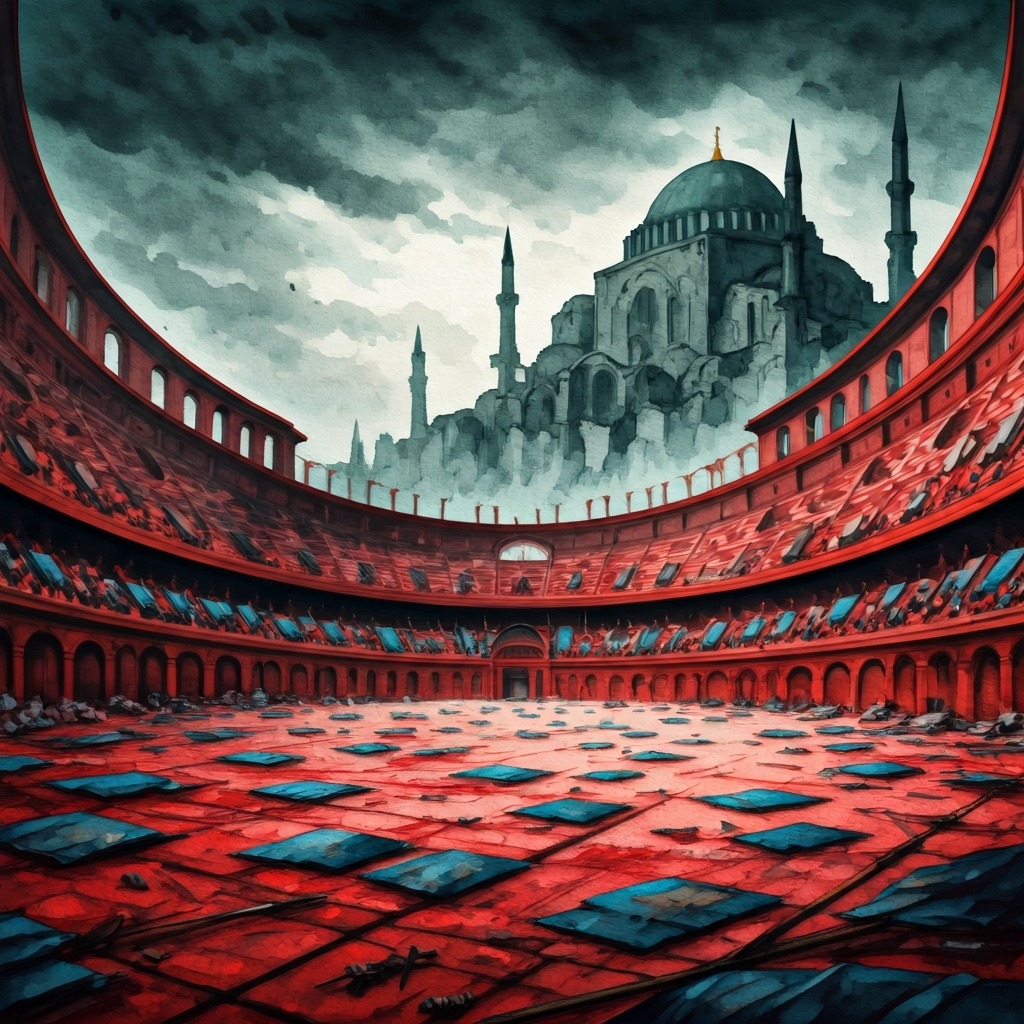
His top generals, Belisarius and Mundus, marched heavily armed imperial troops to the Hippodrome. They barred the massive wooden gates, locking the remaining rioters inside. What followed wasn’t a battle; it was a slaughter. In a matter of hours, an estimated 30,000 citizens—nearly ten percent of the entire city’s population—were massacred in the dirt of the arena.
The aftermath was swift and brutal. The reluctant usurper, Hypatius, was executed. The senators who had supported the uprising had their properties seized and were sent into exile. The fan factions were utterly decimated.
Justinian emerged with absolute, unquestioned power. Standing in the ashes of his ruined capital, he used the destruction as a blank canvas to rebuild Constantinople in his own image. His crowning achievement was the new Hagia Sophia, an architectural marvel that would stand as the world’s largest cathedral for nearly a thousand years. It was a beautiful, towering monument—built directly over the ashes of the people who had dared to shout “Conquer” at a king.